



Question: Can you help me work through these calculations? it says temperatures but I only need help with one temperature. p=0.967atm temp 296.6 V=0.237L n=0.0108 I
Can you help me work through these calculations? it says temperatures but I only need help with one temperature. p=0.967atm temp 296.6 V=0.237L n=0.0108
I need help finding partial pressure
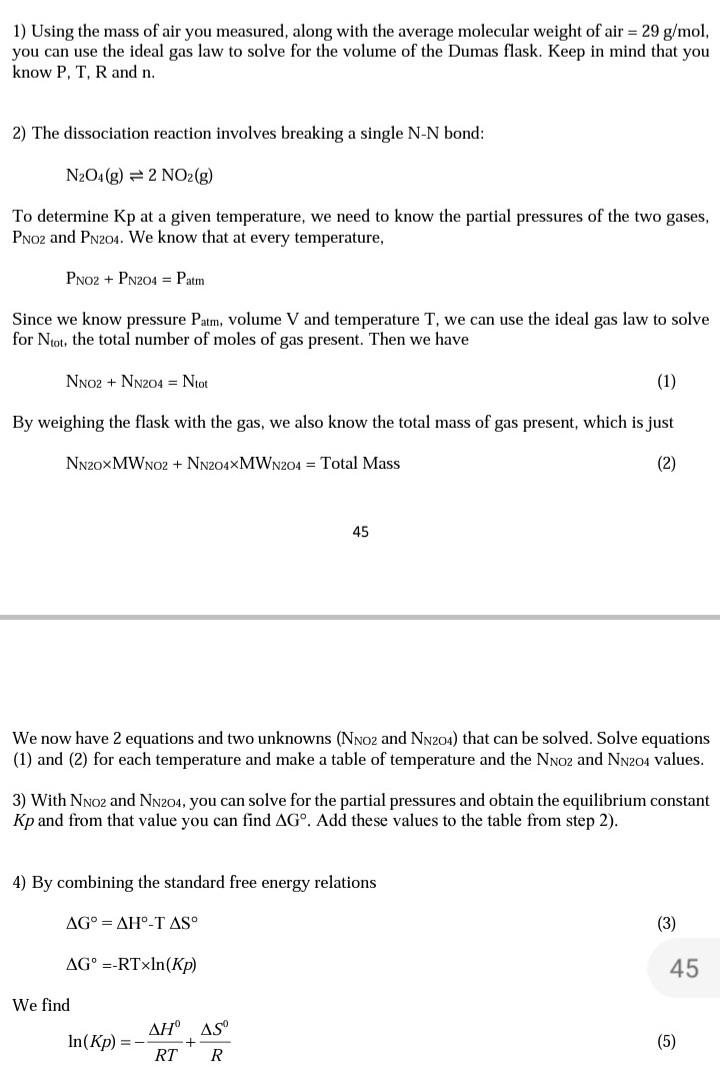
1) Using the mass of air you measured, along with the average molecular weight of air =29g/mol, you can use the ideal gas law to solve for the volume of the Dumas flask. Keep in mind that you know P,T,R and n. 2) The dissociation reaction involves breaking a single NN bond: N2O4(g)2NO2(g) To determine Kp at a given temperature, we need to know the partial pressures of the two gases, PNO2 and PN204. We know that at every temperature, PNO2+PN2O4=Patm Since we know pressure Patm, volume V and temperature T, we can use the ideal gas law to solve for Ntot, the total number of moles of gas present. Then we have NNO2+NN2O4=Ntot By weighing the flask with the gas, we also know the total mass of gas present, which is just NN2OMWNO2+NN2O4MWN2O=TotalMass 45 We now have 2 equations and two unknowns (NNO and NN2O4) that can be solved. Solve equations (1) and (2) for each temperature and make a table of temperature and the NNO and NN2O values. 3) With NNO2 and NN2O, you can solve for the partial pressures and obtain the equilibrium constant Kp and from that value you can find G. Add these values to the table from step 2). 4) By combining the standard free energy relations GG=HTS=RTln(Kp) 45 We find ln(Kp)=RTH0+RS0
Step by Step Solution
There are 3 Steps involved in it

Get step-by-step solutions from verified subject matter experts