



Question: Can you help with questions 4 and 5? Please let me know if you need more information. Thank you. Now use the =NPV (rate, value1,

![(rate, value1, [value2], ...) Excel function to calculate the Net Present Value](https://s3.amazonaws.com/si.experts.images/answers/2024/08/66b2cf3921e05_48866b2cf38b36e9.jpg)
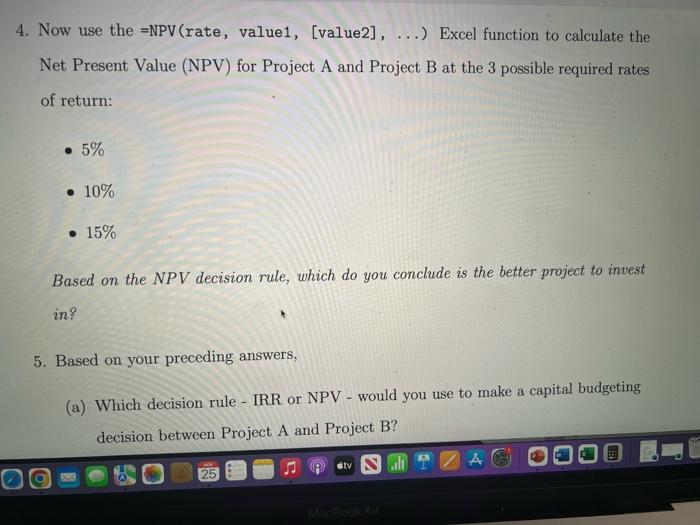
Now use the =NPV (rate, value1, [value2], ...) Excel function to calculate the Net Present Value (NPV) for Project A and Project B at the 3 possible required rates of return: - 5% 10% 15% Based on the NPV decision rule, which do you conclude is the better project to invest in? 5. Based on your preceding answers, (a) Which decision rule - IRR or NPV - would you use to make a capital budgeting decision between Project A and Project B? 5. Based on your preceding answers, (a) Which decision rule - IRR or NPV - would you use to make a capital budgeting decision between Project A and Project B? (b) What are your reasons for choosing that rule? Net Present Value at Rate of... \begin{tabular}{r|rrrr|} 13 & 5% & $4,915.59 & ($5,543) \\ 14 & 10% & $2,438 & ($2,702) \\ 15 & 15% & $420 & ($953) \\ \hline 16 & & \multicolumn{2}{|c|}{} \\ \hline 17 & & & \\ \hline 18 & & & \end{tabular}
Step by Step Solution
There are 3 Steps involved in it

Get step-by-step solutions from verified subject matter experts