







Question: Can you please answer the question? Suomiony ONE QUESTION GET NOTIFIED Part 2. Data Model for Shipping Tickets 1. What is your que ogM )
 Can you please answer the question?
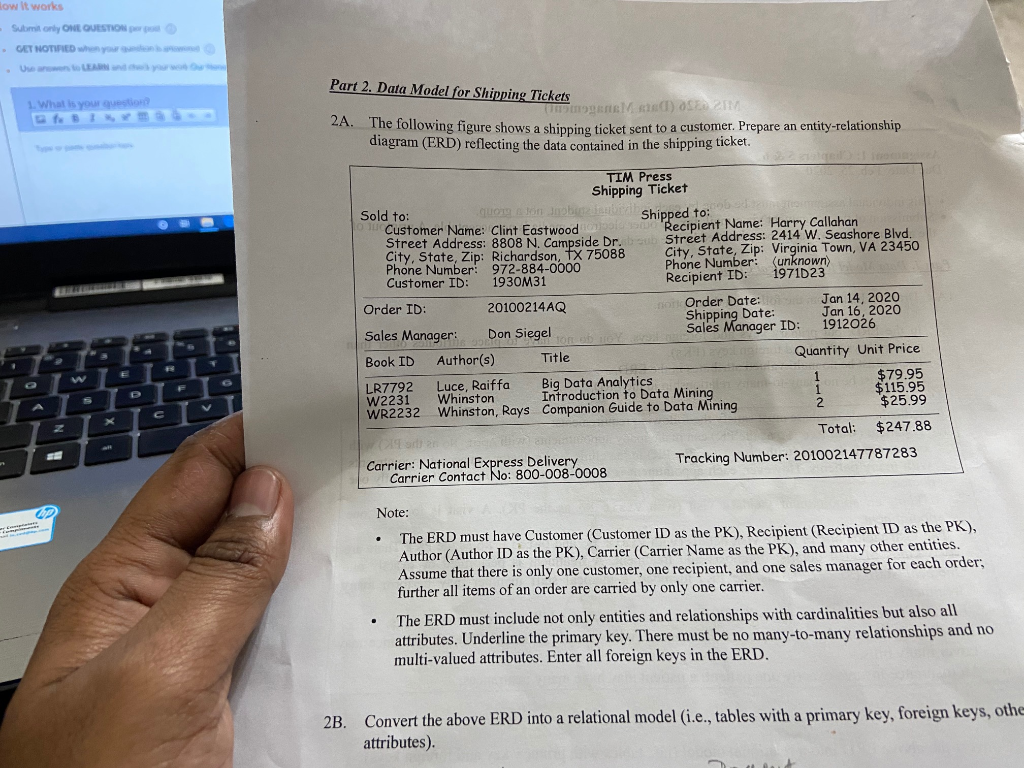
Suomiony ONE QUESTION GET NOTIFIED Part 2. Data Model for Shipping Tickets 1. What is your que ogM ) OSE i ne following figure shows a shipping ticket sent to a customer. Prepare an entity-relationship diagram (ERD) reflecting the data contained in the shipping ticket. TIM Press Shipping Ticket Sold to: Shipped to: Customer Name: Clint Eastwood Recipient Name: Harry Callahan Street Address: 8808 N. Campside Dr. bu Street Address: 2414'W. Seashore Blvd. City, State, Zip: Richardson, TX 75088 City, State, Zip: Virginia Town, VA 23450 Phone Number: 972-884-0000 Phone Number: (unknown) Customer ID: 1930M31 Recipient ID: 1971D23 Order ID: 20100214AQ Order Date: Jan 14, 2020 Shipping Date: Jan 16, 2020 Sales Manager: Don Siegel Sales Manager ID: 1912026 Book ID Author(s) Title Quantity Unit Price LR7792 Luce, Raiffa Big Data Analytics $79.95 W2231 Whinston Introduction to Data Mining $115.95 WR2232 Whinston, Rays Companion Guide to Data Mining $25.99 Total: $247.88 Carrier: National Express Delivery Tracking Number: 201002147787283 Carrier Contact No: 800-008-0008 Note: The ERD must have Customer Customer ID as the PK), Recipient (Recipient ID as the PK), Author (Author ID as the PK), Carrier (Carrier Name as the PK), and many other entities. Assume that there is only one customer, one recipient, and one sales manager for each order, further all items of an order are carried by only one carrier. The ERD must include not only entities and relationships with cardinalities but also all attributes. Underline the primary key. There must be no many-to-many relationships and no multi-valued attributes. Enter all foreign keys in the ERD. 2B. Convert the above ERD into a relational model (i.e., tables with a primary key, foreign keys, othe attributes). Suomiony ONE QUESTION GET NOTIFIED Part 2. Data Model for Shipping Tickets 1. What is your que ogM ) OSE i ne following figure shows a shipping ticket sent to a customer. Prepare an entity-relationship diagram (ERD) reflecting the data contained in the shipping ticket. TIM Press Shipping Ticket Sold to: Shipped to: Customer Name: Clint Eastwood Recipient Name: Harry Callahan Street Address: 8808 N. Campside Dr. bu Street Address: 2414'W. Seashore Blvd. City, State, Zip: Richardson, TX 75088 City, State, Zip: Virginia Town, VA 23450 Phone Number: 972-884-0000 Phone Number: (unknown) Customer ID: 1930M31 Recipient ID: 1971D23 Order ID: 20100214AQ Order Date: Jan 14, 2020 Shipping Date: Jan 16, 2020 Sales Manager: Don Siegel Sales Manager ID: 1912026 Book ID Author(s) Title Quantity Unit Price LR7792 Luce, Raiffa Big Data Analytics $79.95 W2231 Whinston Introduction to Data Mining $115.95 WR2232 Whinston, Rays Companion Guide to Data Mining $25.99 Total: $247.88 Carrier: National Express Delivery Tracking Number: 201002147787283 Carrier Contact No: 800-008-0008 Note: The ERD must have Customer Customer ID as the PK), Recipient (Recipient ID as the PK), Author (Author ID as the PK), Carrier (Carrier Name as the PK), and many other entities. Assume that there is only one customer, one recipient, and one sales manager for each order, further all items of an order are carried by only one carrier. The ERD must include not only entities and relationships with cardinalities but also all attributes. Underline the primary key. There must be no many-to-many relationships and no multi-valued attributes. Enter all foreign keys in the ERD. 2B. Convert the above ERD into a relational model (i.e., tables with a primary key, foreign keys, othe attributes)
Step by Step Solution
There are 3 Steps involved in it

Get step-by-step solutions from verified subject matter experts
 Study Help