







Question: Can you please help explain how to get to the answers. Question 4 (25 marks). Consider an exchange economy with two consumers (Consumer 1 and
Can you please help explain how to get to the answers.
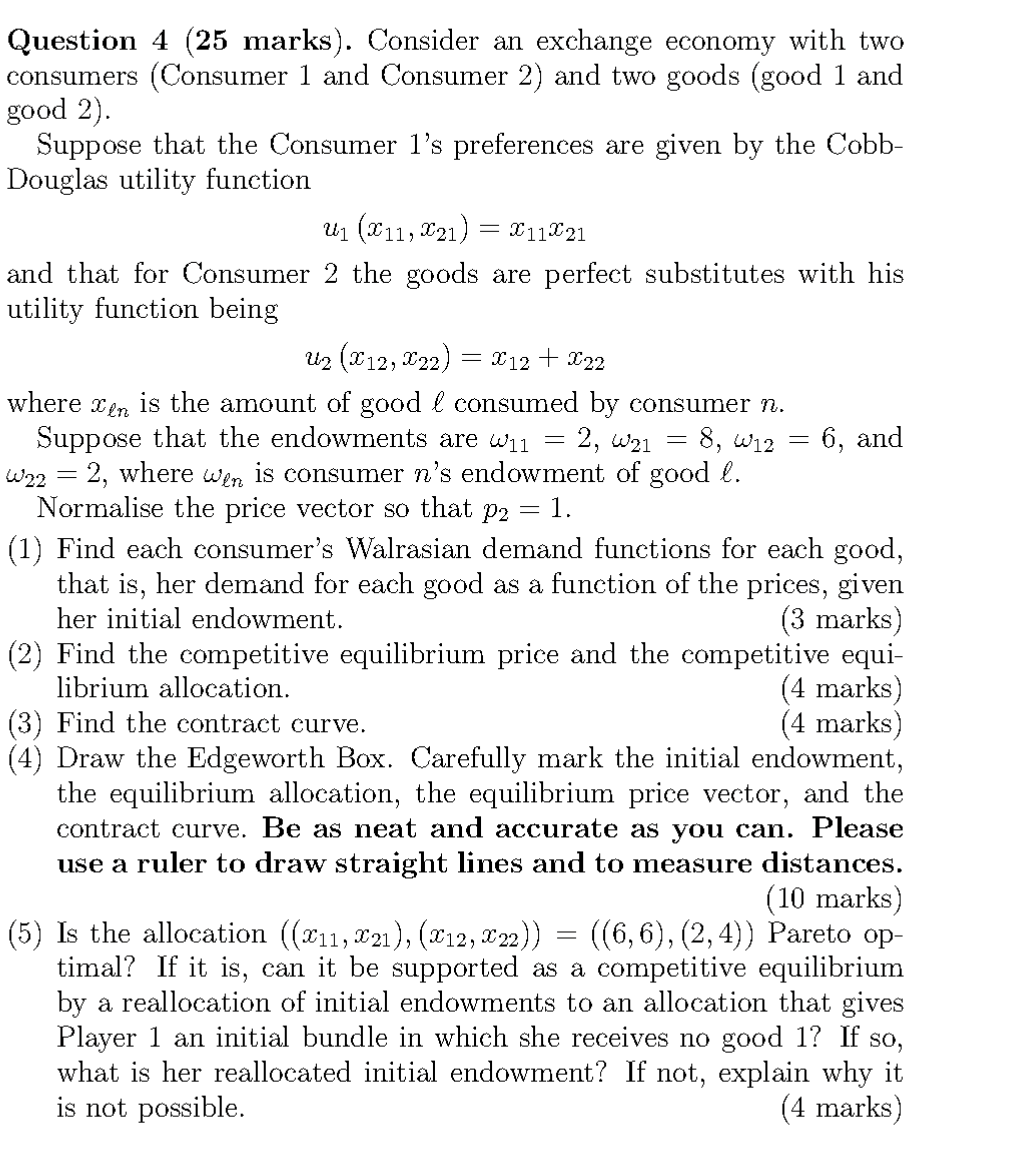
Question 4 (25 marks). Consider an exchange economy with two consumers (Consumer 1 and Consumer 2) and two goods (good 1 and good 2). Suppose that the Consumer 17s preferences are given by the Cobb Douglas utility function U1 (931173521) : 513113521 and that for Consumer 2 the goods are perfect substitutes with his utility function being \"2 (9512: $22) : 5012 t 5022 where 335,, is the amount of good E consumed by consumer n. Suppose that the endowments are can : 2, M21 : 8, 0112 : 6, and (2)22 : 2, where we\" is consumer n's endowment of good E. Normalise the price vector so that 192 : 1. (1) Find each consumer's Walrasian demand functions for each good, that is, her demand for each good as a function of the prices, given her initial endowment, (3 marks) (2) Find the competitive equilibrium price and the competitive equi librium allocation, (4 marks) (3) Find the contract curve, (4 marks) (4) Draw the Edgeworth Box. Carefully mark the initial endowment, the equilibrium allocation, the equilibrium price vector, and the contract curve, Be as neat and accurate as you can. Please use a ruler to draw straight lines and to measure distances. (10 marks) (5) Is the allocation ((mll,m21),(xlg,x22)) = ((6,6), (2,4)) Pareto op- timal? If it is, can it be supported as a competitive equilibrium by a reallocation of initial endowments to an allocation that gives Player 1 an initial bundle in which she receives no good 1? If so, what is her reallocated initial endowment? If not, explain why it is not possible. (4 marks)
Step by Step Solution
There are 3 Steps involved in it

Get step-by-step solutions from verified subject matter experts
 Study Help