







Question: Can you please help me with a detailed solution to this problem.? Consider a cantilever beam of length L with rectangular cross section of width
Can you please help me with a detailed solution to this problem.?
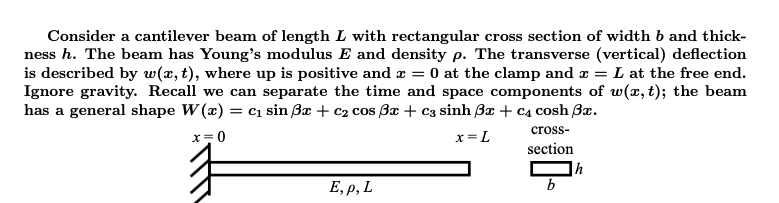
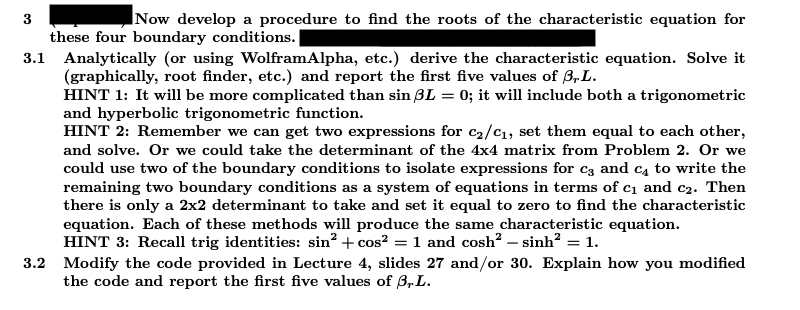



Consider a cantilever beam of length L with rectangular cross section of width b and thick- ness h. The beam has Young's modulus E and density p. The transverse (vertical) deflection is described by w(x, t), where up is positive and x = 0 at the clamp and = L at the free end. Ignore gravity. Recall we can separate the time and space components of w(2, t); the beam has a general shape W(x) = ci sin 3x + C2 cos 6x + c3 sinh 3x + c4 cosh Bc. x=0 x=L cross- section h E,p, L b 3 Now develop a procedure to find the roots of the characteristic equation for these four boundary conditions. 3.1 Analytically (or using Wolfram Alpha, etc.) derive the characteristic equation. Solve it (graphically, root finder, etc.) and report the first five values of B.L. HINT 1: It will be more complicated than sin BL = 0; it will include both a trigonometric and hyperbolic trigonometric function. HINT 2: Remember we can get two expressions for cz/c, set them equal to each other, and solve. Or we could take the determinant of the 4x4 matrix from Problem 2. Or we could use two of the boundary conditions to isolate expressions for Cz and C4 to write the remaining two boundary conditions as a system of equations in terms of ci and C2. Then there is only a 2x2 determinant to take and set it equal to zero to find the characteristic equation. Each of these methods will produce the same characteristic equation. HINT 3: Recall trig identities: sin + cos = 1 and cosh sinh = 1. 3.2 Modify the code provided in Lecture 4, slides 27 and/or 30. Explain how you modified the code and report the first five values of B,L. 4 Now use numerical values for a brass beam with L = 15", b=1", h = 1/8", E = 110 GPa, and p = 8730 kg/m. Using the first five values of B.L found in Problem 3, calculate the first five natural frequencies in rad/s (wr) and in Hz (fr). Setting up and solving the eigenvalue problem in MATLAB (char. eq. and Br). If characteristic equation is already known: >> help fzero >> betaL = fzero(@(BL) sin(BL),3) betaL = 3.142 If only have boundary conditions, write in matrix form: >> BL = 0:0.01:15; >> for iB = 1:length(BL) s=sin(BL(iB)); c=cos(BL(B)); Defined s, c, sh, and ch sh=sinh(BL(iB)); ch=cosh(BL(iB)); to save writing in matrix chareq(iB) = det([-1 0 1 0; 1 0 1 0; Canceled El, to -CS ch sh; simplify matrix C-s ch sh]); >> end >> plot(BL.chareg); axis([O 20 -10 10]) Points where plot of "chareg crosses 0 correspond to det[ ] = 0 >> betaL = (3.142 6.283 9.425 12.57]; MATLAB code to find and solve the characteristic equation to find n If only have boundary conditions, write in matrix form: >> BL = 0:0.01:15; >> for iB = 1:length(BL) s=sin(BL(B)); c=cos(BL(B)); sh=sinh(BL(iB)); ch=cosh(BL(B)); Defined s, C, sh, and ch Change >> charealiB)=dox-1 0 1 0; to save writing in matrix for new 10 1 0; BCS Canceled El, to -CS ch sh; simplify matrix C-s ch sh]; >> end >> plot(BL.chareg); axis([O 20 -10 10]) > Points (x-values) where "chareq crosses 0 are B,L Consider a cantilever beam of length L with rectangular cross section of width b and thick- ness h. The beam has Young's modulus E and density p. The transverse (vertical) deflection is described by w(x, t), where up is positive and x = 0 at the clamp and = L at the free end. Ignore gravity. Recall we can separate the time and space components of w(2, t); the beam has a general shape W(x) = ci sin 3x + C2 cos 6x + c3 sinh 3x + c4 cosh Bc. x=0 x=L cross- section h E,p, L b 3 Now develop a procedure to find the roots of the characteristic equation for these four boundary conditions. 3.1 Analytically (or using Wolfram Alpha, etc.) derive the characteristic equation. Solve it (graphically, root finder, etc.) and report the first five values of B.L. HINT 1: It will be more complicated than sin BL = 0; it will include both a trigonometric and hyperbolic trigonometric function. HINT 2: Remember we can get two expressions for cz/c, set them equal to each other, and solve. Or we could take the determinant of the 4x4 matrix from Problem 2. Or we could use two of the boundary conditions to isolate expressions for Cz and C4 to write the remaining two boundary conditions as a system of equations in terms of ci and C2. Then there is only a 2x2 determinant to take and set it equal to zero to find the characteristic equation. Each of these methods will produce the same characteristic equation. HINT 3: Recall trig identities: sin + cos = 1 and cosh sinh = 1. 3.2 Modify the code provided in Lecture 4, slides 27 and/or 30. Explain how you modified the code and report the first five values of B,L. 4 Now use numerical values for a brass beam with L = 15", b=1", h = 1/8", E = 110 GPa, and p = 8730 kg/m. Using the first five values of B.L found in Problem 3, calculate the first five natural frequencies in rad/s (wr) and in Hz (fr). Setting up and solving the eigenvalue problem in MATLAB (char. eq. and Br). If characteristic equation is already known: >> help fzero >> betaL = fzero(@(BL) sin(BL),3) betaL = 3.142 If only have boundary conditions, write in matrix form: >> BL = 0:0.01:15; >> for iB = 1:length(BL) s=sin(BL(iB)); c=cos(BL(B)); Defined s, c, sh, and ch sh=sinh(BL(iB)); ch=cosh(BL(iB)); to save writing in matrix chareq(iB) = det([-1 0 1 0; 1 0 1 0; Canceled El, to -CS ch sh; simplify matrix C-s ch sh]); >> end >> plot(BL.chareg); axis([O 20 -10 10]) Points where plot of "chareg crosses 0 correspond to det[ ] = 0 >> betaL = (3.142 6.283 9.425 12.57]; MATLAB code to find and solve the characteristic equation to find n If only have boundary conditions, write in matrix form: >> BL = 0:0.01:15; >> for iB = 1:length(BL) s=sin(BL(B)); c=cos(BL(B)); sh=sinh(BL(iB)); ch=cosh(BL(B)); Defined s, C, sh, and ch Change >> charealiB)=dox-1 0 1 0; to save writing in matrix for new 10 1 0; BCS Canceled El, to -CS ch sh; simplify matrix C-s ch sh]; >> end >> plot(BL.chareg); axis([O 20 -10 10]) > Points (x-values) where "chareq crosses 0 are B,L
Step by Step Solution
There are 3 Steps involved in it

Get step-by-step solutions from verified subject matter experts
 Study Help