







Question: Can you please help me with Question 1 please? Much appreciated = RN (1-x) The implementation of a good harvesting policy for fisheries is crucial
Can you please help me with Question 1 please? Much appreciated
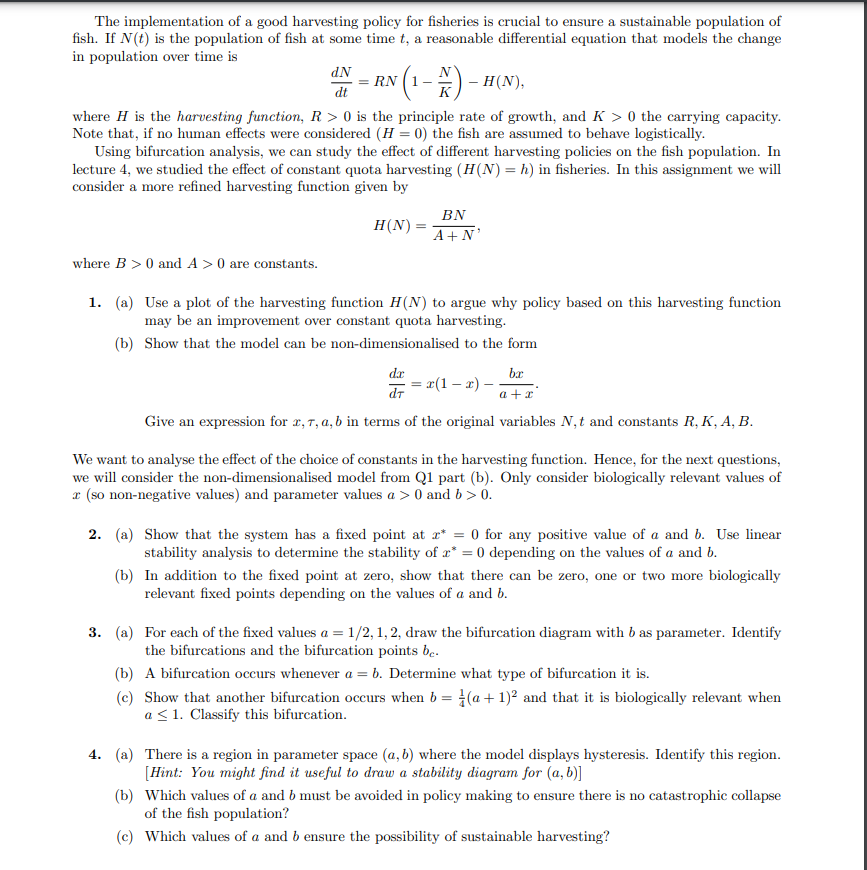
= RN (1-x) The implementation of a good harvesting policy for fisheries is crucial to ensure a sustainable population of fish. If (t) is the population of fish at some time t, a reasonable differential equation that models the change in population over time is dN N -H(N), dt where H is the harvesting function, R > 0 is the principle rate of growth, and K > 0 the carrying capacity. Note that, if no human effects were considered (H = 0) the fish are assumed to behave logistically. Using bifurcation analysis, we can study the effect of different harvesting policies on the fish population. In lecture 4, we studied the effect of constant quota harvesting (H(N) = h) in fisheries. In this assignment we will consider a more refined harvesting function given by BN H(N) = A+N' where B >0 and A >0 are constants. 1. (a) Use a plot of the harvesting function H(N) to argue why policy based on this harvesting function may be an improvement over constant quota harvesting. (b) Show that the model can be non-dimensionalised to the form bar dac dt 2(1 - 2) - a+2 Give an expression for 2,7, a, b in terms of the original variables Net and constants R, K, A, B. We want to analyse the effect of the choice of constants in the harvesting function. Hence, for the next questions, we will consider the non-dimensionalised model from Q1 part (b). Only consider biologically relevant values of * (s non-negative values) and parameter values a > 0 and b>0. 2. (a) Show that the system has a fixed point at 2* = 0 for any positive value of a and b. Use linear stability analysis to determine the stability of r* = 0 depending on the values of a and b. (b) In addition to the fixed point at zero, show that there can be zero, one or two more biologically relevant fixed points depending on the values of a and b. 3. (a) For each of the fixed values a = 1/2, 1, 2, draw the bifurcation diagram with b as parameter. Identify the bifurcations and the bifurcation points be. (b) A bifurcation occurs whenever a = b. Determine what type of bifurcation it is. (e) Show that another bifurcation occurs when b = (a + 1)2 and that it is biologically relevant when a 0 is the principle rate of growth, and K > 0 the carrying capacity. Note that, if no human effects were considered (H = 0) the fish are assumed to behave logistically. Using bifurcation analysis, we can study the effect of different harvesting policies on the fish population. In lecture 4, we studied the effect of constant quota harvesting (H(N) = h) in fisheries. In this assignment we will consider a more refined harvesting function given by BN H(N) = A+N' where B >0 and A >0 are constants. 1. (a) Use a plot of the harvesting function H(N) to argue why policy based on this harvesting function may be an improvement over constant quota harvesting. (b) Show that the model can be non-dimensionalised to the form bar dac dt 2(1 - 2) - a+2 Give an expression for 2,7, a, b in terms of the original variables Net and constants R, K, A, B. We want to analyse the effect of the choice of constants in the harvesting function. Hence, for the next questions, we will consider the non-dimensionalised model from Q1 part (b). Only consider biologically relevant values of * (s non-negative values) and parameter values a > 0 and b>0. 2. (a) Show that the system has a fixed point at 2* = 0 for any positive value of a and b. Use linear stability analysis to determine the stability of r* = 0 depending on the values of a and b. (b) In addition to the fixed point at zero, show that there can be zero, one or two more biologically relevant fixed points depending on the values of a and b. 3. (a) For each of the fixed values a = 1/2, 1, 2, draw the bifurcation diagram with b as parameter. Identify the bifurcations and the bifurcation points be. (b) A bifurcation occurs whenever a = b. Determine what type of bifurcation it is. (e) Show that another bifurcation occurs when b = (a + 1)2 and that it is biologically relevant when aStep by Step Solution
There are 3 Steps involved in it
1 Expert Approved Answer
Step: 1 Unlock

Question Has Been Solved by an Expert!
Get step-by-step solutions from verified subject matter experts
Step: 2 Unlock
Step: 3 Unlock
 Study Help