



Question: can you please help me with this. it due in 3hrs i need it !!! The National Labor Relations Board is divided into two distinct
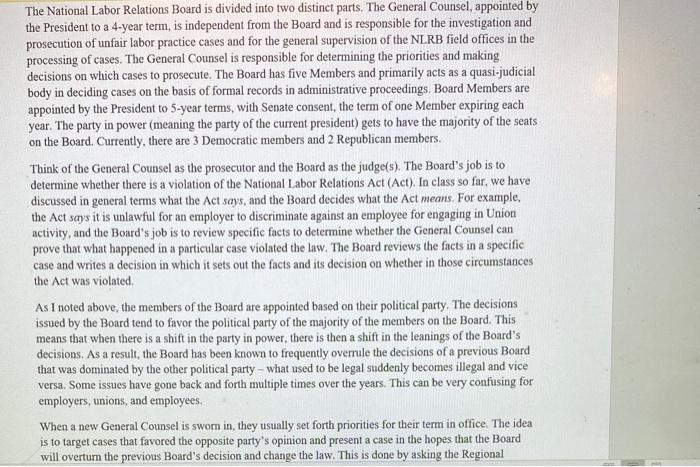
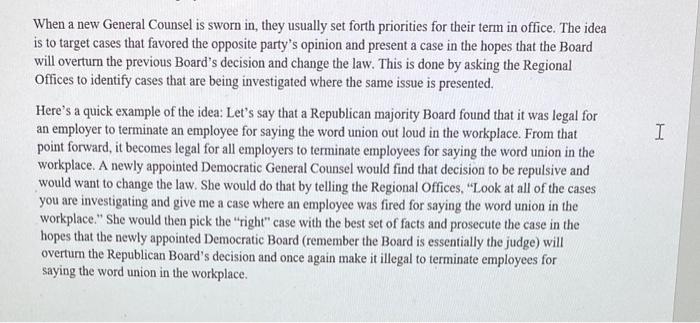
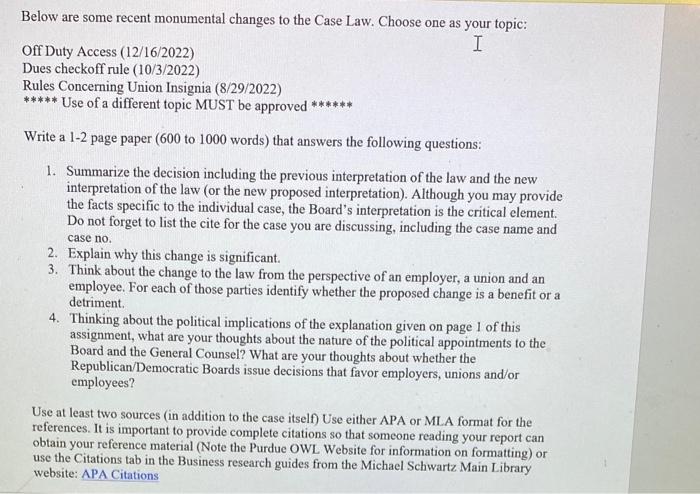
The National Labor Relations Board is divided into two distinct parts. The General Counsel, appoinfed by the President to a 4-year term, is independent from the Board and is responsible for the investigation and prosecution of unfair labor practice cases and for the general supervision of the NLRB field offices in the processing of cases. The General Counsel is responsible for determining the priorities and making decisions on which cases to prosecute. The Board has five Members and primarily acts as a quasi-judicial body in deciding cases on the basis of formal records in administrative proceedings. Board Members are appointed by the President to 5-year terms, with Senate consent, the term of one Member expiring each year. The party in power (meaning the party of the current president) gets to have the majority of the seats on the Board. Currently, there are 3 Democratic members and 2 Republican members. Think of the General Counsel as the prosecutor and the Board as the judge(s). The Board's job is to determine whether there is a violation of the National Labor Relations Act (Act). In class so far, we have discussed in general terms what the Act says, and the Board decides what the Act means. For example, the Act says it is unlawful for an employer to discriminate against an employee for engaging in Union activity, and the Board's job is to review specific facts to determine whether the General Counsel can prove that what happened in a particular case violated the law. The Board reviews the facts in a specific case and writes a decision in which it sets out the facts and its decision on whether in those circumstances the Act was violated. As I noted above, the members of the Board are appointed based on their political party. The decisions issued by the Board tend to favor the political party of the majority of the members on the Board. This means that when there is a shift in the party in power, there is then a shift in the leanings of the Board's decisions. As a result, the Board has been known to frequently overrule the decisions of a previous Board that was dominated by the other political party - what used to be legal suddenly becomes illegal and vice versa. Some issues have gone back and forth multiple times over the years. This can be very confusing for employers, unions, and employees. When a new General Counsel is sworn in, they usually set forth priorities for their term in office. The idea is to target cases that favored the opposite party's opinion and present a case in the hopes that the Board When a new General Counsel is sworn in, they usually set forth priorities for their term in office. The idea is to target cases that favored the opposite party's opinion and present a case in the hopes that the Board will overtum the previous Board's decision and change the law. This is done by asking the Regional Offices to identify cases that are being investigated where the same issue is presented. Here's a quick example of the idea: Let's say that a Republican majority Board found that it was legal for an employer to terminate an employee for saying the word union out loud in the workplace. From that point forward, it becomes legal for all employers to terminate employees for saying the word union in the workplace. A newly appointed Democratic General Counsel would find that decision to be repulsive and would want to change the law. She would do that by telling the Regional Offices, "Look at all of the cases you are investigating and give me a case where an employee was fired for saying the word union in the workplace." She would then pick the "right" case with the best set of facts and prosecute the case in the hopes that the newly appointed Democratic Board (remember the Board is essentially the judge) will overtum the Republican Board's decision and once again make it illegal to terminate employees for saying the word union in the workplace. Below are some recent monumental changes to the Case Law. Choose one as your topic: Off Duty Access (12/16/2022) Dues checkoff rule (10/3/2022) Rules Concerning Union Insignia (8/29/2022) ***** Use of a different topic MUST be approved Write a 1-2 page paper ( 600 to 1000 words) that answers the following questions: 1. Summarize the decision including the previous interpretation of the law and the new interpretation of the law (or the new proposed interpretation). Although you may provide the facts specific to the individual case, the Board's interpretation is the critical element. Do not forget to list the cite for the case you are discussing, including the case name and case no, 2. Explain why this change is significant. 3. Think about the change to the law from the perspective of an employer, a union and an employee. For each of those parties identify whether the proposed change is a benefit or a detriment. 4. Thinking about the political implications of the explanation given on page 1 of this assignment, what are your thoughts about the nature of the political appointments to the Board and the General Counsel? What are your thoughts about whether the Republican/Democratic Boards issue decisions that favor employers, unions and/or employees? Use at least two sources (in addition to the case itself) Use either APA or MLA format for the references. It is important to provide complete citations so that someone reading your report can obtain your reference material (Note the Purdue OWL Website for information on formatting) or use the Citations tab in the Business research guides from the Michael Schwartz Main Library website: APA Citations
Step by Step Solution
There are 3 Steps involved in it

Get step-by-step solutions from verified subject matter experts