







Question: can you please make a copyable code please? A circular pipe made out of new cast iron is used to convey water at a volume
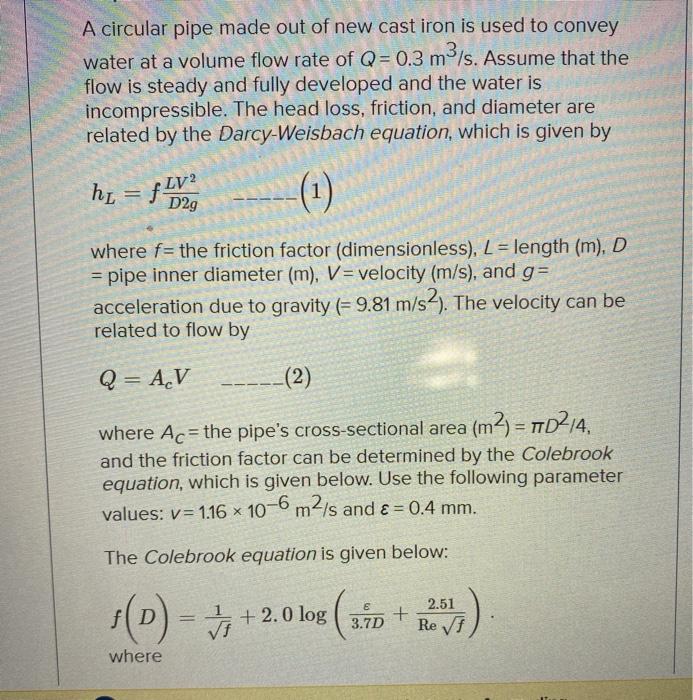
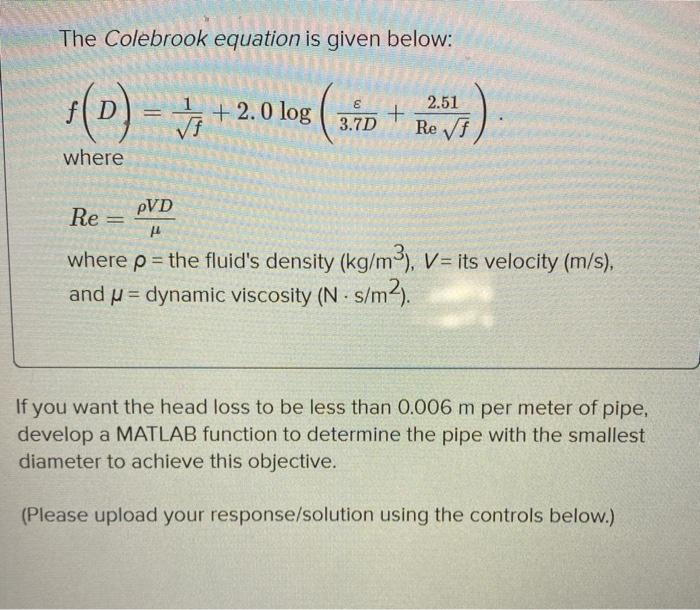
A circular pipe made out of new cast iron is used to convey water at a volume flow rate of Q=0.3 m3/s. Assume that the flow is steady and fully developed and the water is incompressible. The head loss, friction, and diameter are related by the Darcy-Weisbach equation, which is given by LV2 f D29 (1) where f= the friction factor (dimensionless), L = length (m), D = pipe inner diameter (m), V = velocity (m/s), and g= acceleration due to gravity (= 9.81 m/s2). The velocity can be related to flow by Q= AV (2) where Ac = the pipe's cross-sectional area (m2) = T1D24, and the friction factor can be determined by the Colebrook equation, which is given below. Use the following parameter values: v= 1.16 x 10⁻⁶ m2/s and = 0.4 mm. The Colebrook equation is given below: +2. O log ( 3.1D + 2.51 Re vi where The Colebrook equation is given below: 2.51 + 3.7D Re vf where PVD Re = where p = the fluid's density (kg/m3), V = its velocity (m/s), and p = dynamic viscosity (N - s/m2). If you want the head loss to be less than 0.006 m per meter of pipe, develop a MATLAB function to determine the pipe with the smallest diameter to achieve this objective. (Please upload your response/solution using the controls below.)
Step by Step Solution
There are 3 Steps involved in it

Get step-by-step solutions from verified subject matter experts
 Study Help