







Question: can you please separate a,b, and c 2. Why do fertility rates decline as countries become wealthier? 3. What is the role of social norms
can you please separate a,b, and c
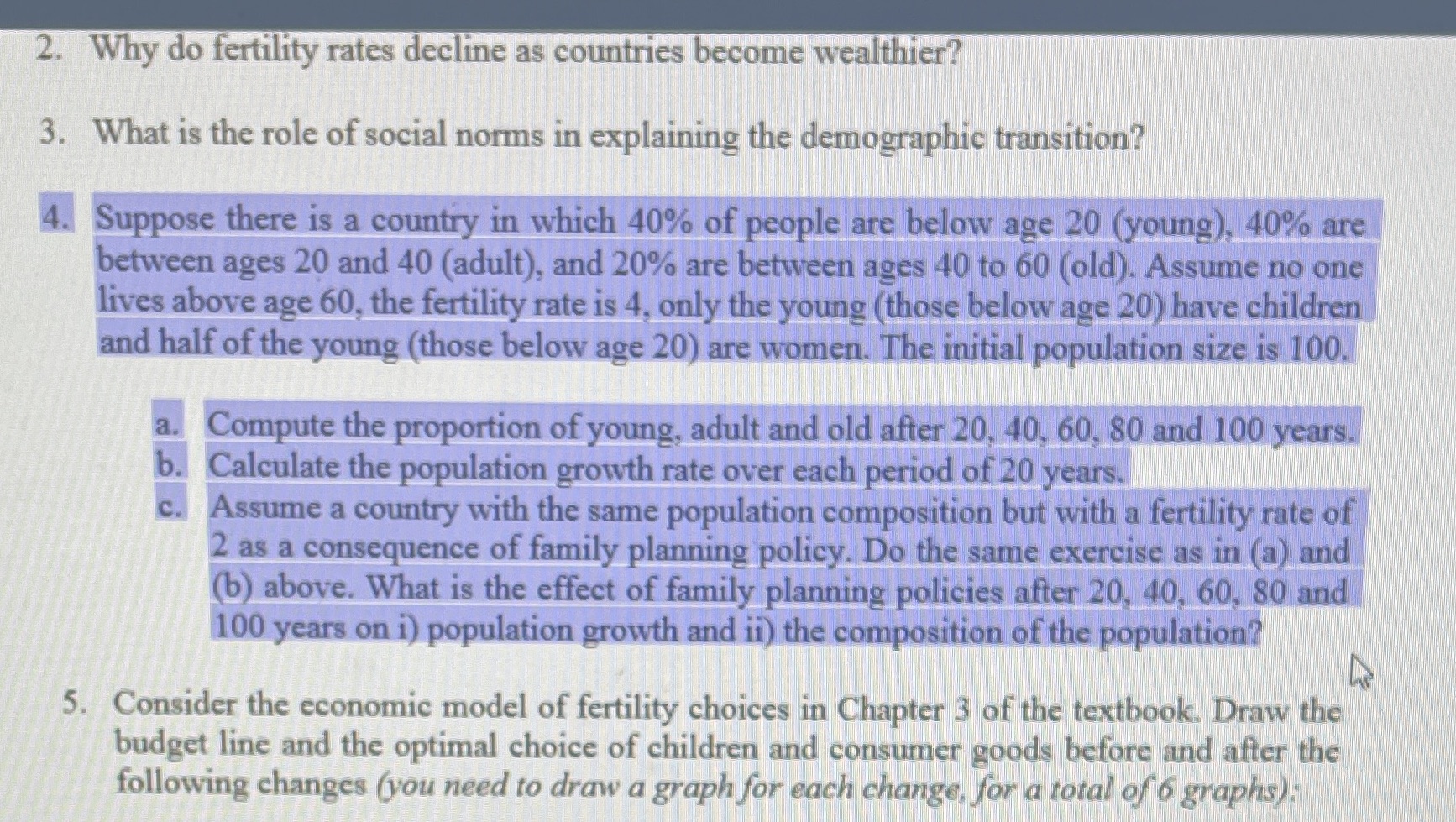
2. Why do fertility rates decline as countries become wealthier? 3. What is the role of social norms in explaining the demographic transition? 4. Suppose there is a country in which 40% of people are below age 20 (young), 40% are between ages 20 and 40 (adult), and 20% are between ages 40 to 60 (old). Assume no one lives above age 60, the fertility rate is 4, only the young (those below age 20) have children and half of the young (those below age 20) are women. The initial population size is 100. a. Compute the proportion of young, adult and old after 20, 40, 60, 80 and 100 years. b. Calculate the population growth rate over each period of 20 years. C. Assume a country with the same population composition but with a fertility rate of 2 as a consequence of family planning policy. Do the same exercise as in (a) and (b) above. What is the effect of family planning policies after 20, 40, 60, 80 and 100 years on i) population growth and ii) the composition of the population? 5. Consider the economic model of fertility choices in Chapter 3 of the textbook. Draw the budget line and the optimal choice of children and consumer goods before and after the following changes (you need to draw a graph for each change. for a total of 6 graphs)
Step by Step Solution
There are 3 Steps involved in it

Get step-by-step solutions from verified subject matter experts
 Study Help