



Question: can you please solve a, b,c and d. I'll rate highly. thank you. There are three categories of income tax filers in the United States:
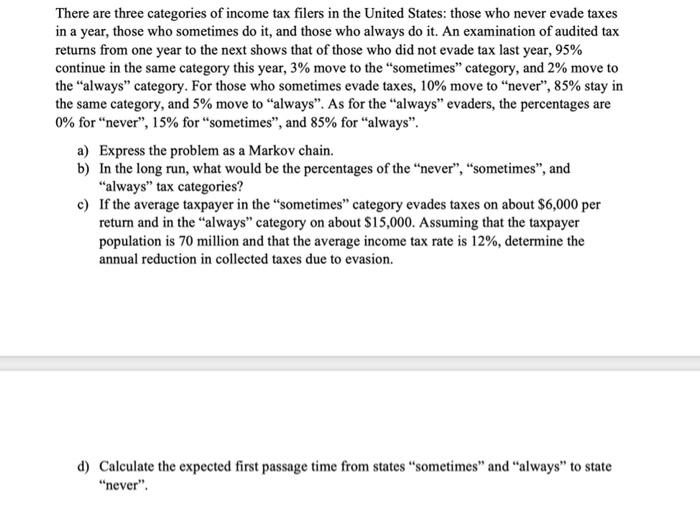
There are three categories of income tax filers in the United States: those who never evade taxes in a year, those who sometimes do it, and those who always do it. An examination of audited tax returns from one year to the next shows that of those who did not evade tax last year, 95% continue in the same category this year, 3% move to the "sometimes" category, and 2% move to the "always" category. For those who sometimes evade taxes, 10% move to "never", 85% stay in the same category, and 5% move to "always". As for the "always" evaders, the percentages are 0% for "never", 15% for "sometimes, and 85% for "always". a) Express the problem as a Markov chain. b) In the long run, what would be the percentages of the "never", "sometimes, and "always" tax categories? c) If the average taxpayer in the "sometimes category evades taxes on about $6,000 per return and in the "always" category on about $15,000. Assuming that the taxpayer population is 70 million and that the average income tax rate is 12%, determine the annual reduction in collected taxes due to evasion. d) Calculate the expected first passage time from states "sometimes" and "always" to state "never
Step by Step Solution
There are 3 Steps involved in it

Get step-by-step solutions from verified subject matter experts