







Question: Can you solve 8.6 CHAPTER 8 Solving Simultaneous Equations 8.6 A test projectile is fired down range at an initial velocity of 1467 fus (1000
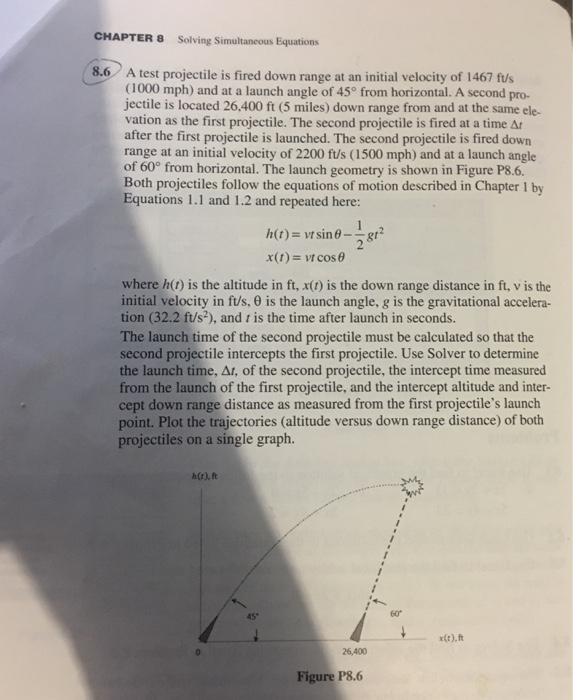
CHAPTER 8 Solving Simultaneous Equations 8.6 A test projectile is fired down range at an initial velocity of 1467 fus (1000 mph) and at a launch angle of 45 from horizontal. A second pro- jectile is located 26,400 ft (5 miles) down range from and at the same ele- vation as the first projectile. The second projectile is fired at a time after the first projectile is launched. The second projectile is fired down range at an initial velocity of 2200 f/s (1500 mph) and at a launch angle of 60 from horizontal. The launch geometry is shown in Figure P8.6. Both projectiles follow the equations of motion described in Chapter 1 by Equations 1.1 and 1.2 and repeated here: h(t) vrsin --gr x(t)s vr cos where h(t) is the altitude in ft, x(t) is the down range distance in ft, v is the initial velocity in ft/s, 0 is the launch angle, g is the gravitational accelera- tion (32.2 ft/s2), and t is the time after launch in seconds. The launch time of the second projectile must be calculated so that the second projectile intercepts the first projectile. Use Solver to determine the launch time, , of the second projectile, the intercept time measured from the launch of the first projectile, and the intercept altitude and inter- cept down range distance as measured from the first projectile's launch point. Plot the trajectories (altitude versus down range distance) of both projectiles on a single graph. h(E), ft 45* x(t),ft 6,400 Figure P8.6
Step by Step Solution
There are 3 Steps involved in it

Get step-by-step solutions from verified subject matter experts
 Study Help