







Question: Can you summarize this case study? between large players. In 2011, AT&T tried to pur- new equipment (the cost of which was heavily subsichase T-Mobile,
Can you summarize this case study?
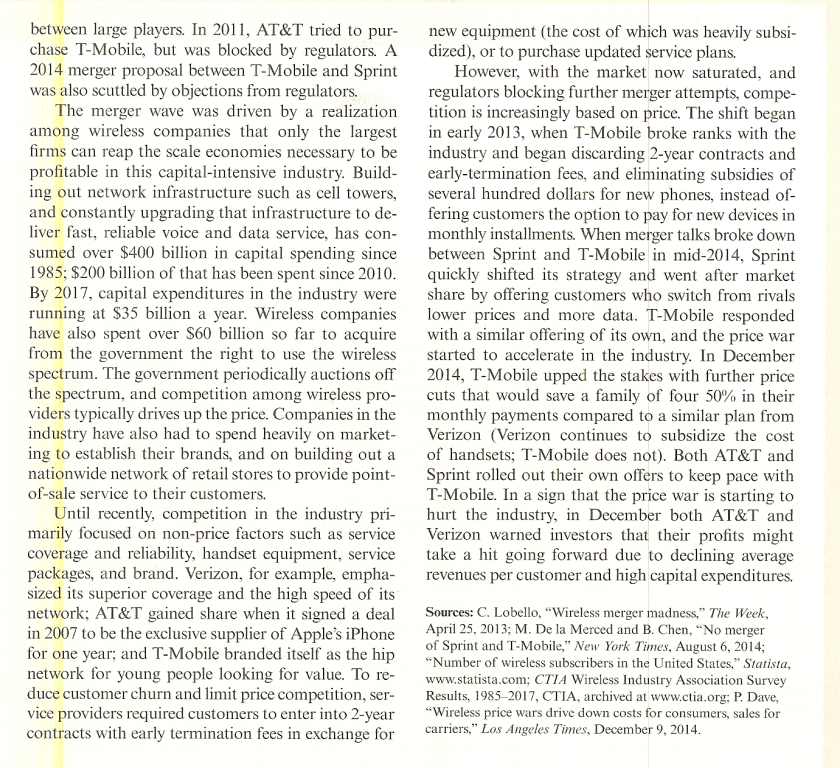
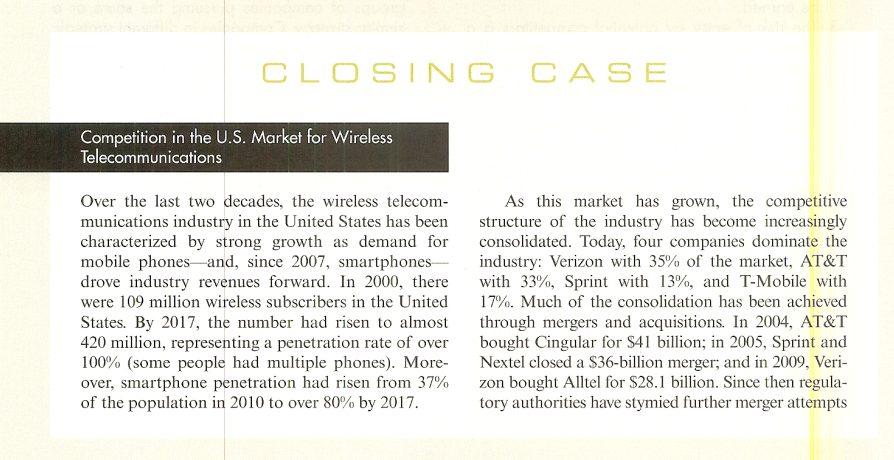
between large players. In 2011, AT\&T tried to pur- new equipment (the cost of which was heavily subsichase T-Mobile, but was blocked by regulators. A dized), or to purchase updated service plans. 2014 merger proposal between T-Mobile and Sprint However, with the market now saturated, and was also scuttled by objections from regulators. regulators blocking further merger attempts, compeThe merger wave was driven by a realization tition is increasingly based on price. The shift began among wireless companies that only the largest in early 2013, when T-Mobile broke ranks with the firms can reap the scale economies necessary to be industry and began discarding 2-year contracts and profitableinthiscapital-intensiveindustry.Build-ingoutnetworkinfrastructuresuchascelltowers,early-terminationfees,andeliminatingsubsidiesofseveralhundreddollarsfornewphones,insteadof- ingoutnetworkinfrastructuresuchascelltowers,andconstantlyupgradingthatinfrastructuretode-severalhundreddollarsfornewphones,insteadof-feringcustomerstheoptiontopayfornewdevicesin liver fast, reliable voice and data service, has con- monthly installments. When merger talks broke down sumedover$400billionincapitalspendingsince1985;$200billionofthathasbeenspentsince2010.quicklyshifteditsstrategyandwentaftermarketbetweenSprintandT-Mobileinmid-2014,Sprint 1985;$200billionofthathasbeenspentsince2010.By2017,capitalexpendituresintheindustrywerequicklyshifteditsstrategyandwentaftermarketsharebyofferingcustomerswhoswitchfromrivals running at $35 billion a year. Wireless companies lower prices and more data. T-Mobile responded have also spent over $60 billion so far to acquire with a similar offering of its own, and the price war from the government the right to use the wireless started to accelerate in the industry. In December spectrum.Thegovernmentperiodicallyauctionsoffthespectrum,andcompetitionamongwirelesspro-2014,T-Mobileuppedthestakeswithfurtherpricecutsthatwouldsaveafamilyoffour50%intheir viderstypicallydrivesuptheprice.Companiesinthemonthlypaymentscomparedtoasimilarplanfrom industry have also had to spend heavily on market- Verizon (Verizon continues to subsidize the cost ing to establish their brands, and on building out a of handsets; T-Mobile does not). Both AT\&T and nationwide network of retail stores to provide point- Sprint rolled out their own offers to keep pace with of-sale service to their customers. Untilrecently,competitionintheindustrypri-rilyfocusedonnon-pricefactorssuchasservicehurttheindustry,inDecemberbothAT&TandVerizonwarnedinvestorsthattheirprofitsmight marilyfocusedonnon-pricefactorssuchasservicecoverageandreliability,handsetequipment,serviceVerizonwarnedinvestorsthattheirprofitsmighttakeahitgoingforwardduetodecliningaverage paverageandreliability,handsetequipment,servicepandbrand.Verizon,forexample,empha-takeahitgoingforwardduetodecliningaveragerevenuespercustomerandhighcapitalexpenditures. sized its superior coverage and the high speed of its network; AT\&T gained share when it signed a deal Sources: C. Lobello, "Wireless merger madness," The Week, in 2007 to be the exclusive supplier of Apple's iPhone April 25, 2013; M. De la Merced and B. Chen, "No merger for one year; and T-Mobile branded itself as the hip of Sprint and T-Mobile," New York Times, August 6, 2014; network for young people looking for value. To re- www.statista.com; CTIA Wireless Industry Association Survey duce customer churn and limit price competition, ser- Results, 1985-2017, CTIA, archived at www.ctia.org; P. Dave, viceprovidersrequiredcustomerstoenterinto2-yearcontractswithearlyterminationfeesinexchangefor"Wirelesspricewarsdrivedowncostsforconsumers,salesfor carrier," Los Angeles Times, December 9, 2014. contracts with early termination fees in exchange for Over the last two decades, the wireless telecom- As this market has grown, the competitive munications industry in the United States has been structure of the industry has become increasingly characterized by strong growth as demand for consolidated. Today, four companies dominate the mobile phones - and, since 2007, smartphones - industry: Verizon with 35% of the market, AT\&T drove industry revenues forward. In 2000 , there with 33%, Sprint with 13%, and T-Mobile with were 109 million wireless subscribers in the United 17%. Much of the consolidation has been achieved States. By 2017, the number had risen to almost through mergers and acquisitions. In 2004, AT\&T 420 million, representing a penetration rate of over bought Cingular for $41 billion; in 2005, Sprint and 100% (some people had multiple phones). More- Nextel closed a \$36-billion merger; and in 2009, Veriover, smartphone penetration had risen from 37\% zon bought Alltel for $28.1 billion. Since then regulaof the population in 2010 to over 80% by 2017 . tory authorities have stymied further merger attemptsStep by Step Solution
There are 3 Steps involved in it
1 Expert Approved Answer
Step: 1 Unlock

Question Has Been Solved by an Expert!
Get step-by-step solutions from verified subject matter experts
Step: 2 Unlock
Step: 3 Unlock
 Study Help