







Question: Can you write a discussion, question and answer? Title: Urea Aim of Experiment: Determination of blood (serum) urea concentration. Theory: A side from protein, the
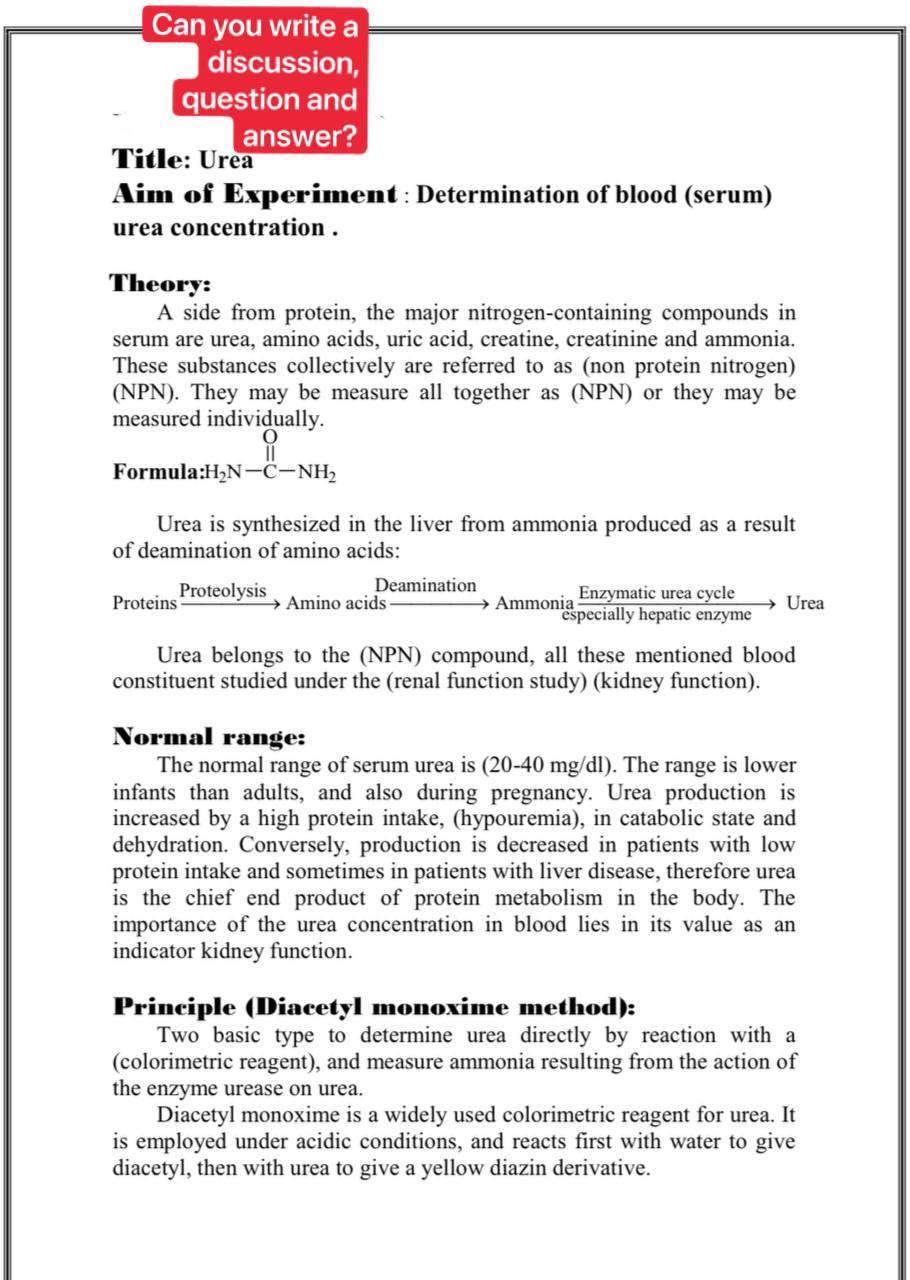
Can you write a discussion, question and answer? Title: Urea Aim of Experiment: Determination of blood (serum) urea concentration. Theory: A side from protein, the major nitrogen-containing compounds in serum are urea, amino acids, uric acid, creatine, creatinine and ammonia. These substances collectively are referred to as (non protein nitrogen) (NPN). They may be measure all together as (NPN) or they may be measured individually. O II Formula:H2N-C-NH2 Urea is synthesized in the liver from ammonia produced as a result of deamination of amino acids: Proteins Deamination Proteolysis Amino acids Enzymatic urea cycle Ammonia Urea especially hepatic enzyme Urea belongs to the (NPN) compound, all these mentioned blood constituent studied under the (renal function study) (kidney function) Normal range: The normal range of serum urea is (20-40 mg/dl). The range is lower infants than adults, and also during pregnancy. Urea production is increased by a high protein intake, (hypouremia), in catabolic state and dehydration. Conversely, production is decreased in patients with low protein intake and sometimes in patients with liver disease, therefore urea is the chief end product of protein metabolism in the body. The importance of the urea concentration in blood lies in its value as an indicator kidney function. Principle (Diacetyl monoxime method): Two basic type to determine urea directly by reaction with a (colorimetric reagent), and measure ammonia resulting from the action of the enzyme urease on urea. Diacetyl monoxime is a widely used colorimetric reagent for urea. It is employed under acidic conditions, and reacts first with water to give diacetyl, then with urea to give a yellow diazin derivative. Can you write a discussion, question and answer? Title: Urea Aim of Experiment: Determination of blood (serum) urea concentration. Theory: A side from protein, the major nitrogen-containing compounds in serum are urea, amino acids, uric acid, creatine, creatinine and ammonia. These substances collectively are referred to as (non protein nitrogen) (NPN). They may be measure all together as (NPN) or they may be measured individually. O II Formula:H2N-C-NH2 Urea is synthesized in the liver from ammonia produced as a result of deamination of amino acids: Proteins Deamination Proteolysis Amino acids Enzymatic urea cycle Ammonia Urea especially hepatic enzyme Urea belongs to the (NPN) compound, all these mentioned blood constituent studied under the (renal function study) (kidney function) Normal range: The normal range of serum urea is (20-40 mg/dl). The range is lower infants than adults, and also during pregnancy. Urea production is increased by a high protein intake, (hypouremia), in catabolic state and dehydration. Conversely, production is decreased in patients with low protein intake and sometimes in patients with liver disease, therefore urea is the chief end product of protein metabolism in the body. The importance of the urea concentration in blood lies in its value as an indicator kidney function. Principle (Diacetyl monoxime method): Two basic type to determine urea directly by reaction with a (colorimetric reagent), and measure ammonia resulting from the action of the enzyme urease on urea. Diacetyl monoxime is a widely used colorimetric reagent for urea. It is employed under acidic conditions, and reacts first with water to give diacetyl, then with urea to give a yellow diazin derivative
Step by Step Solution
There are 3 Steps involved in it

Get step-by-step solutions from verified subject matter experts
 Study Help