







Question: Cap Rates & Affordability Stephen's team had eventually settled on constructing a multifamily rental property, rather than a condominium. The reasons were complicated, but in
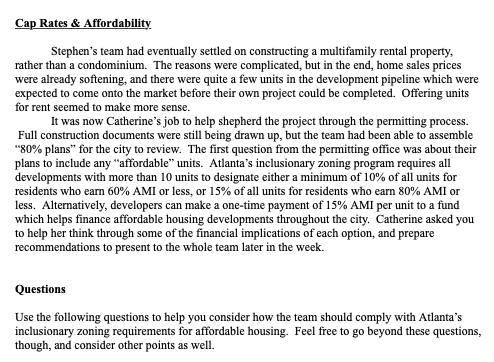
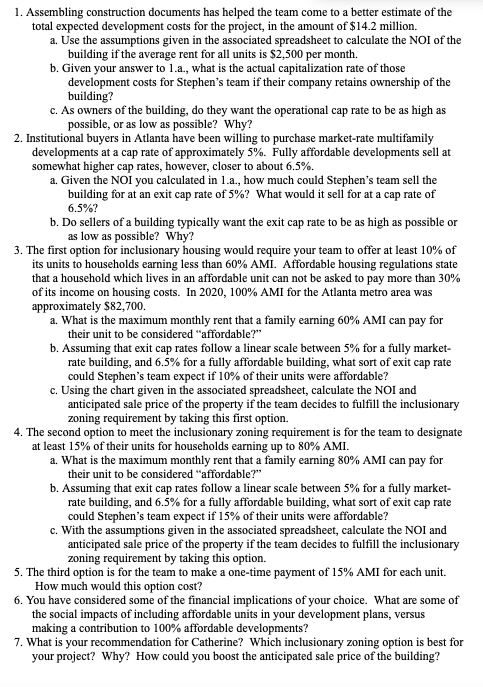
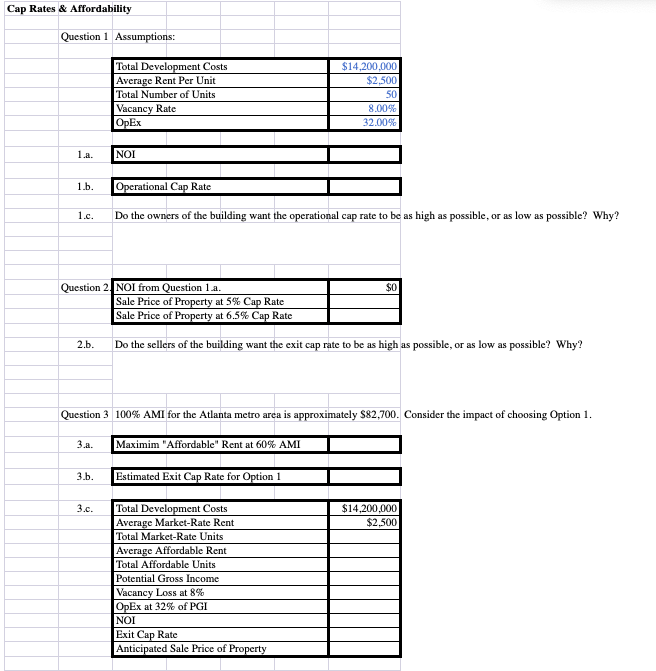
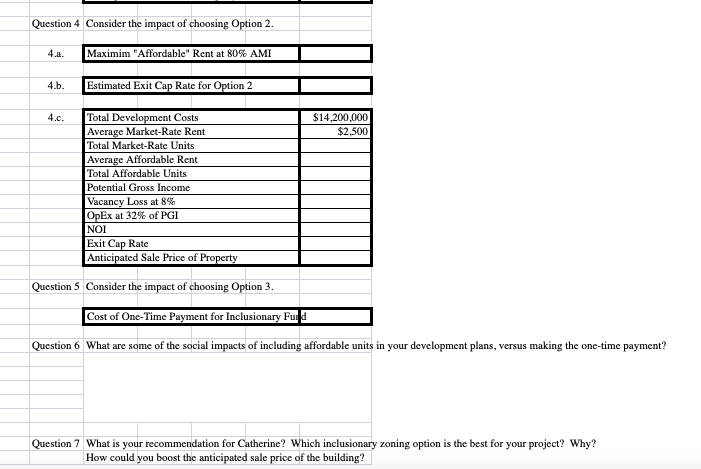
Cap Rates & Affordability Stephen's team had eventually settled on constructing a multifamily rental property, rather than a condominium. The reasons were complicated, but in the end, home sales prices were already softening, and there were quite a few units in the development pipeline which were expected to come onto the market before their own project could be completed. Offering units for rent seemed to make more sense. It was now Catherine's job to help shepherd the project through the permitting process. Full construction documents were still being drawn up, but the team had been able to assemble *80% plans for the city to review. The first question from the permitting office was about their plans to include any "affordable units. Atlanta's inclusionary zoning program requires all developments with more than 10 units to designate either a minimum of 10% of all units for residents who ear 60% AMI or less, or 15% of all units for residents who earn 80% AMI or less. Alternatively, developers can make a one-time payment of 15% AMI per unit to a fund which helps finance affordable housing developments throughout the city. Catherine asked you to help her think through some of the financial implications of each option, and prepare recommendations to present to the whole team later in the week. Questions Use the following questions to help you consider how the team should comply with Atlanta's inclusionary zoning requirements for affordable housing. Feel free to go beyond these questions, though, and consider other points as well. 1. Assembling construction documents has helped the team come to a better estimate of the total expected development costs for the project, in the amount of $14.2 million. a. Use the assumptions given in the associated spreadsheet to calculate the NOI of the building if the average rent for all units is $2,500 per month. b. Given your answer to 1.a., what is the actual capitalization rate of those development costs for Stephen's team if their company retains ownership of the building? c. As owners of the building, do they want the operational cap rate to be as high as possible, or as low as possible? Why? 2. Institutional buyers in Atlanta have been willing to purchase market-rate multifamily developments at a cap rate of approximately 5%. Fully affordable developments sell at somewhat higher cap rates, however, closer to about 6.5%. a. Given the NOI you calculated in 1.a., how much could Stephen's team sell the building for at an exit cap rate of 5%? What would it sell for at a cap rate of 6.5%? b. Do sellers of a building typically want the exit cap rate to be as high as possible or as low as possible? Why? 3. The first option for inclusionary housing would require your team to offer at least 10% of its units to households earning less than 60% AMI. Affordable housing regulations state that a household which lives in an affordable unit can not be asked to pay more than 30% of its income on housing costs. In 2020, 100% AMI for the Atlanta metro area was approximately $82,700. a. What is the maximum monthly rent that a family earning 60% AMI can pay for their unit to be considered "affordable?" b. Assuming that exit cap rates follow a linear scale between 5% for a fully market- rate building, and 6.5% for a fully affordable building, what sort of exit cap rate could Stephen's team expect if 10% of their units were affordable? c. Using the chart given in the associated spreadsheet, calculate the NOI and anticipated sale price of the property if the team decides to fulfill the inclusionary zoning requirement by taking this first option. 4. The second option to meet the inclusionary zoning requirement is for the team to designate at least 15% of their units for households earning up to 80% AMI. a. What is the maximum monthly rent that a family earning 80% AMI can pay for their unit to be considered "affordable?" b. Assuming that exit cap rates follow a linear scale between 5% for a fully market- rate building, and 6.5% for a fully affordable building, what sort of exit cap rate could Stephen's team expect if 15% of their units were affordable? c. With the assumptions given in the associated spreadsheet, calculate the NOI and anticipated sale price of the property if the team decides to fulfill the inclusionary zoning requirement by taking this option. 5. The third option is for the team to make a one-time payment of 15% AMI for each unit. How much would this option cost? 6. You have considered some of the financial implications of your choice. What are some of the social impacts of including affordable units in your development plans, versus making a contribution to 100% affordable developments? 7. What is your recommendation for Catherine? Which inclusionary zoning option is best for your project? Why? How could you boost the anticipated sale price of the building? Cap Rates & Affordability Question 1 Assumptions: Total Development Costs Average Rent Per Unit Total Number of Units Vacancy Rate OpEx $14,200.000 $2.500 50 8.00% 32.00% 1.a. NOI 1.b. Operational Cap Rate 1.c. Do the owners of the building want the operational cap rate to be as high as possible, or as low as possible? Why? $0 Question 2 NOI from Question 1a. Sale Price of Property at 5% Cap Rate Sale Price of Property at 6.5% Cap Rate 2.b. Do the sellers of the building want the exit cap rate to be as high as possible, or as low as possible? Why? Question 3 100% AMI for the Atlanta metro area is approximately $82,700. Consider the impact of choosing Option 1. Maximim "Affordable" Rent at 60% AMI 3.b. Estimated Exit Cap Rate for Option 1 3.c. $14,200.000 $2,500 Total Development Costs Average Market-Rate Rent Total Market-Rate Units Average Affordable Rent Total Affordable Units Potential Gross Income Vacancy Loss at 8% OpEx at 32% of PGI NOI Exit Cap Rate Anticipated Sale Price of Property Question 4 Consider the impact of choosing Option 2. 4.a. Maximim "Affordable" Rent at 80% AMI 4.b. Estimated Exit Cap Rate for Option 2 4.c. $14,200,000 $2.500 Total Development Costs Average Market-Rate Rent Total Market-Rate Units Average Affordable Rent Total Affordable Units Potential Gross Income Vacancy Loss at 8% OpEx at 32% of PGI NOI Exit Cap Rate Anticipated Sale Price of Property Question 5 Consider the impact of choosing Option 3. Cost of One-Time Payment for Inclusionary Fura Question 6 What are some of the social impacts of including affordable units in your development plans, versus making the one-time payment? Question 7 What is your recommendation for Catherine? Which inclusionary zoning option is the best for your project? Why? How could you boost the anticipated sale price of the building
Step by Step Solution
There are 3 Steps involved in it

Get step-by-step solutions from verified subject matter experts
 Study Help