Question: Capful it, is a process by which one concretely and precisely defines a construct To measure the well-defined construct, one must develop indicators (or items)
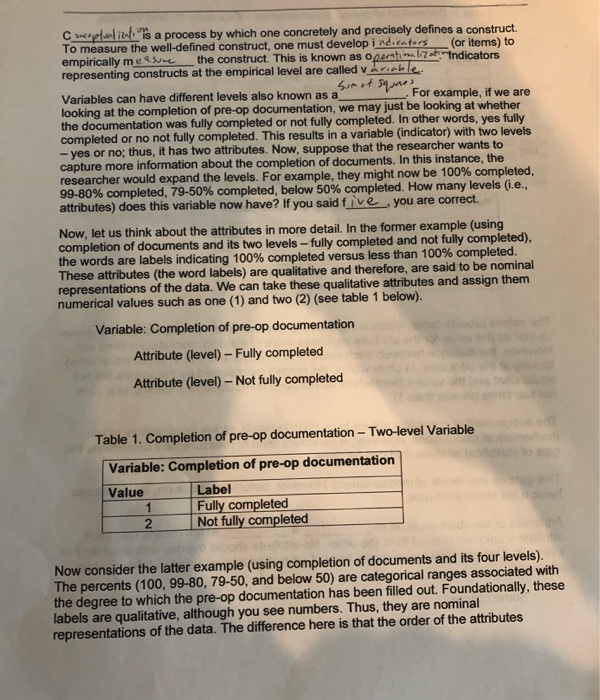
Capful it, is a process by which one concretely and precisely defines a construct To measure the well-defined construct, one must develop indicators (or items) to empirically measure the construct. This is known as operamelizat Indicators representing constructs at the empirical level are called variable Variables can have different levels also known as a Smot squnes For example, if we are looking at the completion of pre-op documentation, we may just be looking at whether the documentation was fully completed or not fully completed. In other words, yes fully completed or no not fully completed. This results in a variable indicator) with two levels - yes or no; thus, it has two attributes. Now, suppose that the researcher wants to capture more information about the completion of documents. In this instance, the researcher would expand the levels. For example, they might now be 100% completed, 99-80% completed, 79-50% completed, below 50% completed. How many levels (i.e., attributes) does this variable now have? If you said five you are correct. Now, let us think about the attributes in more detail. In the former example (using completion of documents and its two levels - fully completed and not fully completed). the words are labels indicating 100% completed versus less than 100% completed. These attributes (the word labels) are qualitative and therefore, are said to be nominal representations of the data. We can take these qualitative attributes and assign them numerical values such as one (1) and two (2) (see table 1 below). Variable: Completion of pre-op documentation Attribute (level) - Fully completed Attribute (level) - Not fully completed Table 1. Completion of pre-op documentation - Two-level Variable Variable: Completion of pre-op documentation Value Label Fully completed 2 Not fully completed Now consider the latter example (using completion of documents and its four levels). The percents (100, 99-80, 79-50, and below 50) are categorical ranges associated with the degree to which the pre-op documentation has been filled out. Foundationally, these labels are qualitative, although you see numbers. Thus, they are nominal representations of the data. The difference here is that the order of the attributes Capful it, is a process by which one concretely and precisely defines a construct To measure the well-defined construct, one must develop indicators (or items) to empirically measure the construct. This is known as operamelizat Indicators representing constructs at the empirical level are called variable Variables can have different levels also known as a Smot squnes For example, if we are looking at the completion of pre-op documentation, we may just be looking at whether the documentation was fully completed or not fully completed. In other words, yes fully completed or no not fully completed. This results in a variable indicator) with two levels - yes or no; thus, it has two attributes. Now, suppose that the researcher wants to capture more information about the completion of documents. In this instance, the researcher would expand the levels. For example, they might now be 100% completed, 99-80% completed, 79-50% completed, below 50% completed. How many levels (i.e., attributes) does this variable now have? If you said five you are correct. Now, let us think about the attributes in more detail. In the former example (using completion of documents and its two levels - fully completed and not fully completed). the words are labels indicating 100% completed versus less than 100% completed. These attributes (the word labels) are qualitative and therefore, are said to be nominal representations of the data. We can take these qualitative attributes and assign them numerical values such as one (1) and two (2) (see table 1 below). Variable: Completion of pre-op documentation Attribute (level) - Fully completed Attribute (level) - Not fully completed Table 1. Completion of pre-op documentation - Two-level Variable Variable: Completion of pre-op documentation Value Label Fully completed 2 Not fully completed Now consider the latter example (using completion of documents and its four levels). The percents (100, 99-80, 79-50, and below 50) are categorical ranges associated with the degree to which the pre-op documentation has been filled out. Foundationally, these labels are qualitative, although you see numbers. Thus, they are nominal representations of the data. The difference here is that the order of the attributes









 Study Help