







Question: Capital Structure and Leverage: Capital Structure Theory Modern capital structure theory began in 1958 when Professors Modigliani and Miller (MM) published a paper that proved
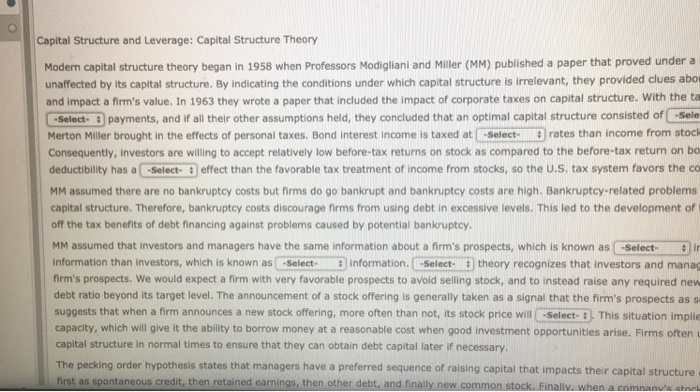
Capital Structure and Leverage: Capital Structure Theory Modern capital structure theory began in 1958 when Professors Modigliani and Miller (MM) published a paper that proved under a unaffected by its capital structure. By indicating the conditions under which capital structure is irrelevant, they provided clues abo and impact a firm's value. In 1963 they wrote a paper that included the impact of corporate taxes on capital structure. With the ta Select payments, and if all their other assumptions held, they concluded that an optimal capital structure consisted of -Sele Merton Miller brought in the effects of personal taxes. Bond interest income is taxed at (-Select3 rates than income from stock Consequently, investors are willing to accept relatively low before-tax returns on stock as compared to the before-tax return on bo deductibility has a ( -Select effect than the favorable tax treatment of income from stocks, so the U.S. tax system favors the co MM assumed there are no bankruptcy costs but firms do go bankrupt and bankruptcy costs are high. Bankruptcy-related problems capital structure. Therefore, bankruptcy costs discourage firms from using debt in excessive levels. This led to the development of off the tax benefits of debt financing against problems caused by potential bankruptcy MM assumed that investors and managers have the same information about a firm's prospects, which is known as -Selecti information than investors, which is known as -Select information. -Select theory recognizes that investors and manag firm's prospects. We would expect a firm with very favorable prospects to avoid selling stock, and to instead raise any required new debt ratio beyond its target level. The announcement of a stock offering is generally taken as a signal that the firm's prospects as s suggests that when a firm announces a new stock offering, more often than not, its stock price will -Select . This situation implie capacity, which will give it the ability to borrow money at a reasonable cost when good investment opportunities arise. Firms often capital structure in normal times to ensure that they can obtain debt capital later if necessary The pecking order hypothesis states that managers have a preferred sequence of raising capital that impacts their capital structure first as spontaneous credit, then retained earnings, then other debt, and finally new common stock
Step by Step Solution
There are 3 Steps involved in it

Get step-by-step solutions from verified subject matter experts
 Study Help