







Question: CASE 19.1 Who Needs the U.S. Penny? Does an object that costs more to make than it's worth have any value in today's economy?
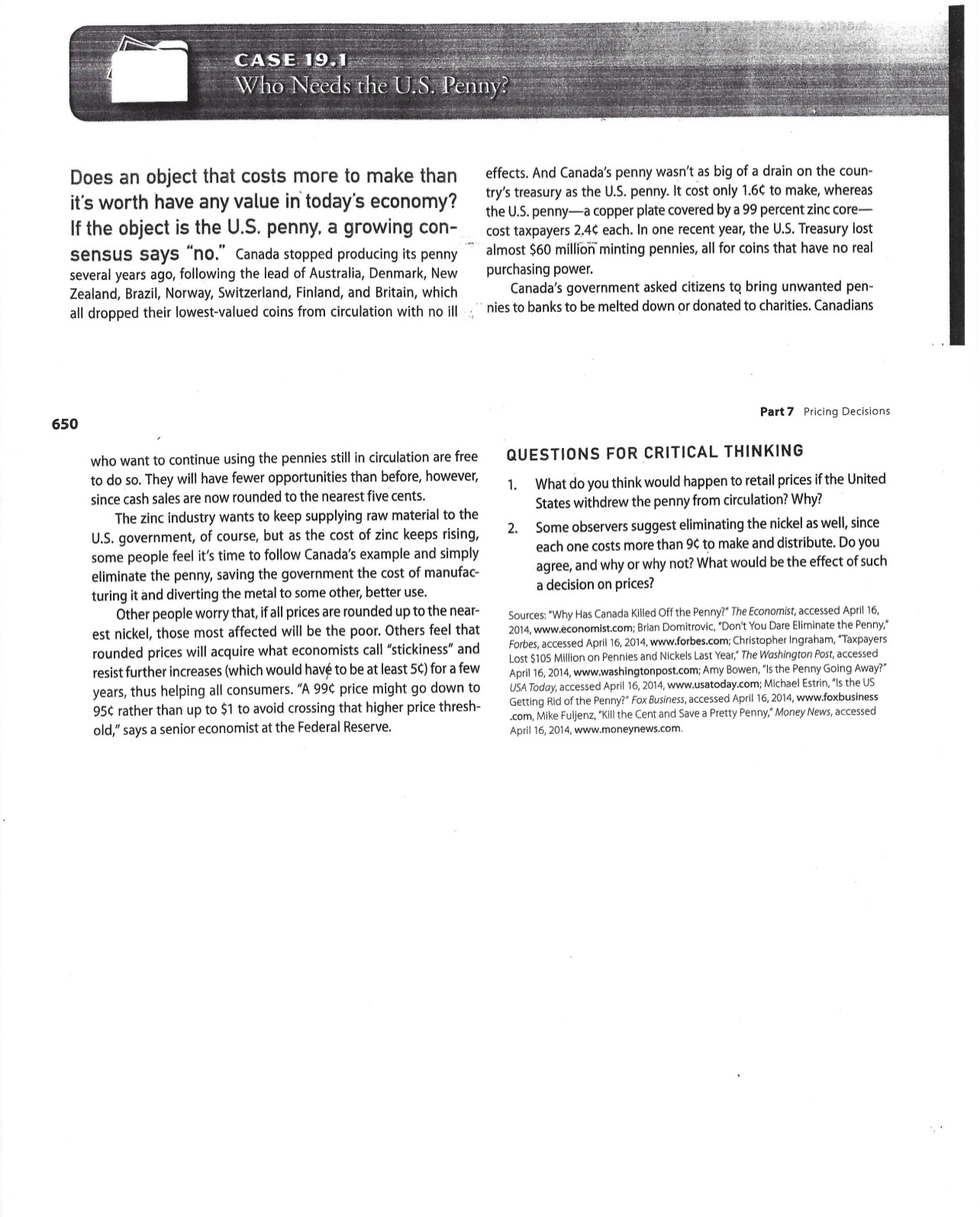
CASE 19.1 Who Needs the U.S. Penny? Does an object that costs more to make than it's worth have any value in today's economy? If the object is the U.S. penny, a growing con- sensus says "no." Canada stopped producing its penny several years ago, following the lead of Australia, Denmark, New Zealand, Brazil, Norway, Switzerland, Finland, and Britain, which all dropped their lowest-valued coins from circulation with no ill effects. And Canada's penny wasn't as big of a drain on the coun- try's treasury as the U.S. penny. It cost only 1.6 to make, whereas the U.S. penny-a copper plate covered by a 99 percent zinc core- cost taxpayers 2,4 each. In one recent year, the U.S. Treasury lost almost $60 million minting pennies, all for coins that have no real purchasing power. Canada's government asked citizens to bring unwanted pen- nies to banks to be melted down or donated to charities. Canadians 650 who want to continue using the pennies still in circulation are free to do so. They will have fewer opportunities than before, however, since cash sales are now rounded to the nearest five cents. The zinc industry wants to keep supplying raw material to the U.S. government, of course, but as the cost of zinc keeps rising, some people feel it's time to follow Canada's example and simply eliminate the penny, saving the government the cost of manufac- turing it and diverting the metal to some other, better use. Other people worry that, if all prices are rounded up to the near- est nickel, those most affected will be the poor. Others feel that rounded prices will acquire what economists call "stickiness" and resist further increases (which would have to be at least 5) for a few years, thus helping all consumers. "A 99 price might go down to 95 rather than up to $1 to avoid crossing that higher price thresh- old," says a senior economist at the Federal Reserve. Part 7 Pricing Decisions QUESTIONS FOR CRITICAL THINKING 1. What do you think would happen to retail prices if the United States withdrew the penny from circulation? Why? 2. Some observers suggest eliminating the nickel as well, since each one costs more than 9 to make and distribute. Do you agree, and why or why not? What would be the effect of such a decision on prices? Sources: "Why Has Canada Killed Off the Penny?" The Economist, accessed April 16, 2014, www.economist.com; Brian Domitrovic, "Don't You Dare Eliminate the Penny," Forbes, accessed April 16, 2014, www.forbes.com; Christopher Ingraham, "Taxpayers Lost $105 Million on Pennies and Nickels Last Year," The Washington Post, accessed April 16, 2014, www.washingtonpost.com; Amy Bowen, "Is the Penny Going Away?" USA Today, accessed April 16, 2014, www.usatoday.com; Michael Estrin, "Is the US Getting Rid of the Penny?" Fox Business, accessed April 16, 2014, www.foxbusiness .com, Mike Fuljenz, "Kill the Cent and Save a Pretty Penny," Money News, accessed April 16, 2014, www.moneynews.com.
Step by Step Solution
There are 3 Steps involved in it

Get step-by-step solutions from verified subject matter experts
 Study Help