Question: Case 2: An upper middle class, middle aged, Canadian man is playing racket ball when he suddenly feels a pop in his knee. In pain,
Case 2: An upper middle class, middle aged, Canadian man is playing racket ball when he suddenly feels a pop in his knee. In pain, he makes an appointment with his general practitioner and is seen the next day. He is given pain medication, and is referred to an orthopedic surgeon (he has no choice of who he will see). After a week wait, he is seen by the orthopedic surgeon and is told he will need surgery. Two weeks later surgery is performed on the man's knee. The physician, who is not very good, does a poor job on the knee, and the man walks with a slight limp for the rest of his life. The surgery costs the man no money directly, however, he pays for it with higher taxes.
Questions For Case 2:
-
What do you think of this man's experience in comparison to case 1 (Discussion #1)? Which situation seems worse, and why?
-
Does it seem like it took too long for him to receive care? (The physicians will perform surgery on the more urgent patients first and then on the less serious.)
-
What do you think about not being able to choose your own physician? (Note: In the United States, many insurance companies limit which physicians you choose.)
-
One suggested solution for our current health care woes is that care for the elderly be decreased/eliminated. For example, people over the age of 80 will no longer be placed on life support, which costs approximately $10,000 per day to operate. What do you think of this?
-
What do you think could be a good middle ground solution to this problem?
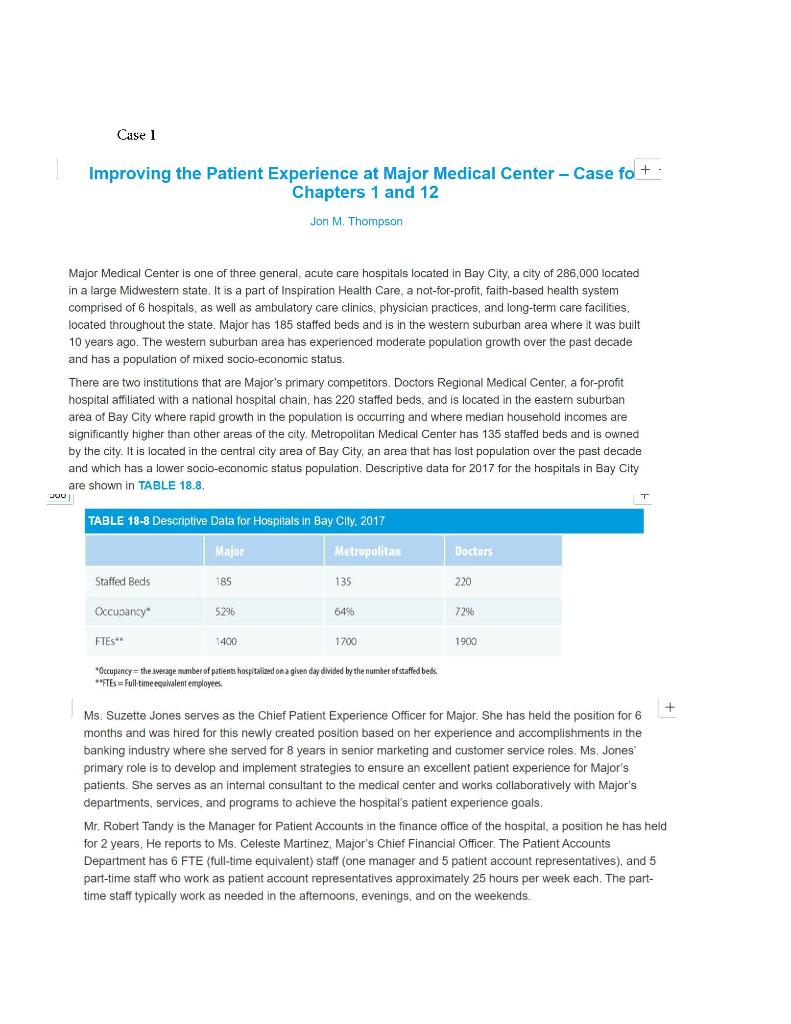
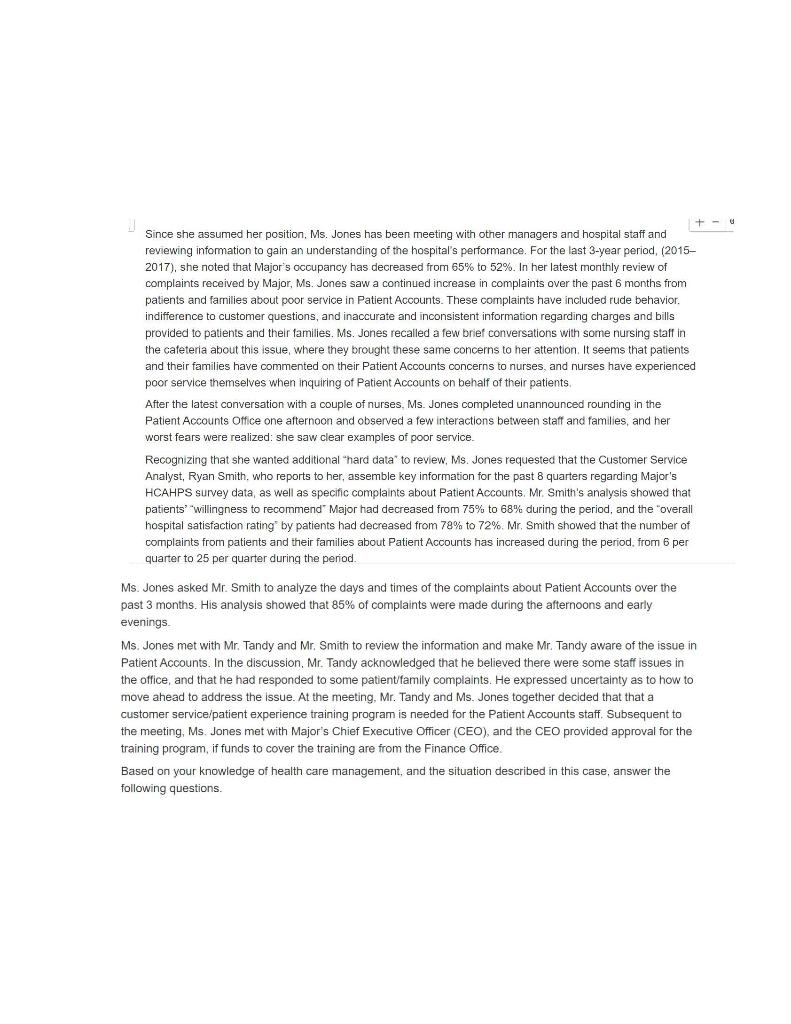
Case 1 Improving the Patient Experience at Major Medical Center - Case fo + Chapters 1 and 12 Jon M. Thompson Major Medical Center is one of three general, acute care hospitals located in Bay City, a city of 286,000 located in a large Midwestem state. It is a part of Inspiration Health Care, a not-for-profit, faith-based health system comprised of 6 hospitals, as well as ambulatory care clinics, physician practices, and long-term care facilities, located throughout the state. Major has 185 staffed beds and is in the westem suburban area where it was built 10 years ago. The westem suburban area has experienced moderate population growth over the past decade and has a population of mixed socio-economic status. There are two institutions that are Major's primary competitors. Doctors Regional Medical Center, a for-profit hospital affiliated with a national hospital chain, has 220 staffed beds, and is located in the eastern suburban area of Bay City where rapid growth in the population is occurring and where median household incomes are significantly higher than other areas of the city. Metropolitan Medical Center has 135 staffed beds and is owned by the city. It is located in the central city area of Bay City, an area that has lost population over the past decade and which has a lower socio-economic status population. Descriptive data for 2017 for the hospitals in Bay City are shown in TABLE 18.8. JUU TABLE 18-8 Descriptive Data for Hospitals in Bay City. 2017 Major Metropolitan Doctors Staffed Beds 185 135 220 Occupancy 52% 64% 72% FTES 400 1700 1900 Occupancy = the average number of patients hospitalized on a given day divided by the number of staffed bels. **ETES -Full-time equivalent employees + Ms. Suzette Jones serves as the Chief Patient Experience Officer for Major. She has held the position for 6 months and was hired for this newly created position based on her experience and accomplishments in the banking industry where she served for 8 years in senior marketing and customer service roles. Ms. Jones primary role is to develop and implement strategies to ensure an excellent patient experience for Major's patients. She serves as an internal consultant to the medical center and works collaboratively with Major's departments, services, and programs to achieve the hospital's patient experience goals. Mr. Robert Tandy is the Manager for Patient Accounts in the finance office of the hospital, a position he has held for 2 years. He reports to Ms. Celeste Martinez, Major's Chief Financial Officer. The Patient Accounts Department has 6 FTE (full-time equivalent) staff (one manager and 5 patient account representatives), and 5 part-time staff who work as patient account representatives approximately 25 hours per week each. The part- time staff typically work as needed in the afternoons, evenings, and on weekends. Since she assumed her position, Ms. Jones has been meeting with other managers and hospital staff and reviewing information to gain an understanding of the hospital's performance. For the last 3-year period, (2015- 2017), she noted that Major's occupancy has decreased from 65% to 52%. In her latest monthly review of complaints received by Major, Ms. Jones saw a continued increase in complaints over the past 6 months from patients and families about poor service in Patient Accounts. These complaints have included rude behavior. indifference to customer questions, and inaccurate and inconsistent information regarding charges and bills provided to patients and their families. Ms. Jones recalled a few brief conversations with some nursing staff in the cafeteria about this issue, where they brought these same concerns to her attention. It seems that patients and their families have commented on their Patient Accounts concerns to nurses, and nurses have experienced poor service themselves when inquiring of Patient Accounts on behalf of their patients After the latest conversation with a couple of nurses, Ms. Jones completed unannounced rounding in the Patient Accounts Office one afternoon and observed a few interactions between staff and families, and her worst fears were realized: she saw clear examples of poor service. Recognizing that she wanted additional "hard data to review, Ms. Jones requested that the Customer Service Analyst, Ryan Smith, who reports to her, assemble key information for the past 8 quarters regarding Major's HCAHPS survey data, as well as specific complaints about Patient Accounts, Mr. Smith's analysis showed that patients willingness to recommend Major had decreased from 75% to 68% during the period, and the overall hospital satisfaction rating" by patients had decreased from 78% to 72%. Mr. Smith showed that the number complaints from patients and their families about Patient Accounts has increased during the period, from 6 per quarter to 25 per quarter during the period. Ms. Jones asked Mr. Smith to analyze the days and times of the complaints about Patient Accounts over the past 3 months. His analysis showed that 85% of complaints were made during the afternoons and early evenings Ms. Jones met with Mr. Tandy and Mr. Smith to review the information and make Mr. Tandy aware of the issue in Patient Accounts. In the discussion, Mr. Tandy acknowledged that he believed there were some staff issues in the office, and that he had responded to some patient/family complaints. He expressed uncertainty as to how to move ahead to address the issue. At the meeting, Mr. Tandy and Ms. Jones together decided that that a customer service/patient experience training program is needed for the Patient Accounts staff. Subsequent to the meeting, Ms. Jones met with Major's Chief Executive Officer (CEO), and the CEO provided approval for the training program, if funds to cover the training are from the Finance Office Based on your knowledge of health care management, and the situation described in this case, answer the following questions









 Study Help