Question: Case 2-2: The Levi's Personal Pair Proposal I'll have my recommendation to you by the end of the week. Heidi Green hung up the
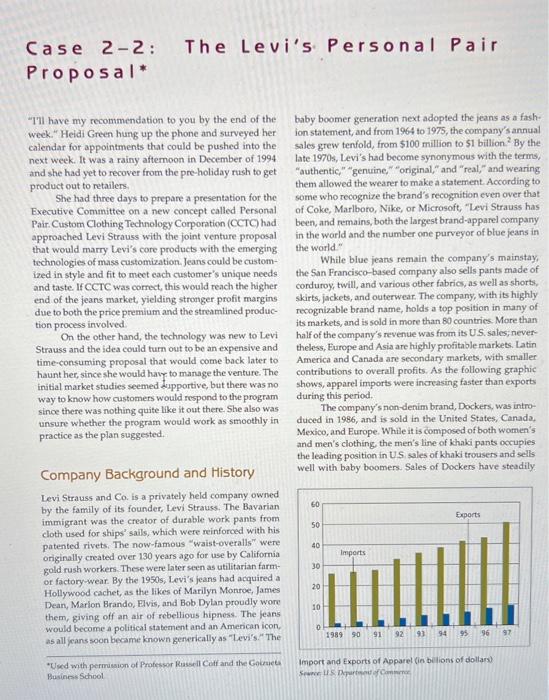
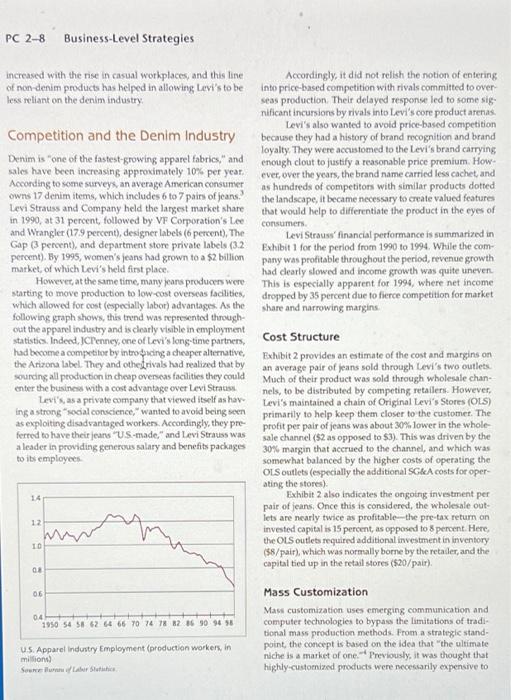
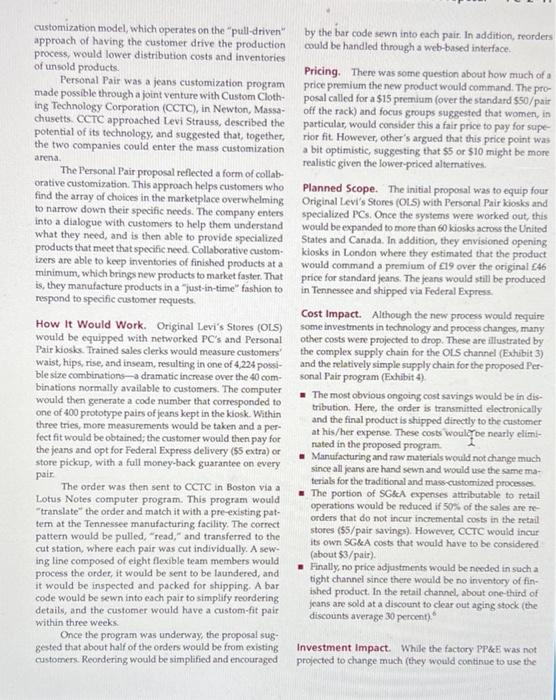
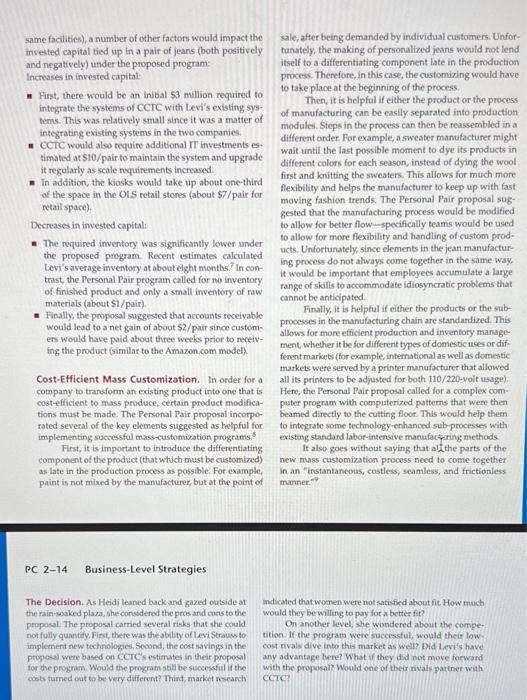
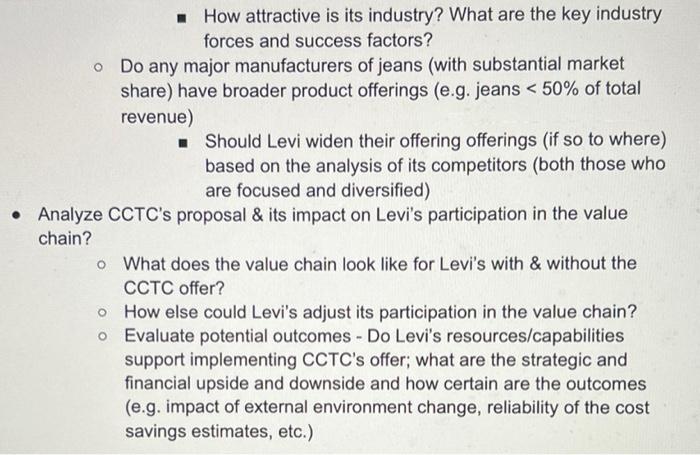
The Levi's Personal Pair Case 2-2: Proposal * "11 have my recommendation to you by the end of the baby boomer generation next adopted the jeans as a fash week." Heidi Green hung up the phone and surveyed her ion statement, and from 1964 to 1975, the company's annual calendar for appointments that could be pushed into the sales grew tenfold, from $100 million to $1 billionBy the next week. It was a rainy afternoon in December of 1994 late 1970s, Levi's had become synonymous with the terms, and she had yet to recover from the pre-holiday rush to get "authentic" "genuine" "original," and "real," and wearing product out to retailers them allowed the wearer to make a statement. According to She had three days to prepare a presentation for the some who recognize the brand's recognition even over that Executive Committee on a new concept called Personal of Coke, Marlboro, Nike, or Microsoft, "Levi Strauss has Pair. Custom Clothing Technology Corporation (CCTC) had been, and remains, both the largest brand-apparel company approached Levi Strauss with the joint venture proposal in the world and the number one purveyor of blue jeans in that would marry Levi's core products with the emerging the world." technologies of mass customization Jeans could be custom- While blue jeans remain the company's mainstay, ized in style and fit to meet each customer's unique needs the San Francisco-based company also sells pants made of and taste. If CCTC was correct, this would reach the higher corduroy, twill, and various other fabrics, as well as shorts, end of the jeans market yielding stronger profit margins skirts, jackets, and outerwear. The company, with its highly due to both the price premium and the streamlined produce recognizable brand name, holds a top position in many of tion process involved its markets, and is sold in more than 80 countries. More than On the other hand, the technology was new to Levi half of the company's revenue was from its US sales, never Strauss and the idea could turn out to be an expensive and theless, Europe and Asia are highly profitable markets. Latin time-consuming proposal that would come back later to America and Canada are secondary markets, with smaller haunt her, since she would have to manage the venture. The contributions to overall profits. As the following graphic initial market studies seemed Supportive, but there was no shows, apparel imports were increasing faster than exports way to know how customers would respond to the program during this period. since there was nothing quite like it out there. She also was The company's non-denim brand, Dockers, was intro- unsure whether the program would work as smoothly in duced in 1986, and is sold in the United States, Canada, practice as the plan suggested. Mexico, and Europe. While it is composed of both women's and men's clothing, the men's line of khaki pants occupies the leading position in US sales of khaki trousers and sells Company Background and History well with baby boomers. Sales of Dockers have steadily Levi Strauss and Co. is a privately held company owned by the family of its founder, Levi Strauss, The Bavarian 60 immigrant was the creator of durable work pants from Exports cloth used for ships' sails, which were reinforced with his patented rivets. The now-famous "waist-overalls" were originally created over 130 years ago for use by California Imports gold rush workers. These were later seen as utilitarian farm- or factory wear. By the 1950s, Levi's jeans had acquired a Hollywood cachet, as the likes of Marilyn Monroe, James Dean, Marlon Brando, Elvis, and Bob Dylan proudly wore them, giving off an air of rebellious hipness. The jeans would become a political statement and an American icon, as all yoans soon became known generically as "Levi's." The 1989 90 91 92 93 94 95 36 50 40 30 20 10 97 *Used with permission of Professor Russell Coff and the Gore Business School Import and Exports of Apparel (in bilions of dollars) SC PC 2-8 Business-Level Strategies increased with the rise in casual workplaces, and this line Accordingly, it did not relish the notion of entering of non-denim products has helped in allowing Levi's to be Into price-based competition with rivals committed to over less reliant on the denim industry seas production. Their delayed response led to some sig nificant incursions by rivals into Levi's core product arenas . Levi's also wanted to avoid price-based competition Competition and the Denim Industry because they had a history of brand recognition and brand loyalty. They were accustomed to the Levi's brand carrying Denim is one of the fastest growing apparel fabrics," and enough clout to justify a reasonable price premium How sales have been increasing approximately 10% per year. ever, over the years, the brand name carried less cachet and According to some surveys, an average American consumer as hundreds of competitors with similar products dotted owns 17 denim items, which includes 6 to 7 pairs of jeans. the landscape, it became necessary to create valued features Levi Strauss and Company held the largest market share in 1990, at 31 percent, followed by VF Corporation's Lee that would help to differentiate the product in the eyes of consumers and Wrangler (17.9 percent), designer labels (6 percent), The Levi Strauss' financial performance is summarized in Gap (3 percent), and department store private labels (3.2 Exhibit 1 for the period from 1990 to 1994. While the com percent). By 1995, women's jeans had grown to a $2 billion pany was profitable throughout the period, revenue growth market, of which Levi's held first place had clearly slowed and income growth was quite uneven However, at the same time, many jeans producers were This is especially apparent for 1994, where net income starting to move production to low-cost overseas facilities, which allowed for cost (especially labot) advantages. As the dropped by 35 percent due to fierce competition for market share and narrowing margins. following graph shows, this trend was represented through out the apparel industry and is clearly visible in employment statistics. Indeed, Cenney, one of Levi's long-time partners, Cost Structure had become a competitor by introducing a cheaper alternative, Exhibit 2 provides an estimate of the cost and margins on the Arizona label. They and otherivals had realized that by an average pair of jeans sold through Levi's two outlets sourcing all production in cheap overseas facilities they could Much of their product was sold through wholesale chan enter the business with a cost advantage over Levi Stratas nels, to be distributed by competing retailers. However, Levi's, as a private company that viewed itself as hay Levi's maintained a chain of Original Levi's Stores (OLS) ing a strong social conscience," wanted to avoid being seen primarily to help keep them closer to the customer. The as exploiting disadvantaged workers. Accordingly, they pre profit per pair of jeans was about 30% lower in the whole ferred to have their jeans "US-made," and Levi Strauss was sale channel (52 as opposed to 53). This was driven by the a leader in providing generous salary and benefits packages 30% margin that accrued to the channel, and which was to its employees somewhat balanced by the higher costs of operating the OLS outlets (especially the additional SG&A costs for oper- ating the stores) Exhibit 2 also indicates the ongoing investment per pair of jeans. Once this is considered the wholesale out- 12 lets are nearly twice as profitable the pre-tax return on invested capital is 15 percent, as opposed to 8 percent. Here, the OLS outlets required additional investment in inventory ($8/pair), which was normally borne by the reader, and the capital tied up in the retail stores (520/pair), Mass Customization Mass customization uses emerging communication and 04 1950 54 58 62 66 66 70 74 78 82 86 90 94 58 computer technologies to bypass the limitations of tradi tional mass production methods. From a strategic stand- U.S. Apparel Industry Employment (production workers in point, the concept is based on the idea that "the ultimate millions) niche is a market of one. * Previously, it was thought that Sena State highly customized products were necessarily expensive to 14 10 08 06 customization model, which operates on the "pull-driven" by the bar code sewn into each pair. In addition, reorders approach of having the customer drive the production could be handled through a web based interface. process, would lower distribution costs and inventories of unsold products Pricing. There was some question about how much of a Personal Pair was a jeans customization program price premium the new product would command. The pro- made possible through a joint venture with Custom Cloth- posal called for a $15 premium (over the standard 550/pair ing Technology Corporation (CCTC), in Newton, Massa- off the rack) and focus groups suggested that women, in chusetts CCTC approached Levi Strauss, described the particular, would consider this a fair price to pay for supe potential of its technology, and suggested that, together, rior fit. However, other's argued that this price point was the two companies could enter the mass customization a bit optimistic suggesting that $5 or $10 might be more arena The l'ersonal Pair proposal reflected a form of collab- realistic given the lower-priced alternatives. orative customization. This approach helps customers who Planned Scope. The initial proposal was to equip four find the array of choices in the marketplace overwhelming Original Levi's Stores (OLS) with Personal Pair kiosks and to narrow down their specific needs. The company enters specialized PCs. Once the systems were worked out, this into a dialogue with customers to help them understand would be expanded to more than 60 kiosks across the United what they need, and is then able to provide specialized States and Canada. In addition, they envisioned opening products that meet that specific need. Collaborative custom kiosks in London where they estimated that the product izers are able to keep inventories of finished products at a would command a premium of 19 over the original 46 minimum, which brings new products to market faster. That price for standard jeans. The jeans would still be produced is, they manufacture products in a "Just-in-time" fashion to in Tennessee and shipped via Federal Express respond to specific customer requests Cost Impact. Although the new process would require How It Would work. Original Levi's Stores (OLS) some investments in technology and process changes, many would be equipped with networked PC's and Personal other costs were projected to drop. These are illustrated by Pair kiosks. Trained sales clerks would measure customers' the complex supply chain for the OLS channel (Exhibit 3) waist, hips, rise, and inseam, resulting in one of 4,224 possi- and the relatively simple supply chain for the proposed Per- ble size combinations-a dramatic increase over the 40 com- sonal Pair program (Exhibit 4) binations normally available to customers. The computer would then generate a code number that corresponded to The most obvious ongoing cost savings would be in dis- tribution. Here, the order is transmitted electronically one of 400 prototype pairs of jeans kept in the kiosk. Within and the final product is shipped directly to the customer three tries, more measurements would be taken and a per fect fit would be obtained the customer would then pay for at his/her expense. These costs woulerbe nearly elimi- nated in the proposed program the jeans and opt for Federal Express delivery (55 extra) or Manufacturing and raw materials would not change much store pickup, with a full money back guarantee on every since all jeans are hand sewn and would use the same ma pair terials for the traditional and mass-customized processes The order was then sent to CCTC in Boston via a The portion of SG&A expenses attributable to retail Lotus Notes computer program. This program would operations would be reduced if 50% of the sales are re translate" the order and match it with a pre-existing pat- orders that do not incur incremental costs in the retail tem at the Tennessee manufacturing facility. The correct stores (55/pair savings). However, CCTC would incur pattern would be pulled "read," and transferred to the its own SG&A costs that would have to be considered cut station, where each pair was cut individually. A sew. (about $3/pair) ing line composed of eight flexible team members would Finally, no ptice adjustments would be needed in such a process the order, it would be sent to be laundered, and tight channel since there would be no inventory of fin it would be inspected and packed for shipping A bar ished product. In the retail channel, about one-third of code would be sewn into each pair to simplify reordering jeans are sold at a discount to clear out aging stock (the details, and the customer would have a custom-fit pair discounts average 30 percent). within three weeks Once the program was underway, the proposal sugo gested that about half of the orders would be from existing Investment impact. While the factory PP& was not customers. Reordering would be simplified and encouraged projected to change much (they would continue to use the same facilities), a number of other factors would impact the invested capital tied up in a pair of jeans (both positively and negatively) under the proposed program Increases in invested capital: First, there would be an initial s3 million required to integrate the systems of CCTC with Levi's existing sys- tems. This was relatively small since it was a matter of integrating existing systems in the two companies CCTC would also require additional IT investments es. timated at $10/pair to maintain the system and upgrade it regularly as scale requirements increased In addition, the kiosks would take up about one-third of the space in the OLS retail stores (about $7/pair for metall space) Decreases in invested capital The required inventory was significantly lower under the proposed program. Recent estimates calculated Levi's average inventory at about eight months. In con trast, the Personal Pair program called for no inventory of finished product and only a small inventory of raw materials (about $1/pair) Finally, the proposal suggested that accounts receivable would lead to a net gain of about $2/pair since custom- ers would have paid about three weeks prior to receiv- ing the product (similar to the Amazon.com model) sale, after being demanded by individual customers. Unfor tunately, the making of personalized jeans would not lend itself to a differentiating component late in the production process. Therefore, in this case, the customizing would have to take place at the beginning of the process Then, it is helpful if either the product or the process of manufacturing can be easily separated into production modules Steps in the process can then be reassembled in a different order. For example, a sweater manufacturer might wait until the last possible moment to dye its products in different colors for each season, instead of dying the wool first and knitting the sweaters. This allows for much more flexibility and helps the manufacturer to keep up with fast moving fashion trends. The Personal Pair proposal sug- gested that the manufacturing process would be modified to allow for better flow-specifically teams would be used to allow for more flexibility and handling of custom prod- ucts. Unfortunately, since elements in the jean manufactur- ing process do not always come together in the same way, it would be important that employees accumulate a large range of skills to accommodate idiosyncratic problems that cannot be anticipated Finally, it is helpful if either the products or the sub- processes in the manufacturing chain are standardized. This allows for more efficient production and inventory manage- ment, whether it be for different types of domestic uses or dif- ferent markets (for example, international as well as domestic markets were served by a printer manufacturer that allowed all its printers to be adjusted for both 110/220-volt usage). Here, the Personal Pair proposal called for a complex com- puter program with computerized patterns that were then beamed directly to the cutting floor. This would help them to integrate some technology enhanced sub-processes with existing standard labor-intensive manufacering methods It also goes without saying that all the parts of the new mass customization process need to come together In an instantaneous, costless, seamless, and frictionless Cost-Efficient Mass Customization. In order for a company to transform an existing product into one that is cost-efficient to mass produce, certain product modifica- tions must be made. The Personal Pair proposal incorpo- rated several of the key elements suggested as helpful for implementing successful mass-customization programs. First, it is important to introduce the differentiating component of the product (that which must be customized) as late in the production process as possible. For example, paint is not mixed by the manufacturer, but at the point of manner PC 2-14 Business-Level Strategies The Decision. As Heidi leaned back and gazed outside at the rain-soaked plaza, se considered the pros and cons to the proposal. The proposal carried several risks that she could not fully quantify. First, there was the ability of levi Strauss to implement new technologies. Second, the cost savings in the proposal were based on CCTC's estimates in their proposal for the program. Would the program still be successful if the costs turned out to be very different? Third, market research indicated that women were not satisfied about fit. How much would they be willing to pay for a better fit? On another level, she wondered about the compe- tition. If the program were successful, would their low cost rivals dive into this market as well? Did Levi's have any advantage here? What if they did not move forward with the proposal Would one of their rivals partner with CCTC How attractive is its industry? What are the key industry forces and success factors? Do any major manufacturers of jeans (with substantial market share) have broader product offerings (e.g. jeans
Case 2-2: The Levi's Personal Pair Proposal "I'll have my recommendation to you by the end of the week." Heidi Green hung up the phone and surveyed her calendar for appointments that could be pushed into the next week. It was a rainy afternoon in December of 1994 and she had yet to recover from the pre-holiday rush to get product out to retailers. She had three days to prepare a presentation for the Executive Committee on a new concept called Personal Pair. Custom Clothing Technology Corporation (CCTC) had approached Levi Strauss with the joint venture proposal that would marry Levi's core products with the emerging technologies of mass customization. Jeans could be custom- ized in style and fit to meet each customer's unique needs and taste. If CCTC was correct, this would reach the higher end of the jeans market, yielding stronger profit margins due to both the price premium and the streamlined produc tion process involved. On the other hand, the technology was new to Levi Strauss and the idea could turn out to be an expensive and time-consuming proposal that would come back later to haunt her, since she would have to manage the venture. The initial market studies seemed dupportive, but there was no way to know how customers would respond to the program since there was nothing quite like it out there. She also was unsure whether the program would work as smoothly in practice as the plan suggested. Company Background and History Levi Strauss and Co. is a privately held company owned by the family of its founder, Levi Strauss. The Bavarian immigrant was the creator of durable work pants from cloth used for ships' sails, which were reinforced with his patented rivets. The now-famous "waist-overalls" were originally created over 130 years ago for use by California gold rush workers. These were later seen as utilitarian farm- or factory-wear. By the 1950s, Levi's jeans had acquired a Hollywood cachet, as the likes of Marilyn Monroe, James Dean, Marlon Brando, Elvis, and Bob Dylan proudly wore them, giving off an air of rebellious hipness. The jeans would become a political statement and an American icon, as all jeans soon became known generically as "Levi's." The "Used with permission of Professor Russell Coff and the Goizueta Business School baby boomer generation next adopted the jeans as a fash- ion statement, and from 1964 to 1975, the company's annual sales grew tenfold, from $100 million to $1 billion. By the late 1970s, Levi's had become synonymous with the terms, "authentic," "genuine," "original," and "real," and wearing them allowed the wearer to make a statement. According to some who recognize the brand's recognition even over that of Coke, Marlboro, Nike, or Microsoft, "Levi Strauss has been, and remains, both the largest brand-apparel company in the world and the number one purveyor of blue jeans in the world." While blue jeans remain the company's mainstay, the San Francisco-based company also sells pants made of corduroy, twill, and various other fabrics, as well as shorts, skirts, jackets, and outerwear. The company, with its highly recognizable brand name, holds a top position in many of its markets, and is sold in more than 80 countries. More than half of the company's revenue was from its US. sales; never- theless, Europe and Asia are highly profitable markets. Latin America and Canada are secondary markets, with smaller. contributions to overall profits. As the following graphic shows, apparel imports were increasing faster than exports during this period. The company's non-denim brand, Dockers, was intro- duced in 1986, and is sold in the United States, Canada, Mexico, and Europe. While it is composed of both women's and men's clothing, the men's line of khaki pants occupies the leading position in US sales of khaki trousers and sells well with baby boomers. Sales of Dockers have steadily 60 50 40 Imports 30 20 10 Exports 1989 90 91 92 93 94 95 96 Import and Exports of Apparel (in billions of dollars) Serce 115 Departmed of Co 97
Step by Step Solution
There are 3 Steps involved in it
1 Expert Approved Answer
Step: 1 Unlock
Question Has Been Solved by an Expert!
Get step-by-step solutions from verified subject matter experts
Step: 2 Unlock
Step: 3 Unlock
Students Have Also Explored These Related General Management Questions!