







Question: Case 3 - 3 The fall casual fashions include. She knows that for the next month, she has ordered 4 5 , 0 0 0
Case The fall casual fashions include.
She knows that for the next month, she has ordered
yards of wool, yards of acetate, yards of cashmere,
yards of silk, yards of rayon, yards of vel
vet, and yards of cotton for production. The prices of the
materials are listed below. Any material that is not used in production can be sent back
to the textile wholesaler for a full refund, although scrap mate
rial cannot be sent back to the wholesaler.
She knows that the production of both the silk blouse and cot
ton sweater leaves leftover scraps of material. Specifically, for
the production of one silk blouse or one cotton sweater, yards
of silk and cotton, respectively, are needed. From these yards,
yards are used for the silk blouse or the cotton sweater and
yard is left as scrap material. She does not want to waste the
material, so she plans to use the rectangular scrap of silk or cot
ton to produce a silk camisole or cotton miniskirt, respectively.
Therefore, whenever a silk blouse is produced, a silk camisole is
also produced. Likewise, whenever a cotton sweater is produced,
a cotton miniskirt is also produced. Note that it is possible to
produce a silk camisole without producing a silk blouse and a
cotton miniskirt without producing a cotton sweater.
The demand forecasts indicate that some items have lim
ited demand. Specifically, because the velvet pants and velvet
shirts are fashion fads, TrendLines has forecasted that it can
sell only pairs of velvet pants and velvet shirts.
TrendLines does not want to produce more than the forecasted
demand because once the pants and shirts go out of style, thecompany cannot sell them. TrendLines can produce less than the
forecasted demand, however, since the company is not required
to meet the demand. The cashmere sweater also has limited
demand because it is quite expensive, and TrendLines knows it
can sell at most cashmere sweaters. The silk blouses and
camisoles have limited demand because many women think silk
is too hard to care for, and TrendLines projects that it can sell at
most silk blouses and silk camisoles.
The demand forecasts also indicate that the wool slacks,
tailored skirts, and wool blazers have a great demand because
they are basic items needed in every professional wardrobe.
Specifically, the demand is pairs of wool slacks and
wool blazers. Katherine wants to meet at least percent of the
demand for these two items to maintain her loyal customer base
and not lose business in the future. Although the demand for
t
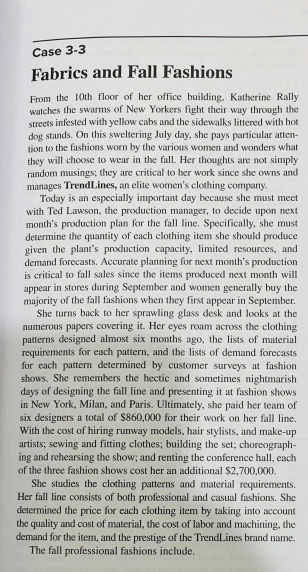
Fabrics and Fall Fashions
From the th floor of her office building, Katherine Rally
watches the swarms of New Yorkers fight their way through the
streets infested with yellow cabs and the sidewalks littered with hot
dog stands. On this sweltering July day, she pays particular atten
tion to the fashions worn by the various women and wonders what
they will choose to wear in the fall. Her thoughts are not simply
random musings; they are critical to her work since she owns and
manages TrendLines, an elite women's clothing company.
Today is an especially important day because she must meet
with Ted Lawson, the production manager, to decide upon next
month's production plan for the fall line. Specifically, she must
determine the quantity of each clothing item she should produce
given the plant's production capacity, limited resources, and
demand forecasts. Accurate planning for next month's production
is critical to fall sales since the items produced next month will
appear in stores during September and women generally buy the
majority of the fall fashions when they first appear in September.
She turns back to her sprawling glass desk and looks at the
numerous papers covering it Her eyes roam across the clothing
patterns designed almost six months ago, the lists of material
requirements for each pattern, and the lists of demand forecasts
for each pattern determined by customer surveys at fashion
shows. She remembers the hectic and sometimes nightmarish
days of designing the fall line and presenting it at fashion shows
in New York, Milan, and Paris. Ultimately, she paid her team of
six designers a total of $ for their work on her fall line.
With the cost of hiring runway models, hair stylists, and makeup
artists; sewing and fitting clothes; building the set; choreograph
ing and rehearsing the show; and renting the conference hall, each
of the three fashion shows cost her an additional $
She studies the clothing patterns and material requirements.
Her fall line consists of both professional and casual fashions. She
determined the price for each clothing item by taking into account
the quality and cost of material, the cost of labor and machining, the
demand for the item, and the prestige of the TrendLines brand name.
Step by Step Solution
There are 3 Steps involved in it
1 Expert Approved Answer
Step: 1 Unlock

Question Has Been Solved by an Expert!
Get step-by-step solutions from verified subject matter experts
Step: 2 Unlock
Step: 3 Unlock
 Study Help