







Question: Case 3 -- Line Balancing Quality Technology (QT), Inc. was founded by two first-year college students to produce a knockoff real estate board game similar
Case 3 -- Line Balancing
Quality Technology (QT), Inc. was founded by two first-year college students to produce a knockoff real estate board game similar to the popular Parker Brothers game Monopoly. Initially, the partners started the company just to produce a board game based in popular local landmarks in their small college town, as a way to help pay for their college expenses. However, the game was a big success and because they enjoyed running their own business, they decided to pursue the business full-time after graduation.
QT has grown rapidly over the last couple of years, designing and producing custom real estate trading games for universities, municipalities, chambers of commerce, and lately even some businesses. Orders range from a couple of hundred games to an occasional order for several thousand.
QTs orders are either for a new game board that has not been produced before, or a repeat orders for a game that was previously produced. If the order is for a new game, the client first meets with a graphic designer from QTs art department and the actual game board is designed. The design of the board can take anywhere from a few hours to several weeks, depending on how much the client has thought about the game before the meeting. All design work is done on personal computers.
After the design is approved by the client, a copy of the computer file containing the design is transferred electronically to the printing department. Workers in the printing department load the file onto their own personal computers and print out the board design on special decals, 19.25 inches by 19.25 inches, using high-quality color inkjet printers. The side of the decal that is printed on is usually light gray, and the other side contains on adhesive that is covered by a removable backing.
The printing department is also responsible for printing the property cards, game cards, and money. The money is printed on colored paper using standard laser printers. Ten copies of a particular denomination are printed on each 8.5-inch by 11-inch piece of paper. The money is then moved to the cutting department, where it is then cut into individual bills. The property cards and game cards are produced similarly, the major difference being that they are printed on material resembling poster board.
In addition to cutting the money, game cards, and property cards, the cutting department also cuts the cardboard that serves as the substrate for the actual game board. The game board consists of two boards created by cutting a single 19-inch by 19.25 inch piece of cardboard in half, yielding two boards each measuring 19.25 inches by 19.5 inches. After being cut, game boards, money, and cards are stored in totes in a work-in-process area and delivered to the appropriate station on the assembly line as needed.
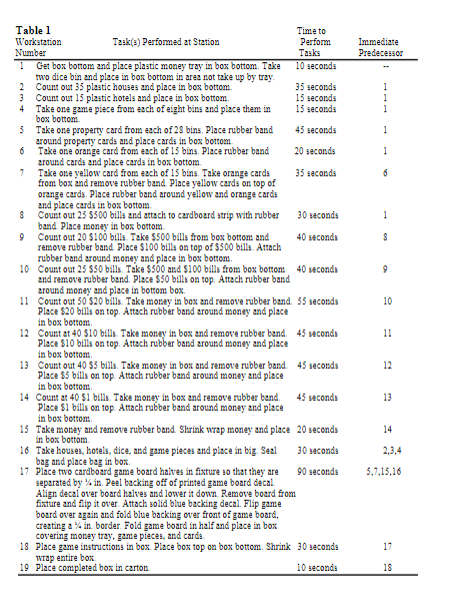
Because of its explosive growth, QTs assembly line was never formally planned. It simply evolved into the 19 stations shown in Table 1.
Questions
- What type(s) of process strategy (i.e., transformation system(s)), does QT use?
- What is the cycle time of the 19-stations line? What is its efficiency?
- What is the lines maximum capacity per day, assuming that it is operated for one 8-hours shift less two 15-minute breaks? Assuming that QT operates 200 days per year, what is its annual capacity?
- Assign tasks to workstations according to the "greatest number of following tasks" approach.
- Calculate the efficiency of the new process
Step by Step Solution
There are 3 Steps involved in it

Get step-by-step solutions from verified subject matter experts
 Study Help