







Question: Case 9 . 2 Whitbread World Sailboat Race Each year countries enter their sailing vessels in the nine - month Round the World Whitbread Sailboat
Case
Whitbread World Sailboat Race
Each year countries enter their sailing vessels in the ninemonth Round the World Whitbread Sailboat Race. In recent years, about countries entered sailboats in the race. Each year's sailboat entries represent the latest technologies and human skills each country can muster.
Bjorn Ericksen has been selected as a project manager because of his past experience as a master helmsman and because of his recent fame as the "best designer of racing sailboats in the world." Bjorn is pleased and proud to have the opportunity to design, build, test, and train the crew for next year's Whitbread entry for his country. Bjorn has picked Karin Knutsen as chief design engineer and Trygve Wallvik as master helmsman to be team leaders responsible for getting next year's entry ready for the traditional parade of all entries on the Thames River in the United Kingdom, which signals the start of the race.
As Bjorn begins to think of a project plan, he sees two parallel paths running through the projectdesign and construction and crew training. Last year's boat will be used for training until the new entry can have the crew on board to learn maintenance tasks. Bjorn calls Karin and Trygve together to develop a project plan. All three agree the major goal is to have a winning boat and crew ready to compete in next year's competition at a cost of $ million. A check of Bjorn's calendar indicates he has weeks before next year's vessel must leave port for the United Kingdom to start the race.
THE KICKOFF MEETING
Bjorn asks Karin to begin by describing the major activities and the sequence required to design, construct, and test the boat. Karin starts by noting that design of the hull, deck, mast, and accessories should only take six weeks given the design prints from past race entries and a few prints from other countries' entries. After the design is complete, the hull can be constructed, the mast ordered, sails ordered, and accessories ordered. The hull will require weeks to complete. The mast can be ordered and will require a lead time of eight weeks; the seven sails can be ordered and will take six weeks to get; accessories can be ordered and will take weeks to receive. As soon as the hull is finished, the ballast tanks can be installed, requiring two weeks. Then the deck can be built, which will require five weeks. Concurrently, the hull can be treated with special sealant and frictionresistance coating, taking three weeks. When the deck is completed and mast and accessories received, the mast and sails can be installed, requiring two weeks; the accessories can be installed, which will take six weeks. When all of these activities have been completed, the ship can be seatested, which should take five weeks. Karin believes she can have firm cost estimates for the boat in about two weeks.
Trygve believes he can start selecting the man or woman crew and securing their housing immediately. He believes it will take six weeks to get a committed crew onsite and three weeks to secure housing for the crew members. Trygve reminds Bjorn that last
year's vessel must be ready to use for training the moment the crew is onsite until the new vessel is ready for testing. Keeping the old vessel operating will cost $ per week as long as it is used. Once the crew is onsite and housed, they can develop and implement a routine sailing and maintenance training program, which will take weeks using the old vessel Also, once the crew is selected and onsite, crew equipment can be selected, taking only two weeks. Then crew equipment can be ordered; it will take five weeks to arrive. When the crew equipment and maintenance training program are complete, crew maintenance on the new vessel can begin; this should take weeks. But crew maintenance on the new vessel cannot begin until the deck is complete and the mast, sails, and accessories have arrived. Once crew maintenance on the new vessel begins, the new vessel will cost $ per week until sea training is complete. After the new ship maintenance is complete and while the boat is being tested, initial sailing training can be implemented; training should take seven weeks. Finally, after the boat is tested and initial training is complete, regular sea training can be implementedweather permitting; regular sea training requires eight weeks. Trygve believes he can put the cost estimates together in a week, given last year's expenses.
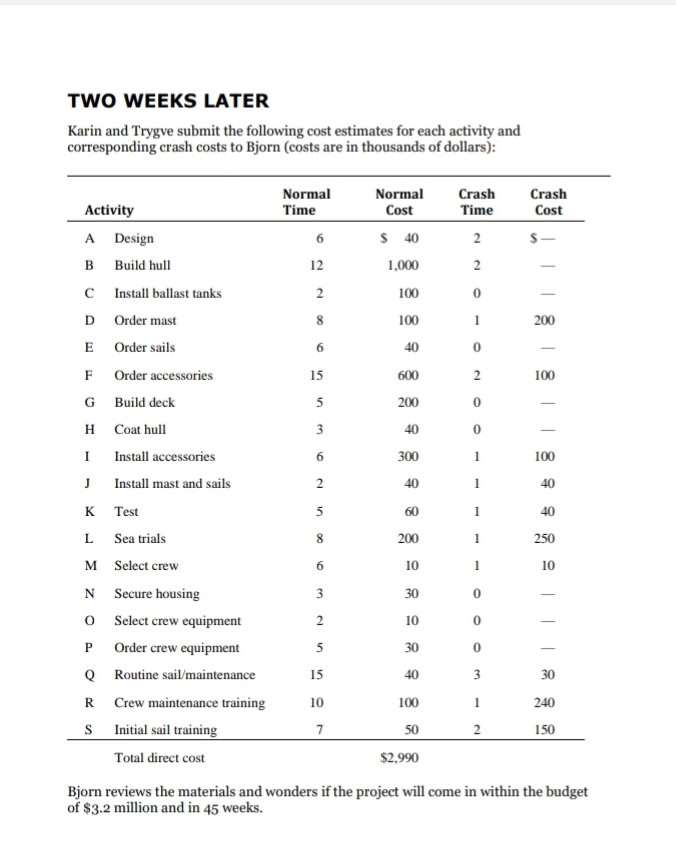
Bjorn is pleased with the expertise displayed by his team leaders. But he believes they need to have someone develop one of those critical path networks to see if they can safely meet the start deadline for the race. Karin and Trygve agree. Karin suggests the cost estimates should also include crash costs for any activities that can be compressed and the resultant costs for crashing. Karin also suggests the
Step by Step Solution
There are 3 Steps involved in it
1 Expert Approved Answer
Step: 1 Unlock

Question Has Been Solved by an Expert!
Get step-by-step solutions from verified subject matter experts
Step: 2 Unlock
Step: 3 Unlock
 Study Help