







Question: Case Analysis 2 - Auditing, Attitudes and Absenteeism Read case, Auditing, Attitudes and Absenteeism, and answer the following questions with reference. Answer and submit the
Case Analysis 2 - "Auditing, Attitudes and Absenteeism"
Read case, "Auditing, Attitudes and Absenteeism", and answer the following questions with reference.
Answer and submit the following questions.
Using the Big 5 Personality Model, assess Peter's personality.
1. Which of the big five personality traits does Peter exhibit? Identify at least two.
2. How does Peter rank on each trait? High or low?
3. What aspects of the case lead you to make the assessment that you did above? That is, why did you rank Peter as high or low on those particular traits?
Describe and assess the organizational culture at the audit firm.
1. Describe the organization culture using the seven primary characteristics of an organizational culture on page 348 of your textbook. Use as many of the characteristics as are applicable.
2. Does the firm work to create an ethical cultural climate? What aspects of the case help you to make an assessment of the cultural climate? Reference pages 351-353 of your textbook.
3. What steps do you think that management could or should take to change the corporate culture at the firm?
Consider the ethical dimensions of Peter's behaviour, and the silence of the employees under Peter's supervision (direct reports).
1. Why do you think that Peter's direct reports kept quiet about the "work from home" directive for as long as they did?.
2. From the perspective of Peter's direct reports, was the decision to speak up ethical?
3. How do the four ethical decision-making criteria apply to the decision to speak up about the "work from home" directive?
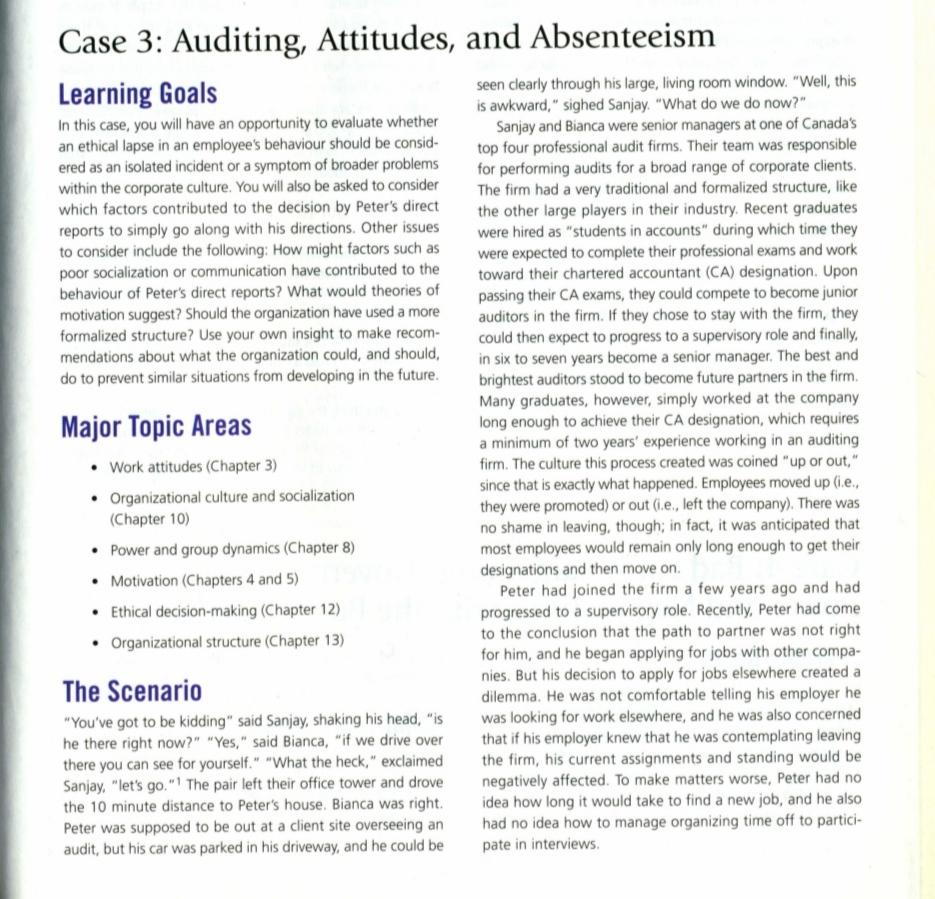
Case 3: Auditing, Attitudes, and Absenteeism Learning Goals seen clearly through his large, living room window. "Well, this In this case, you will have an opportunity to evaluate whether is awkward," sighed Sanjay. "What do we do now? an ethical lapse in an employee's behaviour should be consid- top four professional audit firms. Their team was responsible ered as an isolated incident or a symptom of broader problems for performing audits for a broad range of corporate clients. within the corporate culture. You will also be asked to consider The firm had a very traditional and formalized structure, like which factors contributed to the decision by Peter's direct the other large players in their industry. Recent graduates reports to simply go along with his directions. Other issues were hired as "students in accounts" during which time they to consider include the following: How might factors such as were expected to complete their professional exams and work poor socialization or communication have contributed to the toward their chartered accountant (CA) designation. Upon behaviour of Peter's direct reports? What would theories of passing their CA exams, they could compete to become junior motivation suggest? Should the organization have used a more auditors in the firm. If they chose to stay with the firm, they formalized structure? Use your own insight to make recom-_ could then expect to progress to a supervisory role and finally, mendations about what the organization could, and should, in six to seven years become a senior manager. The best and do to prevent similar situations from developing in the future. brightest auditors stood to become future partners in the firm. Major Topic Areas Many graduates, however, simply worked at the company long enough to achieve their CA designation, which requires - Work attitudes (Chapter 3) firm. The culture this process created was coined "up or out," - Organizational culture and socialization since that is exactly what happened. Employees moved up (i.e., (Chapter 10) they were promoted) or out (i.e., left the company). There was - Power and group dynamics (Chapter 8) most employees would remain only long enough to get their - Motivation (Chapters 4 and 5) designations and then move on. Peter had joined the firm a few years ago and had - Ethical decision-making (Chapter 12) progressed to a supervisory role. Recently, Peter had come - Organizational structure (Chapter 13) to the conclusion that the path to partner was not right for him, and he began applying for jobs with other compa- The Scenario nies. But his decision to apply for jobs elsewhere created a dilemma. He was not comfortable telling his employer he "You've got to be kidding" said Sanjay, shaking his head, "is _ was looking for work elsewhere, and he was also concerned he there right now?" "Yes," said Bianca, "if we drive over that if his employer knew that he was contemplating leaving there you can see for yourself." "What the heck," exclaimed the firm, his current assignments and standing would be Sanjay, "let's go." " The pair left their office tower and drove negatively affected. To make matters worse, Peter had no the 10 minute distance to Peter's house. Bianca was right. idea how long it would take to find a new job, and he also Peter was supposed to be out at a client site overseeing an had no idea how to manage organizing time off to particiaudit, but his car was parked in his driveway, and he could be pate in interviewsStep by Step Solution
There are 3 Steps involved in it

Get step-by-step solutions from verified subject matter experts
 Study Help