



Question: case analysis: Assessment a. What are my options? b. How does each of my options play out? c. What are the pros and cons? Case
case analysis:
Assessment
a. What are my options?
b. How does each of my options play out?
c. What are the pros and cons?
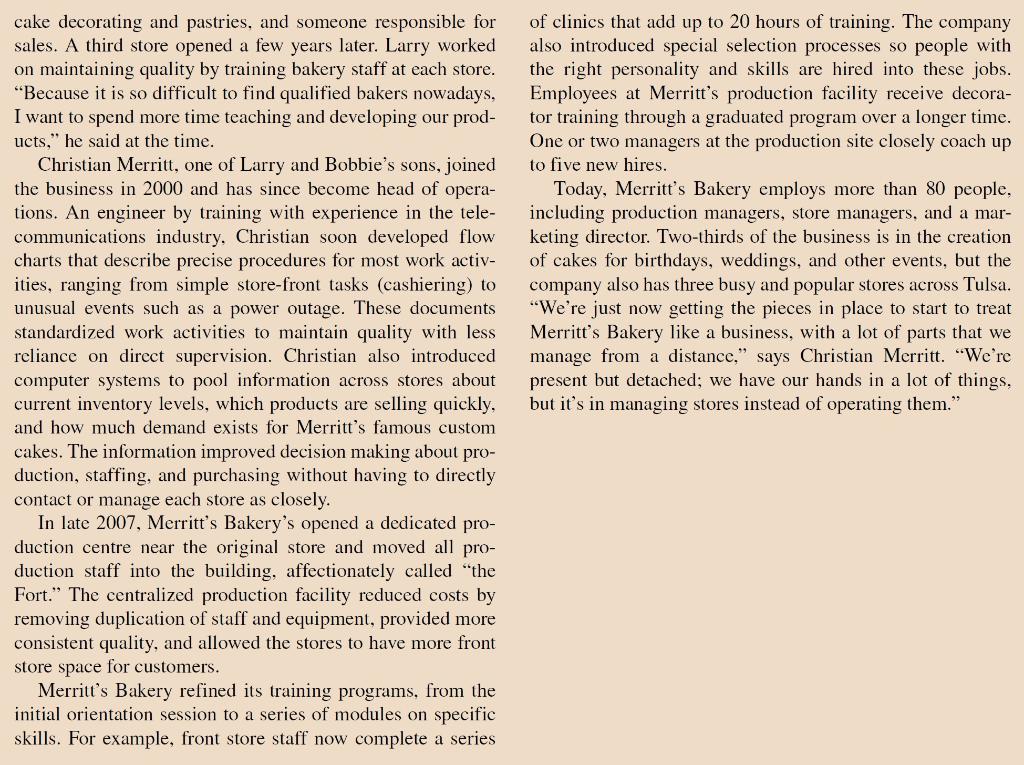
Case Study: MERRITT'S BAKERY by Steven L. McShane, University of Newcastle (Australia) In 1979, Larry Merritt and his wife, Bobbie. bought The Cake Box, a small business located in a tiny 450 square-foot store in Tulsa, Oklahoma. The couple were the only employees. "I would make cakes and Bobbie would come in and deco- rate them," Larry recalls. Bobbie Merritt was already skilled in decorating cakes, whereas baking was a new occupation for Larry Merritt, who previously worked as a discount store manager. So, Larry spent hours pouring over baking books in the local library and testing recipes through trial-and-error experimentation. "I threw away a lot of ingredients that first year," he recalls. Sales were initially slow. Then, a doughnut shop around the corner was put up for sale and its owner made it possi- ble for the Merritts to buy that business. They moved to the larger location and changed the company's name to Merritt's Bakery to reflect the broader variety of products sold. The Merritts hired their first two employees, who performed front store sales and service. Over the next decade. Merritt's Bakery's physical space doubled and its revenues increased 13-fold. The company employed 20 people by the time it made its next move. In 1993, Merritt's Bakery moved to a 6,000 square foot location across the street. The business became so popular that customers were lining up down the street to buy its fresh- baked goods. That looks like success to a lot of people, but that was failure," says Bobbie Merritt. The problem was that the couple didn't want to delegate production to employees, but they couldn't produce their baked goods or decorate their carefully crafted cakes fast enough to keep up with demand. "We felt like failures because we had to work those 20 hours (per day)," she reflects. At some point, the Merritts realized that they had to become business owners and managers rather than bakers. They devised a plan to grow the business and drew up an organizational structure that formalized roles and respon- sibilities. When a second Merritt's Bakery store opened across town in 2001, each store was assigned a manager, a person in charge of baking production, another in charge of cake decorating and pastries, and someone responsible for sales. A third store opened a few years later. Larry worked on maintaining quality by training bakery staff at each store. "Because it is so difficult to find qualified bakers nowadays, I want to spend more time teaching and developing our prod- ucts," he said at the time. Christian Merritt, one of Larry and Bobbie's sons, joined the business in 2000 and has since become head of opera- tions. An engineer by training with experience in the tele- communications industry, Christian soon developed flow charts that describe precise procedures for most work activ- ities, ranging from simple store-front tasks (cashiering) to unusual events such as a power outage. These documents standardized work activities to maintain quality with less reliance on direct supervision. Christian also introduced computer systems to pool information across stores about current inventory levels, which products are selling quickly, and how much demand exists for Merritt's famous custom cakes. The information improved decision making about pro- duction, staffing, and purchasing without having to directly contact or manage each store as closely. In late 2007, Merritt's Bakery's opened a dedicated pro- duction centre near the original store and moved all pro- duction staff into the building, affectionately called the Fort." The centralized production facility reduced costs by removing duplication of staff and equipment, provided more consistent quality, and allowed the stores to have more front store space for customers. Merritt's Bakery refined its training programs, from the initial orientation session to a series of modules on specific skills. For example, front store staff now complete a series a of clinics that add up to 20 hours of training. The company also introduced special selection processes so people with the right personality and skills are hired into these jobs. Employees at Merritt's production facility receive decora- tor training through a graduated program over a longer time. One or two managers at the production site closely coach up to five new hires. Today, Merritt's Bakery employs more than 80 people, including production managers, store managers, and a mar- keting director. Two-thirds of the business is in the creation of cakes for birthdays, weddings, and other events, but the company also has three busy and popular stores across Tulsa. "We're just now getting the pieces in place to start to treat Merritt's Bakery like a business, with a lot of parts that we manage from a distance," says Christian Merritt. "We're present but detached; we have our hands in a lot of things, but it's in managing stores instead of operating themStep by Step Solution
There are 3 Steps involved in it
1 Expert Approved Answer
Step: 1 Unlock

Question Has Been Solved by an Expert!
Get step-by-step solutions from verified subject matter experts
Step: 2 Unlock
Step: 3 Unlock