Question: CASE ANALYSIS MODEL The following represent the steps that you should take in working through your case. Use each of the headings as headings in
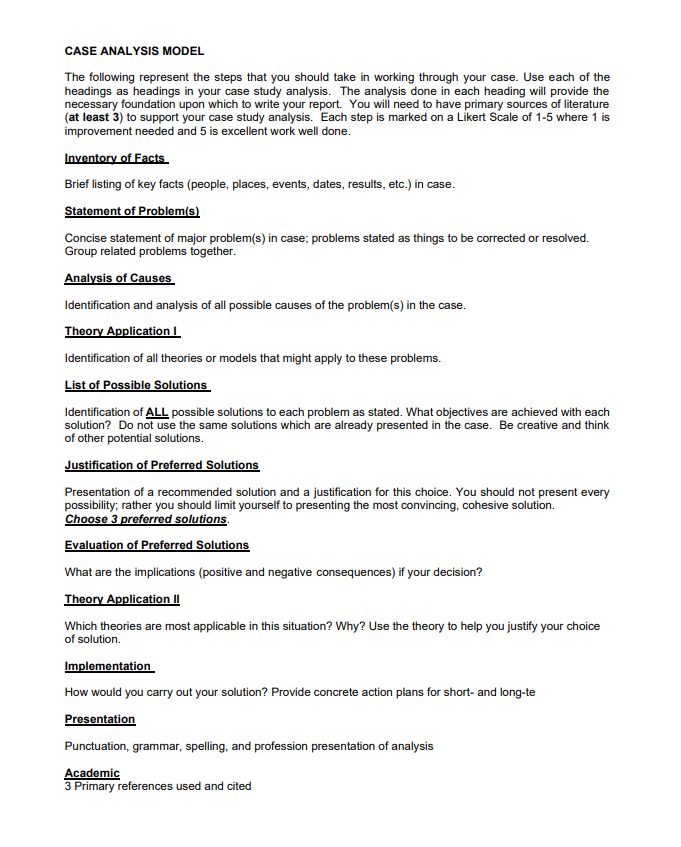
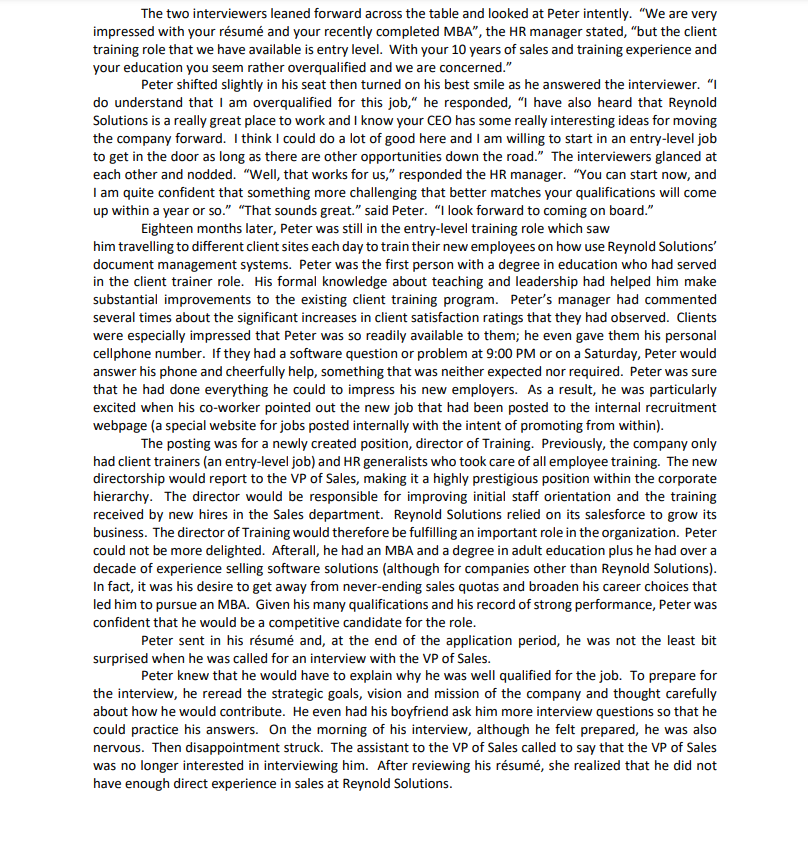

CASE ANALYSIS MODEL The following represent the steps that you should take in working through your case. Use each of the headings as headings in your case study analysis. The analysis done in each heading will provide the necessary foundation upon which to write your report. You will need to have primary sources of literature (at least 3) to support your case study analysis. Each step is marked on a Likert scale of 1-5 where 1 is improvement needed and 5 is excellent work well done. Inventory of Facts Brief listing of key facts (people, places, events, dates, results, etc.) in case. Statement of Problem(s) Concise statement of major problem(s) in case; problems stated as things to be corrected or resolved. Group related problems together. Analysis of Causes Identification and analysis of all possible causes of the problem(s) in the case. Theory Application | Identification of all theories or models that might apply to these problems. List of possible Solutions Identification of ALL possible solutions to each problem as stated. What objectives are achieved with each solution? Do not use the same solutions which are already presented in the case. Be creative and think of other potential solutions. Justification of Preferred Solutions Presentation of a recommended solution and a justification for this choice. You should not present every possibility; rather you should limit yourself to presenting the most convincing, cohesive solution. Choose 3 preferred solutions. Evaluation of Preferred Solutions What are the implications (positive and negative consequences) if your decision? Theory Application II Which theories are most applicable in this situation? Why? Use the theory to help you justify your choice of solution. Implementation How would you carry out your solution? Provide concrete action plans for short- and long-te Presentation Punctuation, grammar, spelling, and profession presentation of analysis Academic 3 Primary references used and cited The two interviewers leaned forward across the table and looked at Peter intently. "We are very impressed with your rsum and your recently completed MBA", the HR manager stated, "but the client training role that we have available is entry level. With your 10 years of sales and training experience and your education you seem rather overqualified and we are concerned." Peter shifted slightly in his seat then turned on his best smile as he answered the interviewer." do understand that I am overqualified for this job," he responded, "I have also heard that Reynold Solutions is a really great place to work and I know your CEO has some really interesting ideas for moving the company forward. I think I could do a lot of good here and I am willing to start in an entry-level job to get in the door as long as there are other opportunities down the road." The interviewers glanced at each other and nodded. "Well, that works for us," responded the HR manager. "You can start now, and I am quite confident that something more challenging that better matches your qualifications will come up within a year or so." "That sounds great." said Peter. "I look forward to coming on board." Eighteen months later, Peter was still in the entry-level training role which saw him travelling to different client sites each day to train their new employees on how use Reynold Solutions' document management systems. Peter was the first person with a degree in education who had served in the client trainer role. His formal knowledge about teaching and leadership had helped him make substantial improvements to the existing client training program. Peter's manager had commented several times about the significant increases in client satisfaction ratings that they had observed. Clients were especially impressed that Peter was so readily available to them; he even gave them his personal cellphone number. If they had a software question or problem at 9:00 PM or on a Saturday, Peter would answer his phone and cheerfully help, something that was neither expected nor required. Peter was sure that he had done everything he could to impress his new employers. As a result, he was particularly excited when his co-worker pointed out the new job that had been posted to the internal recruitment webpage (a special website for jobs posted internally with the intent of promoting from within). The posting was for a newly created position, director of Training. Previously, the company only had client trainers (an entry-level job) and HR generalists who took care of all employee training. The new directorship would report to the VP of Sales, making it a highly prestigious position within the corporate hierarchy. The director would be responsible for improving initial staff orientation and the training received by new hires in the Sales department. Reynold Solutions relied on its salesforce to grow its business. The director of Training would therefore be fulfilling an important role in the organization. Peter could not be more delighted. Afterall, he had an MBA and a degree in adult education plus he had over a decade of experience selling software solutions (although for companies other than Reynold Solutions). In fact, it was his desire to get away from never-ending sales quotas and broaden his career choices that led him to pursue an MBA. Given his many qualifications and his record of strong performance, Peter was confident that he would be a competitive candidate for the role. Peter sent in his rsum and, at the end of the application period, he was not the least bit surprised when he was called for an interview with the VP of Sales. Peter knew that he would have to explain why he was well qualified for the job. To prepare for the interview, he reread the strategic goals, vision and mission of the company and thought carefully about how he would contribute. He even had his boyfriend ask him more interview questions so that he could practice his answers. On the morning of his interview, although he felt prepared, he was also nervous. Then disappointment struck. The assistant to the VP of Sales called to say that the VP of Sales was no longer interested in interviewing him. After reviewing his rsum, she realized that he did not have enough direct experience in sales at Reynold Solutions. Peter was stunned, wondering what on earth had happened. He could not believe that he would not even be given an opportunity to explain why he would be a good candidate for the job. He sent an email to the VP's assistant explaining his qualifications, but the assistant again confirmed that Peter would not be permitted to interview for the job. Ultimately, Peter went home an hour early that day, still distressed and bewildered. At 5:17 PM, his cellphone rang. He saw that it was an important client that had recently purchased an expensive and complex software program from Reynold Solutions. Just days ago, Peter had promised the CEO of the client company that he would be there to answer questions and support their roll-out every step of the way. He again looked at the call display and at the time. He quietly looked away and let the call go to voicemail. The client could wait until Monday









 Study Help