Question: Case Analysis on Andrew Ryan at VC Brakes Problem Statement: What has happened, who cares and why do they care? Analysis: What do you think
Case Analysis on Andrew Ryan at VC Brakes
Problem Statement: What has happened, who cares and why do they care?
Analysis: What do you think has led to the current problem? Why do you believe that to be the case?
Hypothesis 1:
Analysis
Hypothesis 2:
Analysis
Hypothesis 3:
Analysis
Hypothesis 4:
Analysis
Recommendation
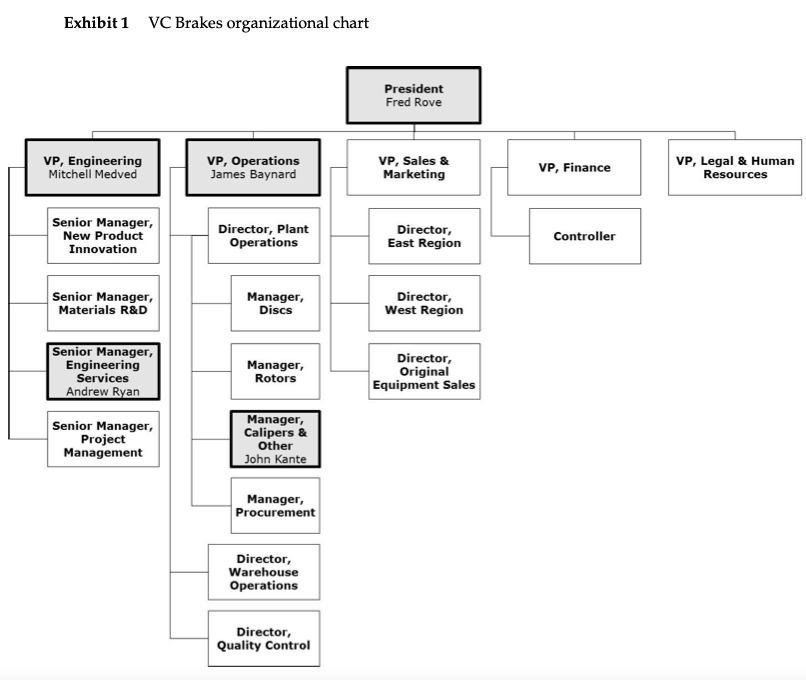
Is HARVARD | BUSINESS SCHOOL BRIEF CASES 9-913-552 FEBRUARY ii, 2013 FRANE . CESPEDES SUNRU YONG Andrew Ryan at VC Brakes Andrew Ryan stared blankly at his laptop. He needed to update his resume, but he had been struggling for the past hour to explain his achievements for the past year. With a sigh, he shut down his computer, knowing that he could not procrastinate indefinitely. He had already warned his wife that he might be fired by VC Brakes, his employer of the last five years. Mitchell Medved, Ryan's boss and mentor, had just been demoted. Once viewed as a potential successor to the CEO, Medved had been relegated to an unpromising position with limited responsibilities. Ryan had some tough choices to make. It was a gloomy way to pass the holiday season. Just ten months earlier, his prospects had seemed much brighter. Medved had selected him for an exciting and challenging new opportunity as one of two instructors for a Total Quality Program that VC Brakes was launching. Ryan had looked forward to helping the broader organization apply management principles that he used with his own team. When he accepted Medved's invitation, he had hoped this initiative could be a crucial step in making necessary changes at VC Brakes. He never imagined that before the end of the year, he would be forced to rethink his future at the company. VC Brakes Background VC Brakes was a manufacturer of automotive brake parts in Middletown, Ohio. It produced aftermarket components for use in passenger and commercial vehicles, selling brake pads, discs, rotors, drums, and calipers. Its customers included major retail chains such as Advance Auto Parts, AutoZone, and Pep Boys. Founded in 1985, VC Brakes had steadily grown its business on the strength of a reputation for quality at a time when U.S. manufacturers were still struggling to match the reliability of their Japanese competitors. In 1998, VC Brakes was acquired by Lantana Industrial, a major automotive parts supplier serving both the Original Equipment (OE) and aftermarket segments.' Established originally as a manufacturer of drive trains, it had grown into a conglomerate that produced everything from steering and suspension systems to electrical systems to seating and interior trim. Lantana Industrial took a hands-off approach to its acquisitions, focusing instead on leveraging its strong relationships with the major automakers and automotive retailers to win new business. In the years following its acquisition, WC Brakes enjoyed rapid growth. This was driven in large part by its success in manufacturing replacement parts for the increasingly popular truck and sports utility vehicle (SUV) segments, which soon accounted for the majority of its revenues. The 2008 financial crisis dealt a nearly crippling blow to the automotive industry. Demand for OE motor vehicle parts fell by nearly 35% as production of new vehicles fell far short of the 10.5 million vehicles estimated to be the breakeven point for the industry. The effect was compounded by the ongoing consumer shift away from \"high-content\" trucks and SUVs to more affordable and fuel- efficient passenger vehicles, which had less value per-vehicle for parts. Historically, a decline in new vehicle sales favored aftermarket manufacturers such as VC Brakes, with owners choosing to keep vehicles longer, thus creating a greater need for replacement parts. However, even aftermarket suppliers saw sales stagnate as vehicle owners deferred repairs or opted for the cheaper, imported parts that had become more widely available. President Obama's Task Force on the Auto Industry directed bailout funds toward saving General Motor and Chrysler, and also set aside a $5 billion Supplier Support Program for Tier 1 manufacturers that directly supplied the \"Big 3\" automakers. Even with government intervention, the industry experienced a significant shakeout. Fifty suppliers filed for Chapter 11 bankruptcy protection and nearly 200 suppliers were liquidated altogether. Ultimately, employment in the U.S. automotive parts industry fell by an estimated 23%, representing nearly 140,000 jobs.* VC Brakes was not immune to the industry turmoil. An expansion in production capacity in 2007 turned out to be poorly timed. Sales stagnated in the subsequent years, particularly due to the company's overexposure to truck and SUV parts, and capacity utilization fell to 65%approximately 10 points below breakeven. As profitability declined sharply, VC Brakes was forced to cut 75 jobs from its workforce of over 700 employees. Making things worse, production challenges, manifested in frequent line stoppages, had led to delayed shipments and the loss of an important contract with a major retailer. The financial crisis also forced Lantana Industrial, its parent company, to reorganize. Lantana had long been criticized by some analysts for being an unwieldy collection of subsidiaries of dubious strategic fit; its performance in the face of the industry's challenges did nothing to prove otherwise. In 2010, it began divesting businesses that it deemed non-core. The following year, VC Brakes was sold to Crossroads Corporation, a global manufacturer of friction systems, supplying automakers, heavy vehicles, and aerospace manufacturers. Organizational Culture and Turnaround of Engineering Services VC Brakes had a reputation for autocratic, top-down management, and both production employees and professional staff felt the company was unresponsive to their concerns. Bickering between departments was common, and a \"finger-pointing\" mentality was pervasive. However, Medved, vice president of engineering, and Ryan's boss and mentor, had worked hard to change this culture within his own department (see Exhibit 1 for an organizational chart of VC Brakes). He encouraged open communication and a participatory approach to problem solving. Medved explained his management philosophy: It's possible to get things done simply through the force of authority. But it's better to get people to think for themselves, take ownership of issues, and solve problems together. It takes more time and it means more listening, but it's worth it. Medved believed his success was reflected in the employee tumover rate, which was significantly lower for the engineering team than for other departments at VC Brakes. Ryan shared Medved's ideas about the right way to manage. After a successful two-year stint as. senior project manager on the materials R&D team, Ryan had been promoted to senior manager of the engineering services (ES) team in early 2010. The ES team was responsible for new product development, but in recent years its productivity suffered from a chaotic design process, poor documentation procedures, and a tendency to mask underperformance by blaming other departments. ES had struggled on its last few projects, and several of its strongest contributors had departed the company in frustration. Taking leadership of this team was Ryan's opportunity to demonstrate that his and Medved''s management philosophy was effective. Given the ES team's recent history, both Medved and Fred Rove, the president of VC Brakes, were concerned specifically about the ceramic composite brakes (CCB) project. ES was starting a new project on its next generation of CCBs, which VC Brakes produced for the aftermarket. Derived from Formula 1 racing technology, CCBs delivered superior braking performance at high speeds and high temperatures. Historically, ceramic composite had only been available on high-end sports cars. In recent years, engineering advances allowed CCB to be introduced in more affordable models of the luxury segment, and it had been adopted by enthusiasts who \"tuned\" their vehicles with aftermarket parts for better driving performance. This trend was expected to continue as falling prices enabled automakers to make the technology more widely available as original equipment. For VC Brakes, as it pivoted away from its SUV aftermarket focus, the CCB product represented an important opportunity to position itself as a potential OE supplier selling directly to automakers. As he stepped into his new role as senior manager of the ES team, Ryan was confident he could lead a turnaround. In addition to his success as a project manager in materials R&D, he had managerial experience at several dot-com start-ups to draw on, and he had invested significant time studying management best practices in books and articles. First, he gathered feedback through one- on-one interviews with each team member. Second, he led the team through a root cause analysis, diagnosing issues from past projects to identify necessary changes. Ryan's approach energized most of the ES team, who appreciated the open discussions and felt that even the input of junior employees mattered. However, one particularly stubborn ES supervisor was resistant to these efforts, and, with Medved's backing, Ryan reassigned the supervisor to another team altogether. The message was clear: Ryan and Medved actively sought everyone's input, but they also expected every member of the team to work together. The results of Ryan's efforts were impressive. The ES team completed the CCB project a full month ahead of schedule. Fewer prototypes were needed in the development process, and the performance of the ceramic composite discs was even better than anticipated. Morale on the ES team was also markedly better. Several of Ryan's peers commented that his enthusiasm and \"open-door\" policy made him a popular leader. Ryan himself felt that his style was effective, particularly with the highly trained engineers who had a tendency to resent managerial intrusion. Reflecting on this success, he said: Transforming the ES team and successfully completing the ceramic composite project had three very important results. First, it demonstrated to the entire company that a different management philosophy could be more effective. Second, it showed senior management that I had the ability to turn teams around and be a change agent. Finally, it proved important to the fate of the business. VC Brakes's capabilities in aftermarket CCBs turned out to be an important part of Crossroads' motivation for acquiring us because they saw the growth potential and the opportunity to become an OE supplier with a highly differentiated product. The TOM Opportunity Unlike Lantana Industrial, Crossroads was an active, hands-on owner and made it clear that it planned to direct how its new subsidiary would be run. In October 2011, Crossroads announced a Total Quality Management (TQM) program that it would execute at all its subsidiaries. The intention was not only to improve product quality and management practices, but also to establish a consistent operational strategy across all of its businesses. The concept of TQM meant moving beyond an understanding of quality merely as conforming to specifications, but defining it in a strategic, customer-centric way. Quality would be determined by present and future customer needs and required a proactive \"zero-defect" and continuous improvement philosophy across all activities. Crossroads set its TOM objectives as follows: To provide product and service quality better than all competitors To be the lowest-cost quality producer To relentlessly pursue quality improvement To manage through leadership To personally involve all employees through participative activity To be comprised of employees who approach the job fearlessly oom he Crossroads wanted each subsidiary to apply a consistent set of quality tools, such as quality circles and systematic supplier evaluation, to every aspect of the business. This would lead to \"quality at the source,\" from initial product design through every subsequent business process. A key element would be empowering employees at all levels to seek out and correct quality problems. For VC Brakes specifically, Crossroads viewed TQM as a necessary step to positioning the company as an attractive OE supplier. To meet the demanding requirements of a major automaker meant adopting a more proactive, customer-focused approach to quality at every step. In early 2012, Crossroads asked each subsidiary to select an executive for the corporate TQM advisory group, as well as TQM site instructors to lead the program implementation. Medved asked Ryan to become one of VC Brakes's site instructors. Ryan believed that Medved wanted to see a strong engineering representative in the program as a counterbalance to the operations team, which would also nominate a site instructor. He explained: Every company in this business has a divide between the engineers and the rest of the operations. At VC Brakes, we take it to an extreme. The employees on the plant floor drive the engineering team crazy, and vice versa. We're even physically separated into different buildings, and it is a hassle to go from one to the other. It's a perfect reflection of the unhealthy culture at VC Brakes. James Baynard was Medved's counterpart in operations, and the differences in the two men's styles only exacerbated the natural tension between their departments. From Ryan's perspective, Baynard's management philosophy represented everything that was wrong at VC Brakes. It seemed that Baynard cared more about managing perceptions than achieving actual results. Moreover, Ryan felt that Baynard surrounded himself only with sycophantic yes-men. To Medved's frustration, Rove, VC Brakes's increasingly hands-off president and the last remaining founder, had nominated Baynard as the company's representative on the Crossroads TOM advisory group. As was his style, Medved was open and direct with Ryan: I need to have one of my best managers on this, which is why I am nominating you. Baynard's position on the advisory group means he's got a lot of influence and can use this to make himself look good without actually changing anything. VC Brakes has to get TQM right, and we will need your leadership in this process. Ryan had some reservations. First, he was wary of the long-standing divide between engineering and operations and between Medved and Baynard; he suspected this could be an obstacle to any meaningful organizational change. Only three months before, Ryan had attempted to form a cross- functional \"tiger team\" to improve cooperation between engineering services and the plant floor. The efforts came to naught as his peers from operations participated in meetings only half-heartedly, or not at all. A second concem about being a TQM instructor was being forced to work with John Kante, who had already been selected as the representative from the operations team. Ryan and Kante had disagreed in the past on how to manage handovers of new products from the ES team. It was hard for Ryan to respect a manager who had a \"firefighting\" mentality, dealing with a problem only after it had become a full-blown crisis. Most importantly, Ryan worried that the TOM program would raise expectations too high, setting employees up for disappointment when there was no commitment from the senior team to follow through. He did not want to raise hopes at VC Brakes and then let people down. Even so, Ryan agreed with Medved's assessment of TOM's importance for VC Brakes, and he also knew it was an important career opportunity. After thinking it over, he accepted the position while clearly stating his concerns to Medved: Frankly, I'm worried that we can really change the whole company the way TQM requires. I don't want to be part of a program that is all talk, with no action. I'll take the TOM opportunity if I don't have to lie. If I find myself misleading anyone on what actions the company will really take, I will stop doing it. Despite his concerns, Ryan harbored hopes that the TOM program could be successful and would lead to the change that VC Brakes needed. Indeed, he openly wondered to his own team whether this might be the last real chance to fix the organizational culture, just as they had done with engineering services. He commented: Thad my doubts, but I really believed that if we could get the quality initiative underway, perhaps we could unite VC Brakes as a single team. We had become really bad at getting to the root cause of challenges in production or design or sales and making sure we did things right the first time. The weak leadership of Fred Rove, our president, had allowed the conflict between engineering and operations to go unresolved, which made it particularly hard to improve processes. Those of us who saw things clearly knew that this was unsustainablethe organization would completely fall apart. One plant supervisor who quit told me he wished that the fight between Medved and Baynard would end one way or another. Then at least everyone would know who won and proceed accordingly. Training the Trainers In April 2012, Ryan and Kante joined the nominated instructors from Crossroads's other subsidiaries for a three-week, off-site course to familiarize them with the Total Quality Management materials. Ryan's interactions with Kante were not promising; there was an underlying tension, and the two men generally avoided each other during company-sponsored meals and refreshment breaks. The program itself was more promising, however. It prepared the site instructors to train employees on the TOM goals of delivering customer-centric quality, achieving lowest-cost position, and pursuing continuous improvement. The program also provided general guidelines for applying TOM management principles: effective leadership, participation from all employees, and an open and \"fearless\" work environment. While the concepts were quite familiar to Ryan, they were apparently new to Baynard, who attended a few of the training sessions in his role as WC Brakes's representative to the TOM corporate advisory group. Ryan recalled: After an early session, I was surprised to hear Baynard say, \"That was great; you learn a lot of new ideas.\" Since all of the concepts were quite familiar, I told him, \"No, I didn't learn much that was new, just some terminology to go with it. But it's exciting to see TOM fit so well with the management philosophy some of us are already applying.\" In addition to training site instructors from each subsidiary, Crossroads's TQM program provided a tworday training session in June to a broader group of managers, and 25 VC Brakes managers attended. The objective was to help management understand TQM and think through the magnitude of changes it would entail. It also provided them with an understanding of the training sessions that Ryan and Kante would begin to run with the staff starting in mid-August. Originally intended to be a week-long interactive workshop, the sessions were condensed, as a cost-saving measure, into an intensive two-day session focused on orienting trainees to TQM ideas. This meant that practical modules on implementation and change management had to be cancelled. Ryan was very discouraged by the response of the VC Brakes managers to this training. A number of them seemed to not understand why they were going through training; nor did they appear to erasp its importance to Crossroads. The materials were rich, yet throughout the sessions there was virtually no feedback from the managers. One questioned what TQM was supposed to accomplish at VC Brakes and how it fit into the overall strategy. Privately, some participants grumbled about whether it was worth investing effort in such a program when further layoffs were imminent. Ryan knew from his own TQM training that there would be a handful of TQM \"champions\"; some people would gradually become supporters, and some simply could not be reached. He concluded that most of the managers were likely in the third category. The TQM training of the staff that Ryan and Kante would lead was scheduled for the third week of August. In preparation, they met with the VC Brakes TOM Steering Committee to discuss the process for prioritizing and implementing ideas generated by the TQM program. The committee was comprised of several senior managers who had attended the two-day training in June, and they had been selected by Baynard. Together, they agreed on a process whereby TQM ideas would be shared immediately with direct supervisors and also communicated biweekly to the Steering Committee, which would help ensure accountability. Ryan and Kante also began to pull together their own presentations and training materials, customizing them to suit WC Brakes's needs. To Ryan's surprise, Kante proved to be a good partner; their respect for each other grew as each recognized the other's commitment to the program and to the company. However, as preparation for the TOM program took more time, Ryan found that the performance of his own engineering services team was suffering in his absence. Kante was similarly struggling to juggle multiple responsibilities. They agreed to ask Baynard, as the TOM advisory group representative, for a one-week extension. Unfortunately, Baynard refused to grant them the extra time. Ryan was unsure whether this was due to his own impatience or Crossroacs's pressure. Launch of TOM at VC Brakes The last few days before the TOM training kick-off were hectic, but Ryan and Kante managed to get the program started on time. In mid-August, they began co-leading one-day training sessions as acheduled. Each training group was comprised of eight to fifteen employees from the same department and at the same level in the VC Brakes hierarchy. For example, Ryan's first sessions were with the line workers in the warehouse, followed by a session with the warehouse shift supervisors. Following each session, Ryan and a representative communicated the best recommendations upwards to the next level of management. Ryan described the goals: The purpose of these sessions was to instill a belief in a new way of managing and in creating a different environment at VC Brakes. We gave the employees a picture of what they could expect to see change. We gave them a chance to express their ideas, identify the best ones, and communicate them upwards to management. The training materials were good, and I felt like I was able to illuminate the huge issues in our organization. Although participants initially showed up confused as to the purpose of TOM, the sessions were invigorating for Ryan. He felt that with just a little explanation, the line workers fully understood and embraced the TOM concepts. As word spread, some participants in later sessions care already prepared with lists of things that were not working, as well as recommendations for how to fix them. Ryan noted the differences in the training groups: What was remarkable was that the frontline workers understood TQM right away. Some of them had just a high school or community college education, but the training sessions allowed them to show basic common sense about doing things right and how to treat people. On the other hand, in our separate sessions with supervisors and middle management, this was entirely missing. Some just looked overwhelmed. Others would question where all this \"TOM stuff" was supposed to lead and grumble about how it would not help them hit their productivity numbers. They just didn't understandthey needed to quit worrying about their numbers and their personal evaluations and face up to the challenges facing the whole company. The right thing to do was blindingly obvious, so I really could not understand their resistance. There were days I wished we could just take the frontline workers and go start a new company altogether! It did not take long for the underlying organizational challenges to erode Ryan's early enthusiasm. By early October, after he and Kante had each completed ten TQM sessions, he started wondering if his early reservations about misleading his colleagues about TOM were now being realized. The problem was in ensuring the right follow-through occurred. Ryan commented: Lam good at getting people excited in the training sessions. However, that ends up setting expectations beyond what we can realistically do right away. The line workers would go back to their daily jobs and see that nothing was changing. Then we ran the risk that this would poison their mindset, that they would start to believe they couldn't change anything. In reflecting on these early weeks, Ryan believed this was exactly what took place. One of the issues raised in the third TQM session involved the carts used to transport unfinished brake pads between workstations, from pressing to curing to a final heat treatment. Brake pads were deposited inte crates, which were then moved onto the carts and pushed to the next step in production. The problem was that the carts had not been designed to be easily maneuvered under the weight of multiple crates of pads. The small wheels would occasionally lock up or turn the wrong way as employees attempted to negotiate a tight corner. The carts were not very stable, and wheeling them over slight bumps on the floor made them difficult to control, making them a potential safety hazard. idea of TOM meant less and less. I was always taking managers aside to explain where they had misunderstood TQM, and it was surprising how much people seemed to resent this. By late November, both Ryan and Kante felt they had been left on their own to push for the TOM initiative. The TOM Steering Committee that Baynard had selectedcomprised entirely of managementwas intended to provide follow-up execution and support after the training sessions. Yet, there were no tangible results. Ryan and Kante heard repeated promises from the committee that they would hold the meetings required to ensure accountability for ideas generated through TOM sessions, but the meetings never took place. In fact, many employees were entirely unaware that the Steering Committee existed to supervise and support TOM. Ryan found the meetings to be a huge disappointment. After two months, almost nothing of consequence had been done. Any updates on TOM recommendations from Kante or me went into a void, with no response. The Steering Committee was always too busy to meet. They finally produced a TOM poster to hang up in the break room. In their minds, that counted as progress. It was infuriating, but, frankly, these were the folks VC Brakes had hired and trained and promoted to be managers; it was not really their fault. As Ryan found his TQM efforts repeatedly stymied, he began expressing his frustration more openly. He found himself sharing his challenges with Medved, as well as with his own staff on the ES team. Publicly and in the training sessions, Ryan maintained a show of enthusiasm and energy. However, with his own team, he was open with his doubts about the TQM program and his frustrations with Baynard. It's my style to be transparent. Perhaps I should have kept more to myself, but that's not in keeping with the honesty that I think marks a good manager. In fact, it's fortunate that I can manage in a way that fits with who I am: achieving real success while treating everyone with respect. Reassessment After nearly four months, neither Ryan nor Kante could deny that the progress was anything but disappointing. There had been no significant visible successes to motivate the employees, and many ideas generated by the TOM sessions had been forgotten or only implemented half-heartedly. Productivity had not improved, with equipment downtime remaining high, line stoppages occurring with the same frequency and for the same reasons as before, and the defect rate no better than before TOM. Furthermore, since Ryan had become a TQM instructor, the company had gone through two additional rounds of layoffs. Morale was low, and Ryan felt the failed promise of TOM was making things worse. In late November, he and Kante asked Baynard for a temporary break in the training sessions so that they could reassess and identify ways to make more progress. Baynard refused, reiterating the importance of adhering to the timeline set by corporate. Ryan commented: Baynard never considered taking a step back to see what could be improved, instead of just going through the motions. Clearly, it was all about perception and sticking to Crossroads's schedule so he would look good. With no other choice, Ryan continued the TQM training sessions. His dissatisfaction grewnot just with the implementation of TQM, but also with the program itself. He began wondering what Crossroads's motivation had been. It looked good on paper, but TOM aimed to do too much. It was a \"one-size-fits-all\" solution with overly broad objectives, and, frankly, not right for where VC Brakes was as an organization. They seemed to think the change would happen overnight. They also sent mixed messagespreaching TOM, but then demanding we report weekly and improve on metrics, such as total output, gross profit per unit, and inventory levelsthat had little to do with TOM objectives, or even undermined the program. Organizational Shakeup In early December, there was an unexpected development: Crossroads shook up the VC Brakes management team. Fred Rove, president of the company, agreed to a retirement package and was quietly ushered out of the business. Baynard, to Ryan's dismay, was named his successor. Baynard immediately made two decisions, each with disturbing implications for Ryan. First, he told Kante and Ryan they would no longer be needed at the TOM Steering Committee meetings, as these were his responsibility. Second, he hired a second vice president of engineering and effectively demoted Medved by assigning him responsibility for a single, low-priority product line. Ryan was shocked. The email I sent to my wife right after | heard the news said just one thing: \"The end is nigh.\" I had no options left. I told Baynard I needed to stop leading the TOM sessions, justifying it by saying the ES team needed my full attention. From a career perspective, I knew it was a terrible move; this would only make it easier for them to lay me off. But TOM was over-promising and under-delivering, and | was its spokesperson. I just could not do it anymore. Baynard urged Ryan to reconsider, arguing that he was too valuable to the TOM initiative and had too many supporters to back out. Ryan suspected that Baynard simply did not want to be in the awkward position of losing a subordinate who had more credibility than he did. When he refused to change his mind, Baynard's response was blunt: You accepted this role and the responsibility that comes with it. Stepping away now undermines the program and, frankly, is not the right move for your long-term future at VC Brakes. Take the holidays and think this over carefully. lf I step away, what little momentum TOM may have had was gone and my days are numbered. It really bothers me how things turned out. At VC Brakes, I stepped into a situation where | thought I could really contribute. I had a good mentor and good opportunites came my way. What could | have done differently? What should I do now? Exhibit 1 VC Brakes organizational chart President Fred Rove VP, Legal & Human VP, Engineering VP, Operations VP, Sales & VP, Finance Mitchell Medved James Baynard Marketing Resources Senior Manager, Director, Plant Director, New Product Controller Operations East Region Innovation Senior Manager, Manager, Director, Materials R&D Discs West Region Senior Manager, Director, Engineering Manager, Original Services Rotors Equipment Sales Andrew Ryan Manager, Senior Manager, Calipers & Project Other Management John Kante Manager, Procurement Director, Warehouse Operations Director, Quality Control
Step by Step Solution
There are 3 Steps involved in it
1 Expert Approved Answer
Step: 1 Unlock
Question Has Been Solved by an Expert!
Get step-by-step solutions from verified subject matter experts
Step: 2 Unlock
Step: 3 Unlock
Students Have Also Explored These Related General Management Questions!









 Study Help