



Question: case brief: can you please find the issue, Rule, Application and conclusion. Thank you That dispute was relevant because in October 2010 (at which poin
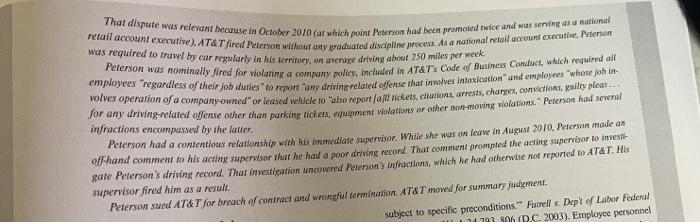
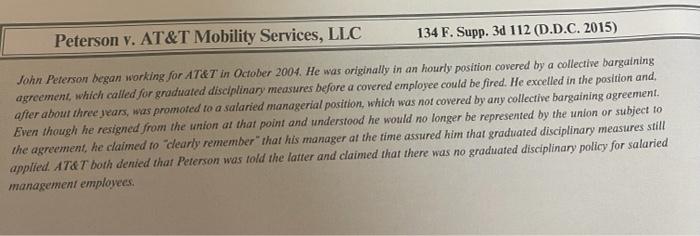
That dispute was relevant because in October 2010 (at which poin Peterson had been promoted twice and was seni axa national refail account executive). 47&T fired Peterson without any graduated discipline proces. As a national retail crown executive Petersen Peterson was nominally fired for violating a company policy, included in AT&T's Code of Business Conduct, which required all employees regardless of their job duties to report any driving related offense that involves intoxication and employees whose job in was required to travel by car regularly in his territory, on aterare driving about 250 miles per week folves operation for any driving-related offense other than parking Hicken, eguperen wolations or other non-moving violations - Peterson had several infractions encompassed by the latter. Peterson had a contentions relationship with his bemediate supervisor. While she was on leave in August 2010. Peterson made an off-hand comment to his acting supervisor that he had a poor driving record. That comment prompted the acting supervisor to investi- gate Peterson's driving record. That investigation uncovered Peterson's fractions, which he had otherwise not reported to AT&T. His supervisor fired him as a result. Peterson sued AT&T for breach of contract and wrongful termination. AT&T moved for summary judgment subject to specific preconditions." Futrell Dept of Labor Federal 2793 DC 2003). Employee personnel Peterson v. AT&T Mobility Services, LLC 134 F. Supp. 3d 112 (D.D.C. 2015) John Peterson began working for AT&T in October 2004. He was originally in an hourly position covered by a collective bargaining agreement, which called for graduated disciplinary measures before a covered employee could be fired. He excelled in the position and, after about three years, was promoted to a salaried managerial position, which was not covered by any collective bargaining agreement. Even though he resigned from the union ar that point and understood he would no longer be represented by the union or subject to the agreement, he claimed to "clearly remember that his manager at the time assured him thar graduated disciplinary measures still applied. AT&T both denied that Peterson was told the latter and claimed that there was no graduated disciplinary policy for salaried management employees. That dispute was relevant because in October 2010 (at which poin Peterson had been promoted twice and was seni axa national refail account executive). 47&T fired Peterson without any graduated discipline proces. As a national retail crown executive Petersen Peterson was nominally fired for violating a company policy, included in AT&T's Code of Business Conduct, which required all employees regardless of their job duties to report any driving related offense that involves intoxication and employees whose job in was required to travel by car regularly in his territory, on aterare driving about 250 miles per week folves operation for any driving-related offense other than parking Hicken, eguperen wolations or other non-moving violations - Peterson had several infractions encompassed by the latter. Peterson had a contentions relationship with his bemediate supervisor. While she was on leave in August 2010. Peterson made an off-hand comment to his acting supervisor that he had a poor driving record. That comment prompted the acting supervisor to investi- gate Peterson's driving record. That investigation uncovered Peterson's fractions, which he had otherwise not reported to AT&T. His supervisor fired him as a result. Peterson sued AT&T for breach of contract and wrongful termination. AT&T moved for summary judgment subject to specific preconditions." Futrell Dept of Labor Federal 2793 DC 2003). Employee personnel Peterson v. AT&T Mobility Services, LLC 134 F. Supp. 3d 112 (D.D.C. 2015) John Peterson began working for AT&T in October 2004. He was originally in an hourly position covered by a collective bargaining agreement, which called for graduated disciplinary measures before a covered employee could be fired. He excelled in the position and, after about three years, was promoted to a salaried managerial position, which was not covered by any collective bargaining agreement. Even though he resigned from the union ar that point and understood he would no longer be represented by the union or subject to the agreement, he claimed to "clearly remember that his manager at the time assured him thar graduated disciplinary measures still applied. AT&T both denied that Peterson was told the latter and claimed that there was no graduated disciplinary policy for salaried management employees
Step by Step Solution
There are 3 Steps involved in it

Get step-by-step solutions from verified subject matter experts