







Question: (- case evaluation more calculation-oriented than normal (value of number tables approx. 70%) - replacement parts means that a certain number of components are manufactured,
(- case evaluation "more calculation-oriented" than normal (value of number tables approx. 70%)
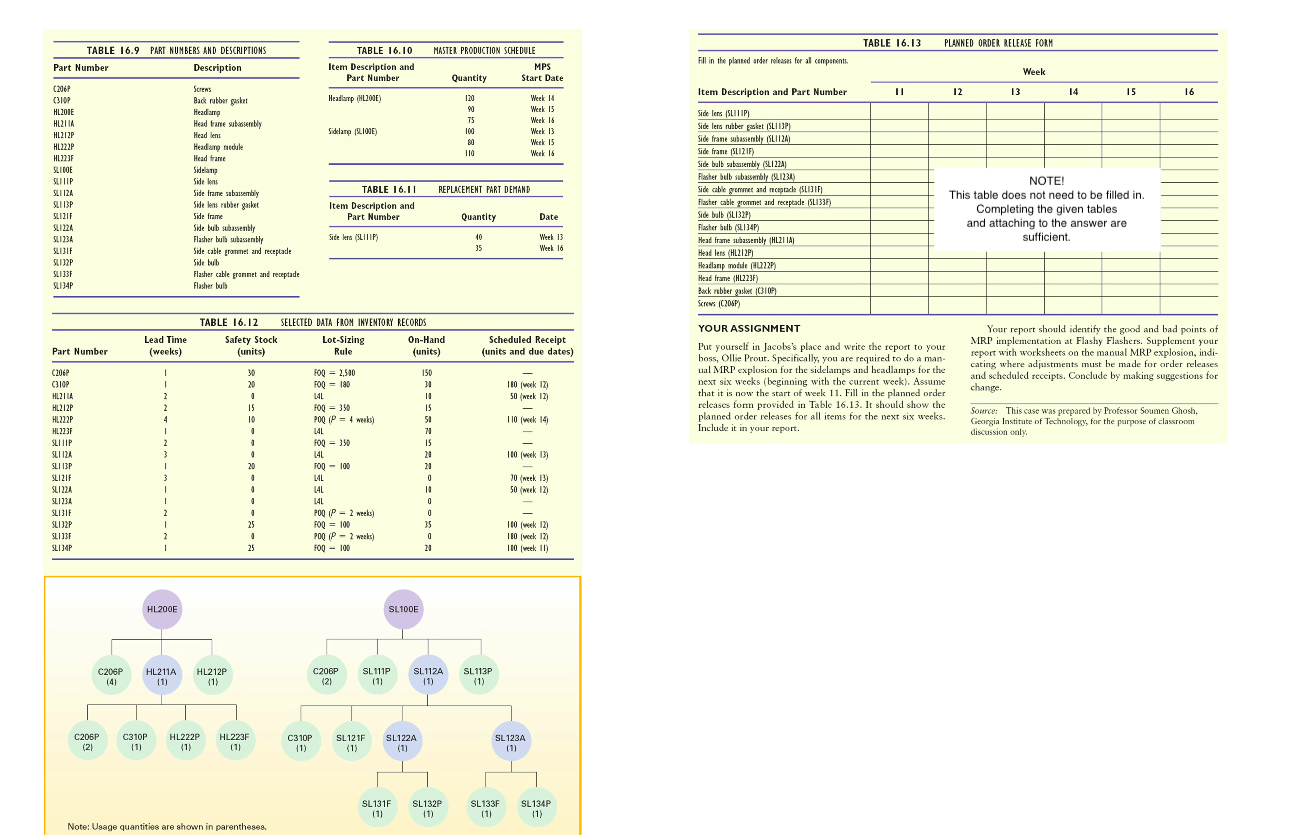
- replacement parts" means that a certain number of components are manufactured, e.g. as spare parts. The entire production therefore, the volume does not go into sales or the production of certain products. In invoices, it causes nothing but that in addition to other requirements, these "spare parts requirements" are added to the component requirement lines at the right time and at the right volume.
- The POQ idea is to order, if necessary, a quantity that covers the needs of the next P period (obviously taking into account the current one warehouse and possible safety stock requirement). If there is a compelling situation, then in theory even these orders can be hurried, delayed and made in practice in quick formats.
- action notice recommendation means "what needs to be done this week" (i.e. in this case week 11).
- If the MRP tables show that, for example, an order must be placed in week 12, then at the moment it is only design information and does not require "action"
- you can't go back in time yet (e.g. "we'll place an order in week 9"), but "in problem situations we either have to hurry up the order that is already coming, make a Quick Order or completely change the production plans
- how rushing/delays related to agreed deliveries are marked in the tables is often quite situational. The most important thing is that the information about the transfer is revealed somewhere. This can be done e.g. with arrows or in plain text
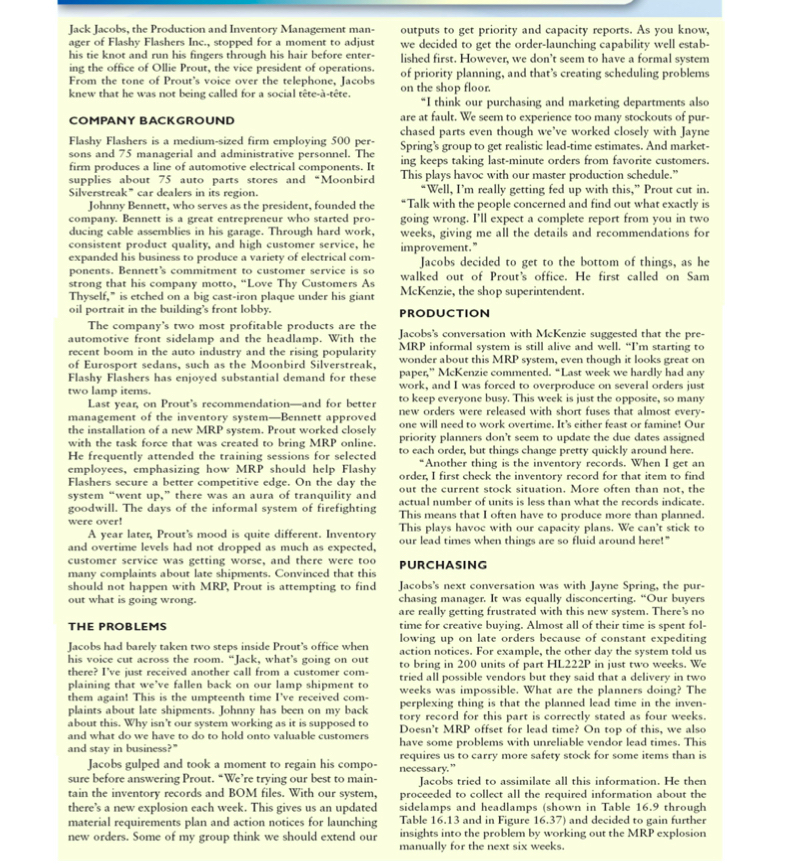
Jack Jacobs, the Production and Inventory Management manager of Flashy Flashers Inc., stopped for a moment to adjust his tie knot and run his fingers through his hair before entering the office of Ollie Prout, the vice president of operations. From the tone of Prout's voice over the telephone, Jacobs knew that he was not being called for a social tte--tte. COMPANY BACKGROUND Flashy Flashers is a medium-sized firm employing 500 persons and 75 managerial and administrative personnel. The firm produces a line of automotive electrical components. It supplies about 75 auto parts stores and "Moonbird Silverstreak" car dealers in its region. Johnny Bennett, who serves as the president, founded the company. Bennett is a great entrepreneur who started producing cable assemblies in his garage. Through hard work, consistent product quality, and high customer service, he expanded his business to produce a variety of electrical components. Bennett's commitment to customer service is so strong that his company motto, "Love Thy Customers As Thyself," is etched on a big cast-iron plaque under his giant oil portrait in the building's front lobby. The company's two most profitable products are the automotive front sidelamp and the headlamp. With the recent boom in the auto industry and the rising popularity of Eurosport sedans, such as the Moonbird Silverstreak, Flashy Flashers has enjoyed substantial demand for these two lamp items. Last year, on Prout's recommendation-and for better management of the inventory system-Bennett approved the installation of a new MRP system. Prout worked closely with the task force that was created to bring MRP online. He frequently attended the training sessions for selected employees, emphasizing how MRP should help Flashy Flashers secure a better competitive edge. On the day the system "went up," there was an aura of tranquility and goodwill. The days of the informal system of firefighting were over! A year later, Prout's mood is quite different. Inventory and overtime levels had not dropped as much as expected, customer service was getting worse, and there were too many complaints about late shipments. Convinced that this should not happen with MRP, Prout is attempting to find out what is going wrong. THE PROBLEMS Jacobs had barely taken two steps inside Prout's office when his voice cut across the room. "Jack, what's going on out there? I've just received another call from a customer complaining that we've fallen back on our lamp shipment to them again! This is the umpteenth time I've received complaints about late shipments. Johnny has been on my back about this. Why isn't our system working as it is supposed to and what do we have to do to hold onto valuable customers and stay in business?" Jacobs gulped and took a moment to regain his composure before answering Prout. "We're trying our best to maintain the inventory records and BOM files. With our system, there's a new explosion each week. This gives us an updated material requirements plan and action notices for launching new orders. Some of my group think we should extend our outputs to get priority and capacity reports. As you know, we decided to get the order-launching capability well established first. However, we don't seem to have a formal system of priority planning, and that's creating scheduling problems on the shop floor. "I think our purchasing and marketing departments also are at fault. We seem to experience too many stockouts of purchased parts even though we've worked closely with Jayne Spring's group to get realistic lead-time estimates. And marketing keeps taking last-minute orders from favorite customers. This plays havoc with our master production schedule." "Well, I'm really getting fed up with this," Prout cut in. "Talk with the people concerned and find out what exactly is going wrong. I'll expect a complete report from you in two weeks, giving me all the details and recommendations for improvement." Jacobs decided to get to the bottom of things, as he walked out of Prout's office. He first called on Sam McKenzie, the shop superintendent. PRODUCTION Jacobs's conversation with MeKenzie suggested that the preMRP informal system is still alive and well. "I'm starting to wonder about this MRP system, even though it looks great on paper," McKenzie commented. "Last week we hardly had any work, and I was forced to overproduce on several orders just to keep everyone busy. This week is just the opposite, so many new orders were released with short fuses that almost everyone will need to work overtime. It's either feast or famine! Our priority planners don't seem to update the due dates assigned to each order, but things change pretty quickly around here. "Another thing is the inventory records. When I get an order, I first check the inventory record for that item to find out the current stock situation. More often than not, the actual number of units is less than what the records indicate. This means that I often have to produce more than planned. This plays havoc with our capacity plans. We can't stick to our lead times when things are so fluid around here!" PURCHASING Jacobs's next conversation was with Jayne Spring, the purchasing manager. It was equally disconcerting. "Our buyers are really getting frustrated with this new system. There's no time for creative buying. Almost all of their time is spent following up on late orders because of constant expediting action notices. For example, the other day the system told us to bring in 200 units of part HL222P in just two weeks. We tried all possible vendors but they said that a delivery in two weeks was impossible. What are the planners doing? The perplexing thing is that the planned lead time in the inventory record for this part is correctly stated as four weeks. Doesn't MRP offset for lead time? On top of this, we also have some problems with unreliable vendor lead times. This requires us to carry more safety stock for some items than is necessary." Jacobs tried to assimilate all this information. He then proceeded to collect all the required information about the sidelamps and headlamps (shown in Table 16.9 through Table 16.13 and in Figure 16.37) and decided to gain further insights into the problem by working out the MRP explosion manually for the next six weeks. Jack Jacobs, the Production and Inventory Management manager of Flashy Flashers Inc., stopped for a moment to adjust his tie knot and run his fingers through his hair before entering the office of Ollie Prout, the vice president of operations. From the tone of Prout's voice over the telephone, Jacobs knew that he was not being called for a social tte--tte. COMPANY BACKGROUND Flashy Flashers is a medium-sized firm employing 500 persons and 75 managerial and administrative personnel. The firm produces a line of automotive electrical components. It supplies about 75 auto parts stores and "Moonbird Silverstreak" car dealers in its region. Johnny Bennett, who serves as the president, founded the company. Bennett is a great entrepreneur who started producing cable assemblies in his garage. Through hard work, consistent product quality, and high customer service, he expanded his business to produce a variety of electrical components. Bennett's commitment to customer service is so strong that his company motto, "Love Thy Customers As Thyself," is etched on a big cast-iron plaque under his giant oil portrait in the building's front lobby. The company's two most profitable products are the automotive front sidelamp and the headlamp. With the recent boom in the auto industry and the rising popularity of Eurosport sedans, such as the Moonbird Silverstreak, Flashy Flashers has enjoyed substantial demand for these two lamp items. Last year, on Prout's recommendation-and for better management of the inventory system-Bennett approved the installation of a new MRP system. Prout worked closely with the task force that was created to bring MRP online. He frequently attended the training sessions for selected employees, emphasizing how MRP should help Flashy Flashers secure a better competitive edge. On the day the system "went up," there was an aura of tranquility and goodwill. The days of the informal system of firefighting were over! A year later, Prout's mood is quite different. Inventory and overtime levels had not dropped as much as expected, customer service was getting worse, and there were too many complaints about late shipments. Convinced that this should not happen with MRP, Prout is attempting to find out what is going wrong. THE PROBLEMS Jacobs had barely taken two steps inside Prout's office when his voice cut across the room. "Jack, what's going on out there? I've just received another call from a customer complaining that we've fallen back on our lamp shipment to them again! This is the umpteenth time I've received complaints about late shipments. Johnny has been on my back about this. Why isn't our system working as it is supposed to and what do we have to do to hold onto valuable customers and stay in business?" Jacobs gulped and took a moment to regain his composure before answering Prout. "We're trying our best to maintain the inventory records and BOM files. With our system, there's a new explosion each week. This gives us an updated material requirements plan and action notices for launching new orders. Some of my group think we should extend our outputs to get priority and capacity reports. As you know, we decided to get the order-launching capability well established first. However, we don't seem to have a formal system of priority planning, and that's creating scheduling problems on the shop floor. "I think our purchasing and marketing departments also are at fault. We seem to experience too many stockouts of purchased parts even though we've worked closely with Jayne Spring's group to get realistic lead-time estimates. And marketing keeps taking last-minute orders from favorite customers. This plays havoc with our master production schedule." "Well, I'm really getting fed up with this," Prout cut in. "Talk with the people concerned and find out what exactly is going wrong. I'll expect a complete report from you in two weeks, giving me all the details and recommendations for improvement." Jacobs decided to get to the bottom of things, as he walked out of Prout's office. He first called on Sam McKenzie, the shop superintendent. PRODUCTION Jacobs's conversation with MeKenzie suggested that the preMRP informal system is still alive and well. "I'm starting to wonder about this MRP system, even though it looks great on paper," McKenzie commented. "Last week we hardly had any work, and I was forced to overproduce on several orders just to keep everyone busy. This week is just the opposite, so many new orders were released with short fuses that almost everyone will need to work overtime. It's either feast or famine! Our priority planners don't seem to update the due dates assigned to each order, but things change pretty quickly around here. "Another thing is the inventory records. When I get an order, I first check the inventory record for that item to find out the current stock situation. More often than not, the actual number of units is less than what the records indicate. This means that I often have to produce more than planned. This plays havoc with our capacity plans. We can't stick to our lead times when things are so fluid around here!" PURCHASING Jacobs's next conversation was with Jayne Spring, the purchasing manager. It was equally disconcerting. "Our buyers are really getting frustrated with this new system. There's no time for creative buying. Almost all of their time is spent following up on late orders because of constant expediting action notices. For example, the other day the system told us to bring in 200 units of part HL222P in just two weeks. We tried all possible vendors but they said that a delivery in two weeks was impossible. What are the planners doing? The perplexing thing is that the planned lead time in the inventory record for this part is correctly stated as four weeks. Doesn't MRP offset for lead time? On top of this, we also have some problems with unreliable vendor lead times. This requires us to carry more safety stock for some items than is necessary." Jacobs tried to assimilate all this information. He then proceeded to collect all the required information about the sidelamps and headlamps (shown in Table 16.9 through Table 16.13 and in Figure 16.37) and decided to gain further insights into the problem by working out the MRP explosion manually for the next six weeks
Step by Step Solution
There are 3 Steps involved in it

Get step-by-step solutions from verified subject matter experts
 Study Help