







Question: Case Examination and Analysis with a focus on practical application of the topics. interaction, proactive maintenance and reducing costs. IoT can have a significant role
Case Examination and Analysis with a focus on practical application of the topics.
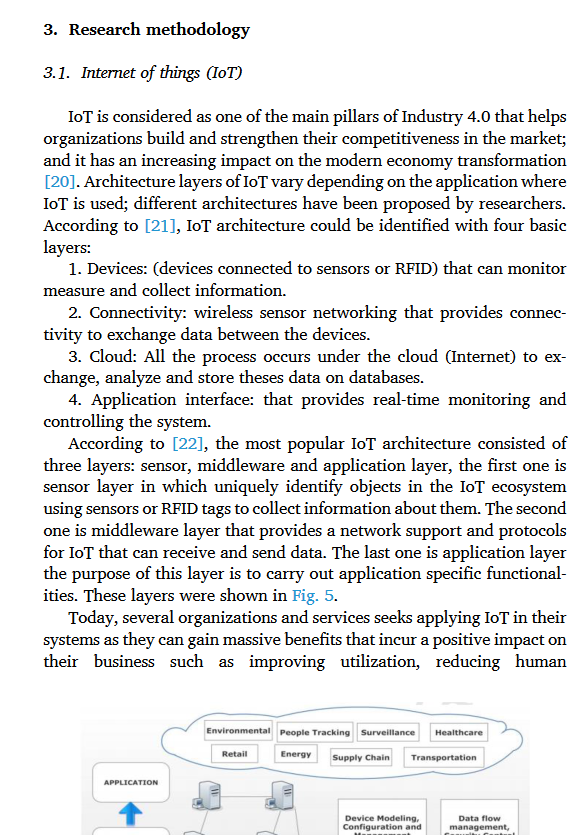
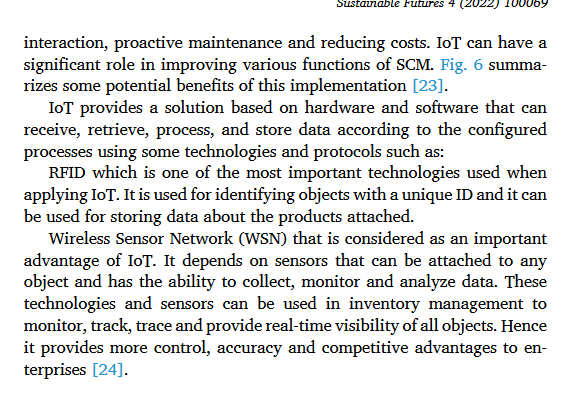
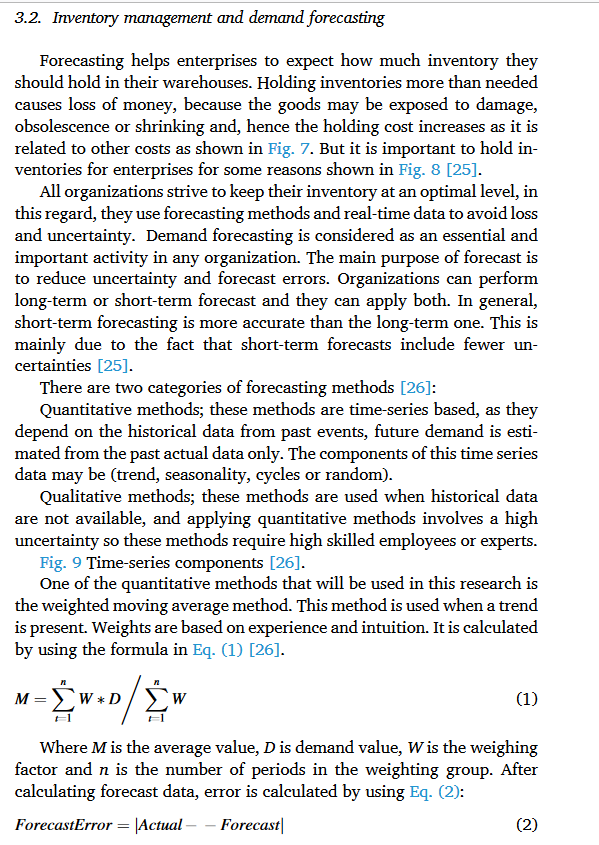
interaction, proactive maintenance and reducing costs. IoT can have a significant role in improving various functions of SCM. Fig. 6 summarizes some potential benefits of this implementation [23]. IoT provides a solution based on hardware and software that can receive, retrieve, process, and store data according to the configured processes using some technologies and protocols such as: RFID which is one of the most important technologies used when applying IoT. It is used for identifying objects with a unique ID and it can be used for storing data about the products attached. Wireless Sensor Network (WSN) that is considered as an important advantage of IoT. It depends on sensors that can be attached to any object and has the ability to collect, monitor and analyze data. These technologies and sensors can be used in inventory management to monitor, track, trace and provide real-time visibility of all objects. Hence it provides more control, accuracy and competitive advantages to enterprises [24]. 3.1. Internet of things (IoT) IoT is considered as one of the main pillars of Industry 4.0 that helps organizations build and strengthen their competitiveness in the market; and it has an increasing impact on the modern economy transformation [20]. Architecture layers of IoT vary depending on the application where IoT is used; different architectures have been proposed by researchers. According to [21], IoT architecture could be identified with four basic layers: 1. Devices: (devices connected to sensors or RFID) that can monitor measure and collect information. 2. Connectivity: wireless sensor networking that provides connectivity to exchange data between the devices. 3. Cloud: All the process occurs under the cloud (Internet) to exchange, analyze and store theses data on databases. 4. Application interface: that provides real-time monitoring and controlling the system. According to [22], the most popular IoT architecture consisted of three layers: sensor, middleware and application layer, the first one is sensor layer in which uniquely identify objects in the IoT ecosystem using sensors or RFID tags to collect information about them. The second one is middleware layer that provides a network support and protocols for IoT that can receive and send data. The last one is application layer the purpose of this layer is to carry out application specific functionalities. These layers were shown in Fig. 5. Today, several organizations and services seeks applying IoT in their systems as they can gain massive benefits that incur a positive impact on their business such as improving utilization, reducing human Forecasting helps enterprises to expect how much inventory they should hold in their warehouses. Holding inventories more than needed causes loss of money, because the goods may be exposed to damage, obsolescence or shrinking and, hence the holding cost increases as it is related to other costs as shown in Fig. 7. But it is important to hold inventories for enterprises for some reasons shown in Fig. 8 [25]. All organizations strive to keep their inventory at an optimal level, in this regard, they use forecasting methods and real-time data to avoid loss and uncertainty. Demand forecasting is considered as an essential and important activity in any organization. The main purpose of forecast is to reduce uncertainty and forecast errors. Organizations can perform long-term or short-term forecast and they can apply both. In general, short-term forecasting is more accurate than the long-term one. This is mainly due to the fact that short-term forecasts include fewer uncertainties [25]. There are two categories of forecasting methods [26]: Quantitative methods; these methods are time-series based, as they depend on the historical data from past events, future demand is estimated from the past actual data only. The components of this time series data may be (trend, seasonality, cycles or random). Qualitative methods; these methods are used when historical data are not available, and applying quantitative methods involves a high uncertainty so these methods require high skilled employees or experts. Fig. 9 Time-series components [26]. One of the quantitative methods that will be used in this research is the weighted moving average method. This method is used when a trend is present. Weights are based on experience and intuition. It is calculated by using the formula in Eq. (1) [26]. M=t=1nWD/t=1nW Where M is the average value, D is demand value, W is the weighing factor and n is the number of periods in the weighting group. After calculating forecast data, error is calculated by using Eq. (2): ForecastError = Actual -- Forecast
Step by Step Solution
There are 3 Steps involved in it

Get step-by-step solutions from verified subject matter experts
 Study Help