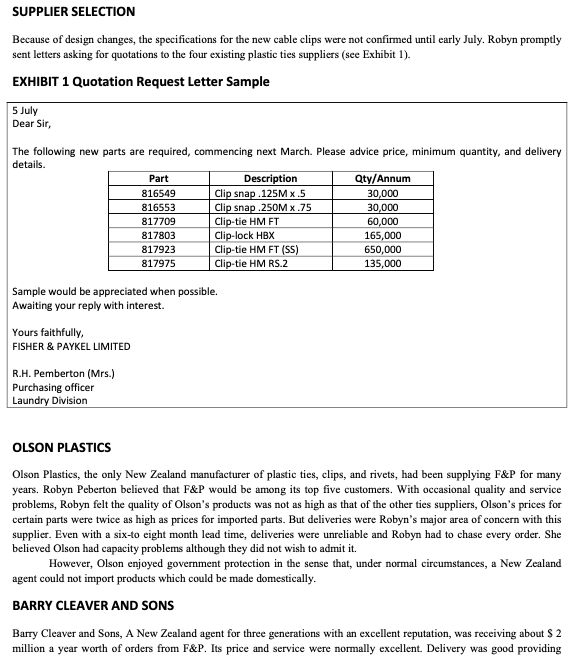
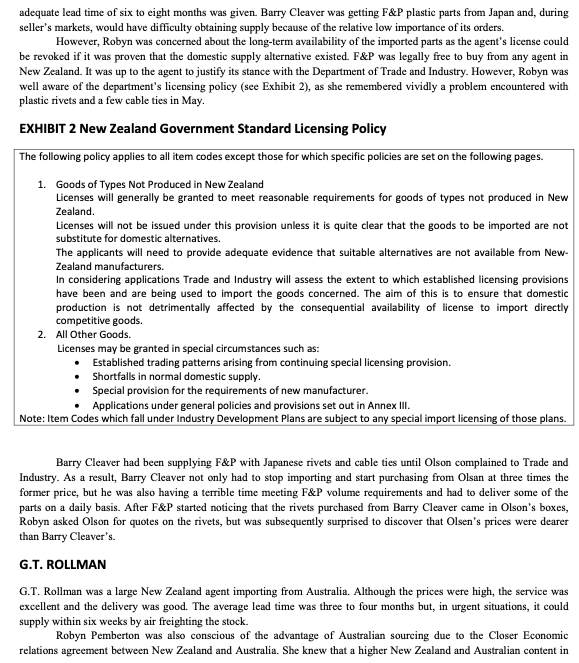
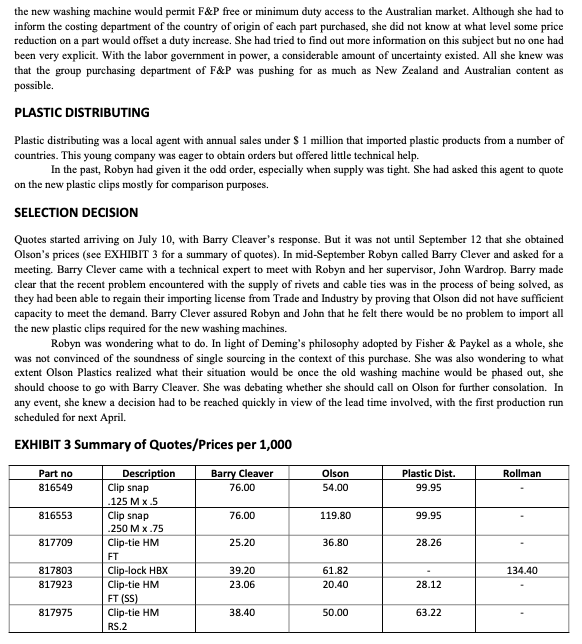
Case H19-1 Plastic Cable Clips In mid September Robyn Pemberton, purchasing officer in the laundry division of Fisher & Paykel Limited, located in Auckland, New Zealand, was wondering which procurement option made most sense for the plastic cable clips requirements for the new line of washing machines. THE LAUNDRY DIVISION Fisher & Paykel Limited was the largest home appliance manufacture in New Zealand with sales of the major appliances amounting to $135,000,000 and total sales of $270,000,000 for the fiscal year ending March 31, including S36,000,000 of export sales and royalty income. It comprised eight operating divisions, one of which was the laundry division employing over 500 people to produce washing machines and dryers. Currently, the laundry division produced about 50,000 washing machines, solely for the domestic market. THE NEW WASHING MACHINE For the last two years, the laundry division had been developing a new line of automatic washing machines. The planning and development of the new machine was conducted by a seven-person committee of engineers, production, and marketing people as well as a purchasing coordinator. The new machine, designed entirely by F&P, used electronic controls. It was believed to be technologically advanced by world standards. Its manufacturing process would be highly automated, featuring considerable part rationalization and cost reduction over the old production line. In fact, maintaining costs at the lowest possible level was one of the key priorities of the planning committee. With good opportunities for export and royalty income, the laundry division hoped to produce between 75,000 and 100,000 new washing machines a year. However, 50,000 machines were planned for the first full year of production. The production run was scheduled for the beginning of next April. PLASTIC CABLE CLIPS The old washing machine used about 20 different plastic cable ties for a total of about a 250 ties in each machine. At the moment, the laundry division bought nearly $1,250,000. A year's worth of plastic cable ties: about $500,000 from Olson Plastics, a New Zealand manufacturer; $500,000 from Barry Cleaver and sons, a local agent importing mostly from Japan; $200,000 from G.T. Rollman, another local agent importing from Australia; and at most $50,000 from Plastic Distributing, a relatively new and smaller multisource New Zealand agent. The ties to be used in the New machine required new specifications because of the automated production process. None of the existing ties suppliers actually had in stock the kind of parts required. A year earlier, Robyn Pemberton, who was the purchasing coordinator for the new washing machine, managed to convince the planning committee to draw on the technical expertise of Barry Cleaver, the New Zealand agent currently supplying some of the plastic ties. As a result Barry Cleaver's input, the number of ties required was reduced to half a dozen new parts for a total of about 45 plastic clips to be used in each new machine. Robyn Pemberton made it very clear to Barry Cleaver that all current plastic ties supplies would be asked to submit quotations as soon as all the specifications on the new clips were finalized and that has involvement would not give him any preferential treatment over the others. SUPPLIER SELECTION Because of design changes, the specifications for the new cable clips were not confirmed until early July. Robyn promptly sent letters asking for quotations to the four existing plastic ties suppliers (see Exhibit 1). EXHIBIT 1 Quotation Request Letter Sample 5 July Dear Sir, The following new parts are required, commencing next March. Please advice price, minimum quantity, and delivery details. Part Description Qty/Annum 816549 Clip snap.125M X.5 30,000 816553 Clip snap.250M X.75 30,000 817709 Clip-tie HM FT 60,000 817803 Clip-lock HBX 165,000 817923 Clip-tie HM FT (SS) 650,000 817975 Clip-tie HM RS.2 135,000 Sample would be appreciated when possible. Awaiting your reply with interest. Yours faithfully, FISHER & PAYKEL LIMITED R.H. Pemberton (Mrs.) Purchasing officer Laundry Division OLSON PLASTICS Olson Plastics, the only New Zealand manufacturer of plastic ties, clips, and rivets, had been supplying F&P for many years. Robyn Peberton believed that F&P would be among its top five customers. With occasional quality and service problems, Robyn felt the quality of Olson's products was not as high as that of the other ties suppliers, Olson's prices for certain parts were twice as high as prices for imported parts. But deliveries were Robyn's major area of concern with this supplier. Even with a six-to eight month lead time, deliveries were unreliable and Robyn had to chase every order. She believed Olson had capacity problems although they did not wish to admit it. However, Olson enjoyed government protection in the sense that, under normal circumstances, a New Zealand agent could not import products which could be made domestically. BARRY CLEAVER AND SONS Barry Cleaver and Sons, A New Zealand agent for three generations with an excellent reputation, was receiving about $ 2 million a year worth of orders from F&P. Its price and service were normally excellent. Delivery was good providing adequate lead time of six to eight months was given. Barry Cleaver was getting F&P plastic parts from Japan and during seller's markets, would have difficulty obtaining supply because of the relative low importance of its orders. However, Robyn was concerned about the long-term availability of the imported parts as the agent's license could be revoked if it was proven that the domestic supply alternative existed. F&P was legally free to buy from any agent in New Zealand. It was up to the agent to justify its stance with the Department of Trade and Industry. However, Robyn was well aware of the department's licensing policy (see Exhibit 2), as she remembered vividly a problem encountered with plastic rivets and a few cable ties in May. EXHIBIT 2 New Zealand Government Standard Licensing Policy The following policy applies to all item codes except those for which specific policies are set on the following pages. 1. Goods of Types Not Produced in New Zealand Licenses will generally be granted to meet reasonable requirements for goods of types not produced in New Zealand. Licenses will not be issued under this provision unless it is quite clear that the goods to be imported are not substitute for domestic alternatives. The applicants will need to provide adequate evidence that suitable alternatives are not available from New- Zealand manufacturers. In considering applications Trade and Industry will assess the extent to which established licensing provisions have been and are being used to import the goods concerned. The aim of this is to ensure that domestic production is not detrimentally affected by the consequential availability of license to import directly competitive goods. 2. All Other Goods. Licenses may be granted in special circumstances such as: Established trading patterns arising from continuing special licensing provision. Shortfalls in normal domestic supply. Special provision for the requirements of new manufacturer. Applications under general policies and provisions set out in Annex III. Note: Item Codes which fall under Industry Development Plans are subject to any special import licensing of those plans. Barry Cleaver had been supplying F&P with Japanese rivets and cable ties until Olson complained to Trade and Industry. As a result, Barry Cleaver not only had to stop importing and start purchasing from Olsan at three times the former price, but he was also having a terrible time meeting F&P volume requirements and had to deliver some of the parts on a daily basis. After F&P started noticing that the rivets purchased from Barry Cleaver came in Olson's boxes, Robyn asked Olson for quotes on the rivets, but was subsequently surprised to discover that Olsen's prices were dearer than Barry Cleaver's. G.T. ROLLMAN G.T. Rollman was a large New Zealand agent importing from Australia. Although the prices were high, the service was excellent and the delivery was good. The average lead time was three to four months but, in urgent situations, it could supply within six weeks by air freighting the stock. Robyn Pemberton was also conscious of the advantage of Australian sourcing due to the Closer Economic relations agreement between New Zealand and Australia. She knew that a higher New Zealand and Australian content in the new washing machine would permit F&P free or minimum duty access to the Australian market. Although she had to inform the costing department of the country of origin of each part purchased, she did not know at what level some price reduction on a part would offset a duty increase. She had tried to find out more information on this subject but no one had been very explicit. With the labor government in power, a considerable amount of uncertainty existed. All she knew was that the group purchasing department of F&P was pushing for as much as New Zealand and Australian content as possible. PLASTIC DISTRIBUTING Plastic distributing was a local agent with annual sales under $ 1 million that imported plastic products from a number of countries. This young company was eager to obtain orders but offered little technical help. In the past, Robyn had given it the odd order, especially when supply was tight. She had asked this agent to quote on the new plastic clips mostly for comparison purposes. SELECTION DECISION Quotes started arriving on July 10, with Barry Cleaver's response. But it was not until September 12 that she obtained Olson's prices (see EXHIBIT 3 for a summary of quotes). In mid-September Robyn called Barry Clever and asked for a meeting. Barry Clever came with a technical expert to meet with Robyn and her supervisor, John Wardrop. Barry made clear that the recent problem encountered with the supply of rivets and cable ties was in the process of being solved, as they had been able to regain their importing license from Trade and Industry by proving that Olson did not have sufficient capacity to meet the demand. Barry Clever assured Robyn and John that he felt there would be no problem to import all the new plastic clips required for the new washing machines. Robyn was wondering what to do. In light of Deming's philosophy adopted by Fisher & Paykel as a whole, she was not convinced of the soundness of single sourcing in the context of this purchase. She was also wondering to what extent Olson Plastics realized what their situation would be once the old washing machine would be phased out, she should choose to go with Barry Cleaver. She was debating whether she should call on Olson for further consolation. In any event, she knew a decision had to be reached quickly in view of the lead time involved, with the first production run scheduled for next April. EXHIBIT 3 Summary of Quotes/Prices per 1,000 Rollman Part no 816549 Barry Cleaver 76.00 Olson 54.00 Plastic Dist. 99.95 816553 76.00 119.80 99.95 817709 25.20 36.80 28.26 Description Clip snap .125 Mx.5 Clip snap .250 MX.75 Clip-tie HM FT Clip-lock HBX Clip-tie HM FT (SS) Clip-tie HM RS.2 134.40 817803 817923 39.20 23.06 61.82 20.40 28.12 817975 38.40 50.00 63.22 Case Assignment Questions Student Instruction: The case assignment questions are intended as a starting point not a finishing point. The case must be developed beyond the case questions due to the variety of issues presented. If you were in the position of Robyn Pemberton: 1. Would you use a single source for plastic cable clips? 2. What supplier(s) would you choose for plastic cable clips and why? 3. How does the Deming philosophy apply to this particular decision




