Question: Case. Introduction (10 marks); Analysis (20 marks); Recommendations (10 marks); Conclusion (10 marks). Total 60 marks. Please use headings. London-based Reuters is a respected company
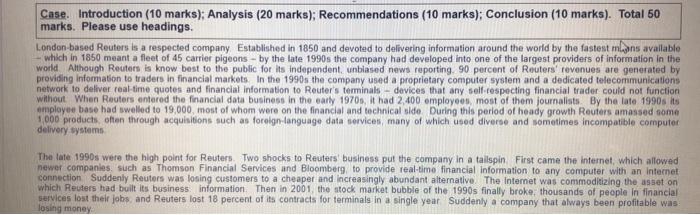
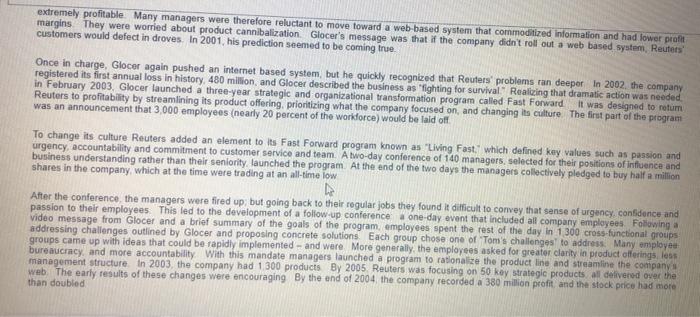
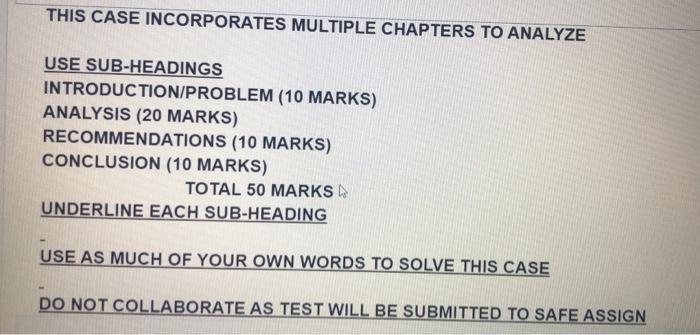
Case. Introduction (10 marks); Analysis (20 marks); Recommendations (10 marks); Conclusion (10 marks). Total 60 marks. Please use headings. London-based Reuters is a respected company Established in 1850 and devoted to delivering information around the world by the fastest milions available which in 1850 meant a fleet of 45 carrier pigeons - by the late 1990s the company had developed into one of the largest providers of information in the world. Although Reuters is know best to the public for its independent, unbiased news reporting, 90 percent of Reuters' revenues are generated by providing information to traders in financial markets in the 1990s the company used a proprietary computer system and a dedicated telecommunications network to deliver real-time quotes and financial information to Reuter's terminals- devices that any self respecting financial trader could not function without When Routers entered the financial data business in the early 1970s, it had 2,400 employees, most of them journalists. By the late 1990s its employee base had swelled to 19,000, most of whom were on the financial and technical side. During this period of heady growth Reuters amassed some 1.000 products often through acquisitions such as foreign language data services, many of which used diverse and sometimes incompatible computer delivery Systems The late 1990s were the high point for Reuters. Two shocks to Reuters' business put the company in a tailspin First came the Internet, which allowed newer companies, such as Thomson Financial Services and Bloomberg to provide real-time financial Information to any computer with an internet connection Suddenly Reuters was losing customers to a cheaper and increasingly abundant alternative. The Internet was commoditizing the asset on which Reuters had built its business Information Then in 2001, the stock market bubble of the 1990s finally broke thousands of people in financial services lost their jobs and Reuters lost 18 percent of its contracts for terminals in a single year Suddenly a company that always been profitable was losing money extremely profitable. Many managers were therefore reluctant to move toward a web based system that commoditized Information and had lower profit margins. They were worried about product cannibalization. Glocer's message was that if the company didn't roll out a web based system, Reuters customers would defect in droves. In 2001, his prediction seemed to be coming true Once in charge, Glocer again pushed an internet based system, but he quickly recognized that Reuters' problems ran deeper in 2002, the company registered its first annual loss in history, 480 million, and Glocer described the business as "fighting for survival." Realizing that dramatic action was needed in February 2003 Glocer launched a three-year strategic and organizational transformation program called Fast Forward it was designed to retum Reuters to profitability by streamlining its product offering, prioritizing what the company focused on, and changing its culture. The first part of the program was an announcement that 3,000 employees (nearly 20 percent of the workforce) would be laid off To change its culture Reuters added an element to its Fast Forward program known as "Living Fast," which defined key values such as passion and urgency, accountability and commitment to customer service and team. A two-day conference of 140 managers, selected for their positions of influence and business understanding rather than their seniority launched the program. At the end of the two days the managers collectively pledged to buy half a million shares in the company which at the time were trading at an all-time low After the conference, the managers were fired up, but going back to their regular jobs they found it difficult to convey that sense of urgency, confidence and passion to their employees. This led to the development of a follow-up conference a one day event that included all company employees. Following a video message from Glocer and a brief summary of the goals of the program, employees spent the rest of the day in 1 300 cross-functional groups addressing challenges outlined by Glocer and proposing concrete solutions Each group chose one of Tom's challenges to address. Many employee groups came up with ideas that could be rapidly implemented - and were. More generally the employees asked for greater clarity in product offerings less bureaucracy, and more accountability. With this mandate managers launched a program to rationalize the product line and streamline the company management structure. In 2003, the company had 1 300 products By 2005 Reuters was focusing on 50 kay strategic products all delivered over the web The early results of these changes were encouraging By the end of 2004, the company recorded a 380 million profit and the stock price had more than doubled THIS CASE INCORPORATES MULTIPLE CHAPTERS TO ANALYZE USE SUB-HEADINGS INTRODUCTION/PROBLEM (10 MARKS) ANALYSIS (20 MARKS) RECOMMENDATIONS (10 MARKS) CONCLUSION (10 MARKS) TOTAL 50 MARKS UNDERLINE EACH SUB-HEADING USE AS MUCH OF YOUR OWN WORDS TO SOLVE THIS CASE DO NOT COLLABORATE AS TEST WILL BE SUBMITTED TO SAFE ASSIGN









 Study Help