Case p. 183 in text: So what if Im a few minutes late to work?
Im often late to work; something always comes up at the last minute. But my boss is such a jerk about it! Hes threatening to install a time clock. This is so insultingIm in management, Im a professional, Im on salary, and I do the work! Please tell me how to talk some sense into him.
Rene
Using attribution theory, determine how you would think through this case:
What is the answer to the consensus question?
What is the answer to the consistency question?
What is the answer to the distinctiveness question?
Look at the pattern of answers to the above 3 questions (LHL, HLH, etc) and then make an internal or external attribution.
NOTE: the behavior you're making an attribution about is Renee coming to work late.
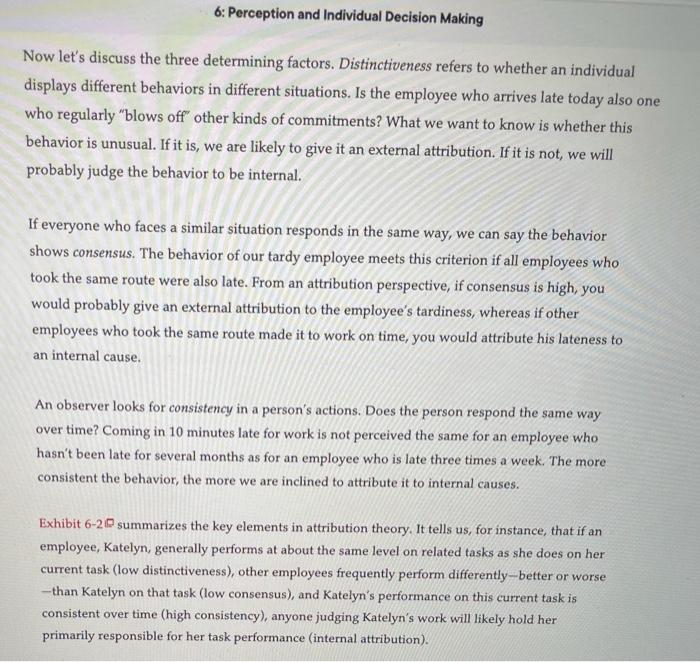
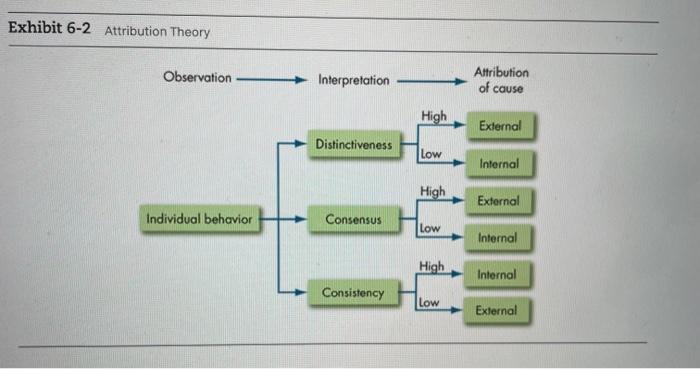
6: Perception and Individual Decision Making Now let's discuss the three determining factors. Distinctiveness refers to whether an individual displays different behaviors in different situations. Is the employee who arrives late today also one who regularly "blows off other kinds of commitments? What we want to know is whether this behavior is unusual. If it is, we are likely to give it an external attribution. If it is not, we will probably judge the behavior to be internal. If everyone who faces a similar situation responds in the same way, we can say the behavior shows consensus. The behavior of our tardy employee meets this criterion if all employees who took the same route were also late. From an attribution perspective, if consensus is high, you would probably give an external attribution to the employee's tardiness, whereas if other employees who took the same route made it to work on time, you would attribute his lateness to an internal cause. An observer looks for consistency in a person's actions. Does the person respond the same way over time? Coming in 10 minutes late for work is not perceived the same for an employee wh hasn't been late for several months as for an employee who is late three times a week. The more consistent the behavior, the more we are inclined to attribute it to internal causes. Exhibit 6-20 summarizes the key elements in attribution theory. It tells us, for instance, that if an employee, Katelyn, generally performs at about the same level on related tasks as she does on her current task (low distinctiveness), other employees frequently perform differently--better or worse ---than Katelyn on that task (low consensus), and Katelyn's performance on this current task is consistent over time (high consistency), anyone judging Katelyn's work will likely hold her primarily responsible for her task performance (internal attribution). Exhibit 6-2 Attribution Theory Observation Interpretation Attribution of cause High External Distinctiveness Low Internal High External Individual behavior Consensus Low Internal High Internal Consistency Low External