Case Questions
1. How does the Court define public use"?
2. Would the case have been decided differently if the proposed project was for large industrial park? Why or why not?
3. Focus on Critical ThinkingIn dissenting opinions, members of the Court argued that this decision makes all private property vulnerable to being taken and transferred to another private owner so long as the property is improved in some way that serves a public purpose. Moreover, they argued that this decision is advantageous to large corporations or individuals with political power or connectionswhile those with few resources are disadvantaged. Do you agree with either of these criticisms? Why or why not?
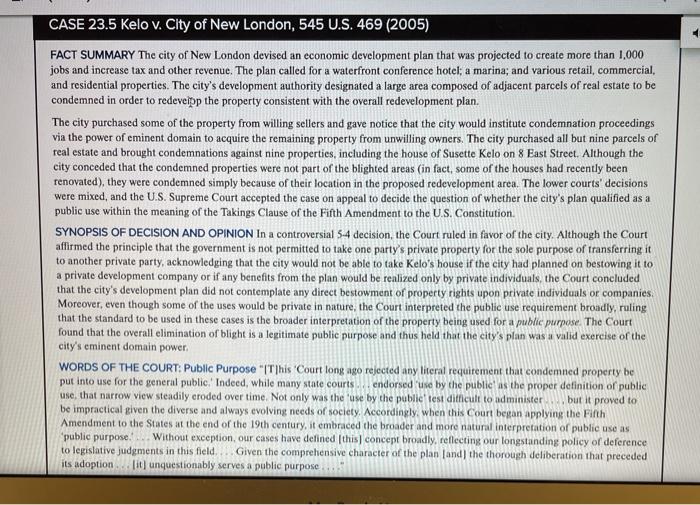
CASE 23.5 Kelo v. City of New London, 545 U.S. 469 (2005) FACT SUMMARY The city of New London devised an economic development plan that was projected to create more than 1,000 jobs and increase tax and other revenue. The plan called for a waterfront conference hotel; a marina; and various retail, commercial, and residential properties. The city's development authority designated a large area composed of adjacent parcels of real estate to be condemned in order to redeveipp the property consistent with the overall redevelopment plan. The city purchased some of the property from willing sellers and gave notice that the city would institute condemnation proceedings via the power of eminent domain to acquire the remaining property from unwilling owners. The city purchased all but nine parcels of real estate and brought condemnations against nine properties, including the house of Susette Kelo on 8 East Street. Although the city conceded that the condemned properties were not part of the blighted areas (in fact, some of the houses had recently been renovated), they were condemned simply because of their location in the proposed redevelopment area. The lower courts' decisions were mixed, and the U.S. Supreme Court accepted the case on appeal to decide the question of whether the city's plan qualified as a public use within the meaning of the Takings Clause of the Fifth Amendment to the U.S. Constitution SYNOPSIS OF DECISION AND OPINION In a controversial 5-4 decision, the Court ruled in favor of the city. Although the Court affirmed the principle that the government is not permitted to take one party's private property for the sole purpose of transferring it to another private party, acknowledging that the city would not be able to take Kelo's house if the city had planned on bestowing it to a private development company or if any benefits from the plan would be realized only by private individuals, the Court concluded that the city's development plan did not contemplate any direct bestowment of property rights upon private individuals or companies Moreover, even though some of the uses would be private in nature, the Court interpreted the public use requirement broadly, ruling that the standard to be used in these cases is the broader interpretation of the property being used for a public purpose. The Court found that the overall elimination of blight is a legitimate public purpose and thus held that the city's plan was a valid exercise of the city's eminent domain power, WORDS OF THE COURT: Public Purpose "This 'Court long ago rejected any literal requirement that condemned property be put into use for the general public. Indeed, while many state courts endorsed use by the public' as the proper detinition of public use, that narrow view steadily eroded over time. Not only was the use by the public test difficult to administer but it proved to be impractical given the diverse and always evolving needs of society. Accordingly, when this Court began applying the Finh Amendment to the States at the end of the 19th century, it embraced the broader and more natural interpretation of public use as public purpose. Without exception, our cases have defined (this concept broadly, reflecting our longstanding policy of deference to legislative judgments in this field Given the comprehensive character of the plan and the thorough deliberation that preceded its adoption Tit) unquestionably serves a public purpose