



Question: CASE STU DY : ELASTICITY 0F DEMAND FOR HIGHER EDUCATION Peculiarities 0f higher-education demand Before we examine some elasticity estimates, we need to consider some
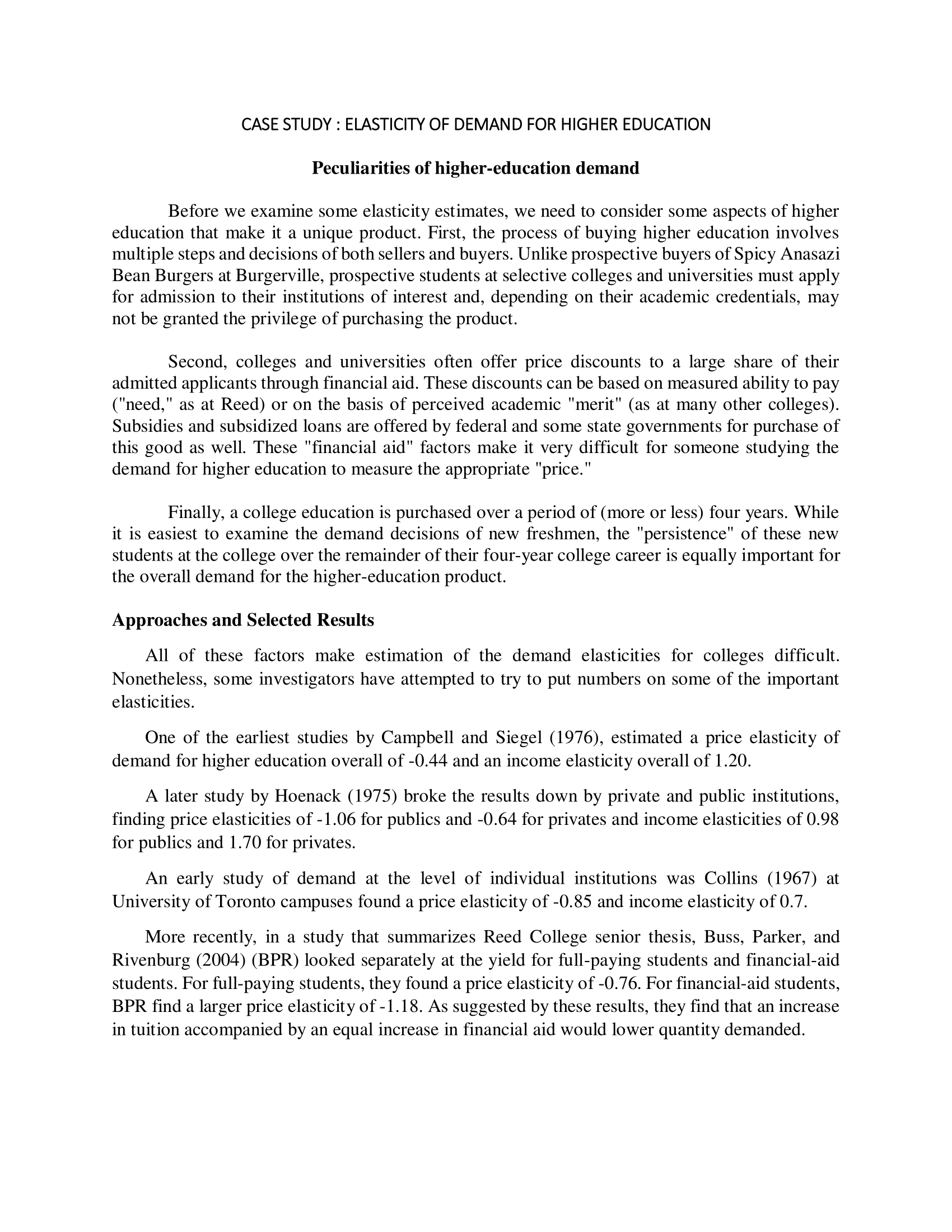
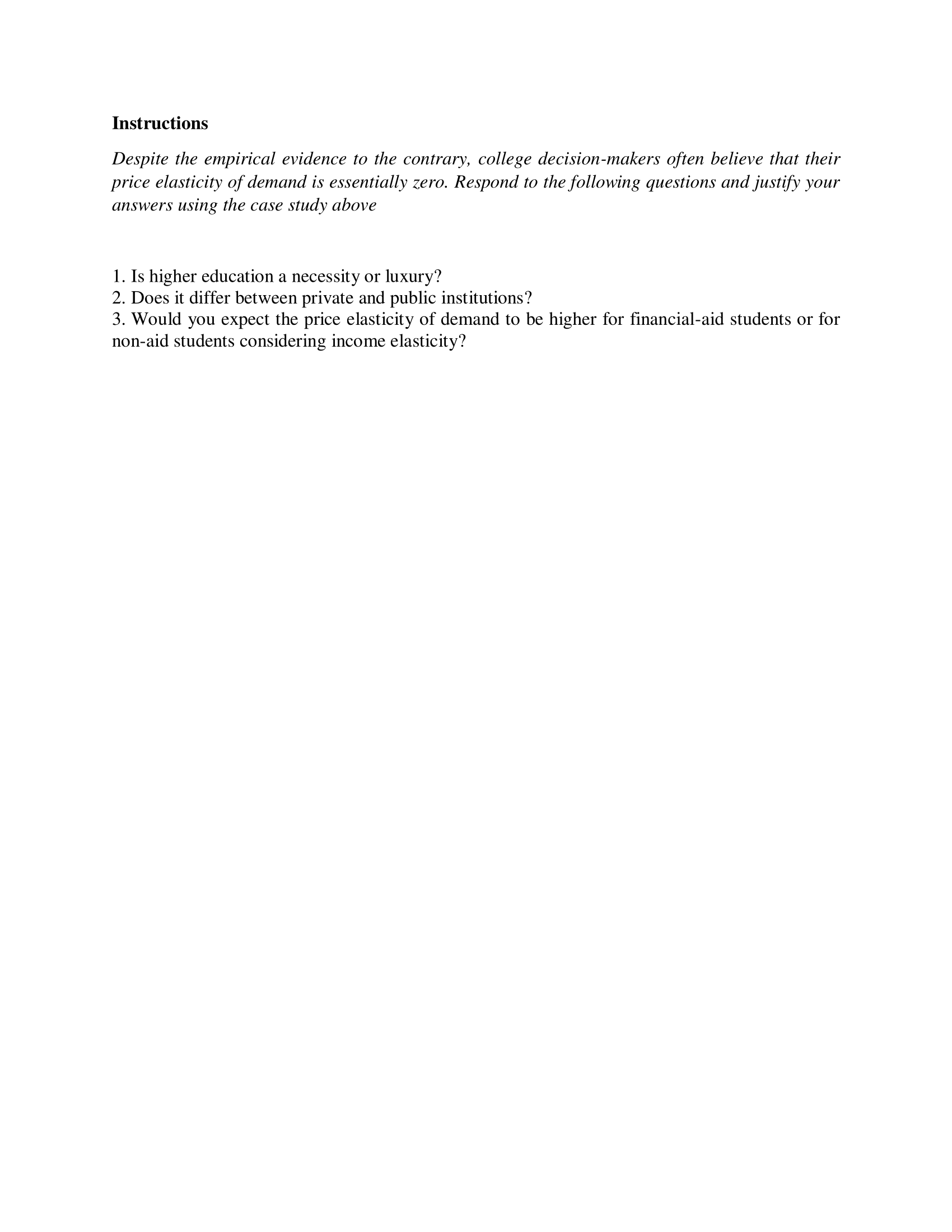
CASE STU DY : ELASTICITY 0F DEMAND FOR HIGHER EDUCATION Peculiarities 0f higher-education demand Before we examine some elasticity estimates, we need to consider some aspects of higher education that make it a unique product. First, the process of buying higher education involves multiple steps and decisions of both sellers and buyers. Unlike prospective buyers of Spicy Anasazi Bean Burgers at Burgerville, prospective students at selective colleges and universities must apply for admission to their institutions of interest and, depending on their academic credentials, may not be granted the privilege of purchasing the product. Second, colleges and universities often offer price discounts to a large share of their admitted applicants through nancial aid. These discounts can be based on measured ability to pay ("need," as at Reed) or on the basis of perceived academic "merit" (as at many other colleges). Subsidies and subsidized loans are offered by federal and some state governments for purchase of this good as well. These "nancial aid" factors make it very difficult for someone studying the demand for higher education to measure the appropriate "price." Finally, a college education is purchased over a period of (more or less) four years. While it is easiest to examine the demand decisions of new freshmen, the "persistence" of these new students at the college over the remainder of their four-year college career is equally important for the overall demand for the highereducation product. Approaches and Selected Results All of these factors make estimation of the demand elasticities for colleges difficult. Nonetheless, some investigators have attempted to try to put numbers on some of the important elasticities. One of the earliest studies by Campbell and Siegel (1976), estimated a price elasticity of demand for higher education overall of 0.44 and an income elasticity overall of 1.20. A later study by Hoenack (1975) broke the results down by private and public institutions, finding price elasticities of -1.06 for publics and -0.64 for privates and income elasticities of 0.98 for publics and 1.70 for privates. An early study of demand at the level of individual institutions was Collins (1967) at University of Toronto campuses found a price elasticity of -0.85 and income elasticity of 0.7. More recently, in a study that summarizes Reed College senior thesis, Buss, Parker, and Rivenburg (2004) (BPR) looked separately at the yield for fullpaying students and nancialaid students. For full-paying students, they found a price elasticity of -0.76. For financial-aid students, BPR nd a larger price elasticity of -1.18. As suggested by these results, they nd that an increase in tuition accompanied by an equal increase in nancial aid would lower quantity demanded. Instructions Despite the empirical evidence to the contrary, college decisionmakers often believe that their price elasticity of demand is essentially zero. Respond to the following questions and justify your answers using the case study above 1. Is higher education a necessity or luxury? 2. Does it differ between private and public institutions? 3. Would you expect the price elasticity of demand to be higher for nancial-aid students or for non-aid students considering income elasticity
Step by Step Solution
There are 3 Steps involved in it

Get step-by-step solutions from verified subject matter experts