







Question: Case Stud Jaqual tlectr OlllCS. Irtc (This case study is derived from one Mitten by Frank C. Burinsky and Michael A. McGinnis. Shippensburg University. The
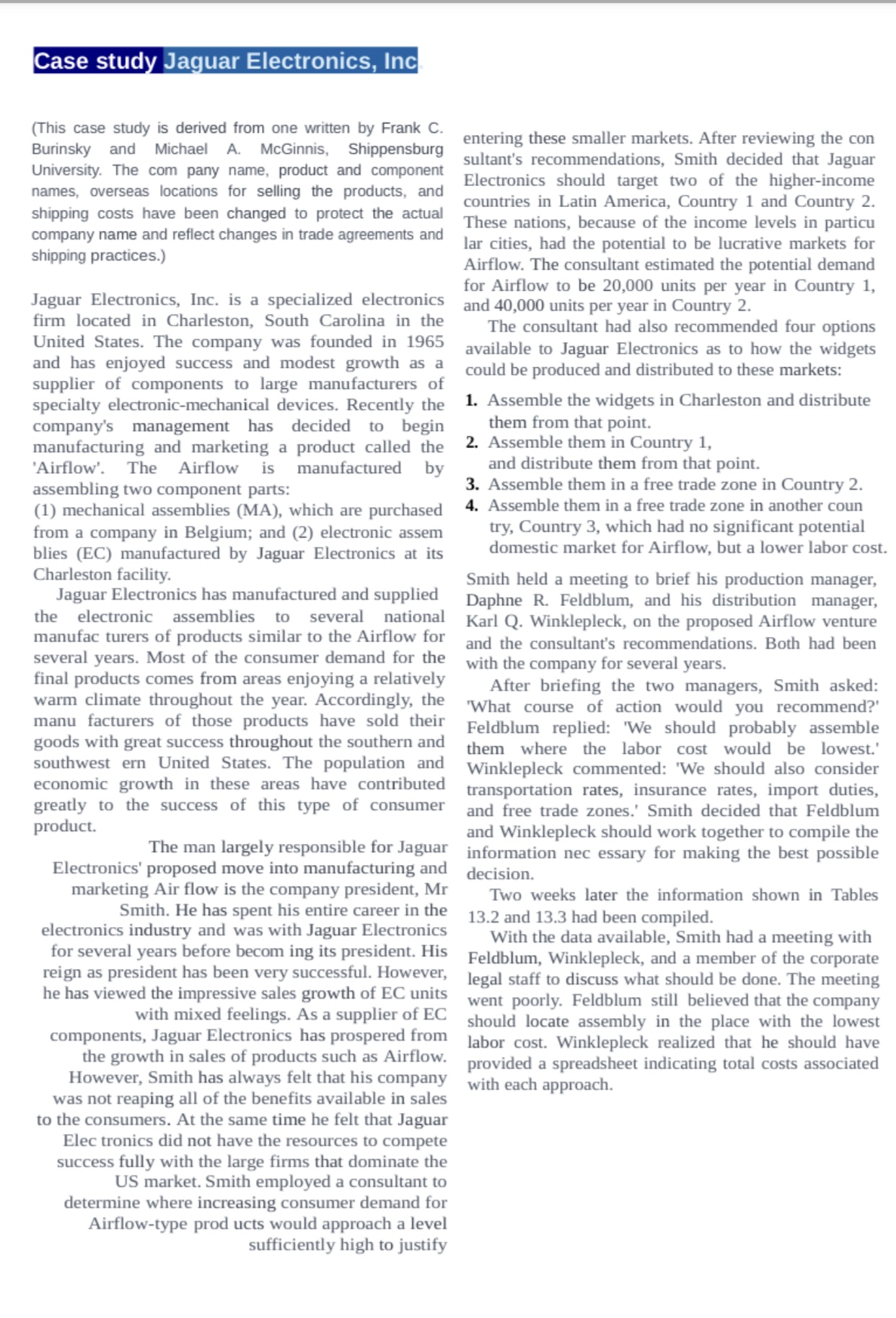
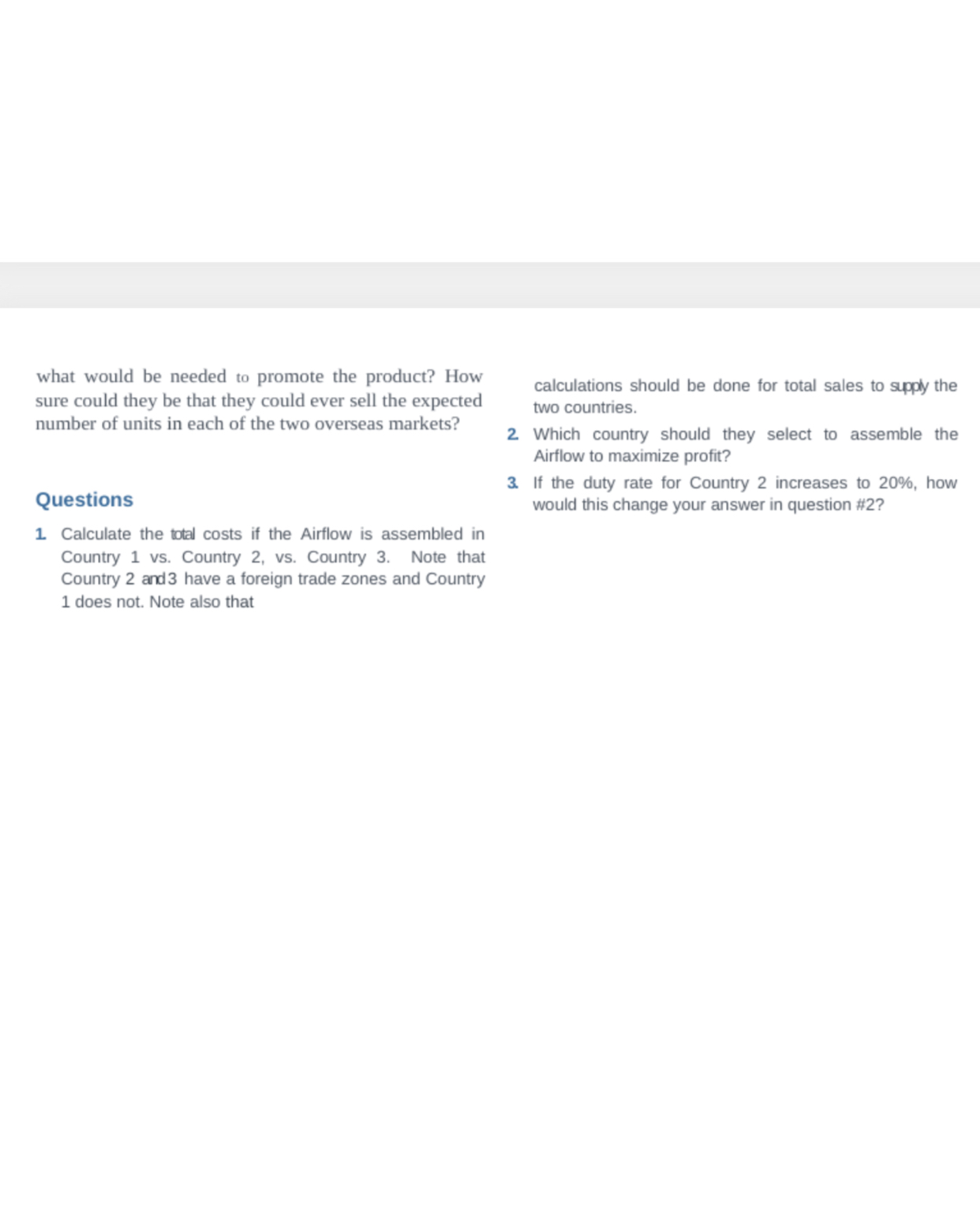
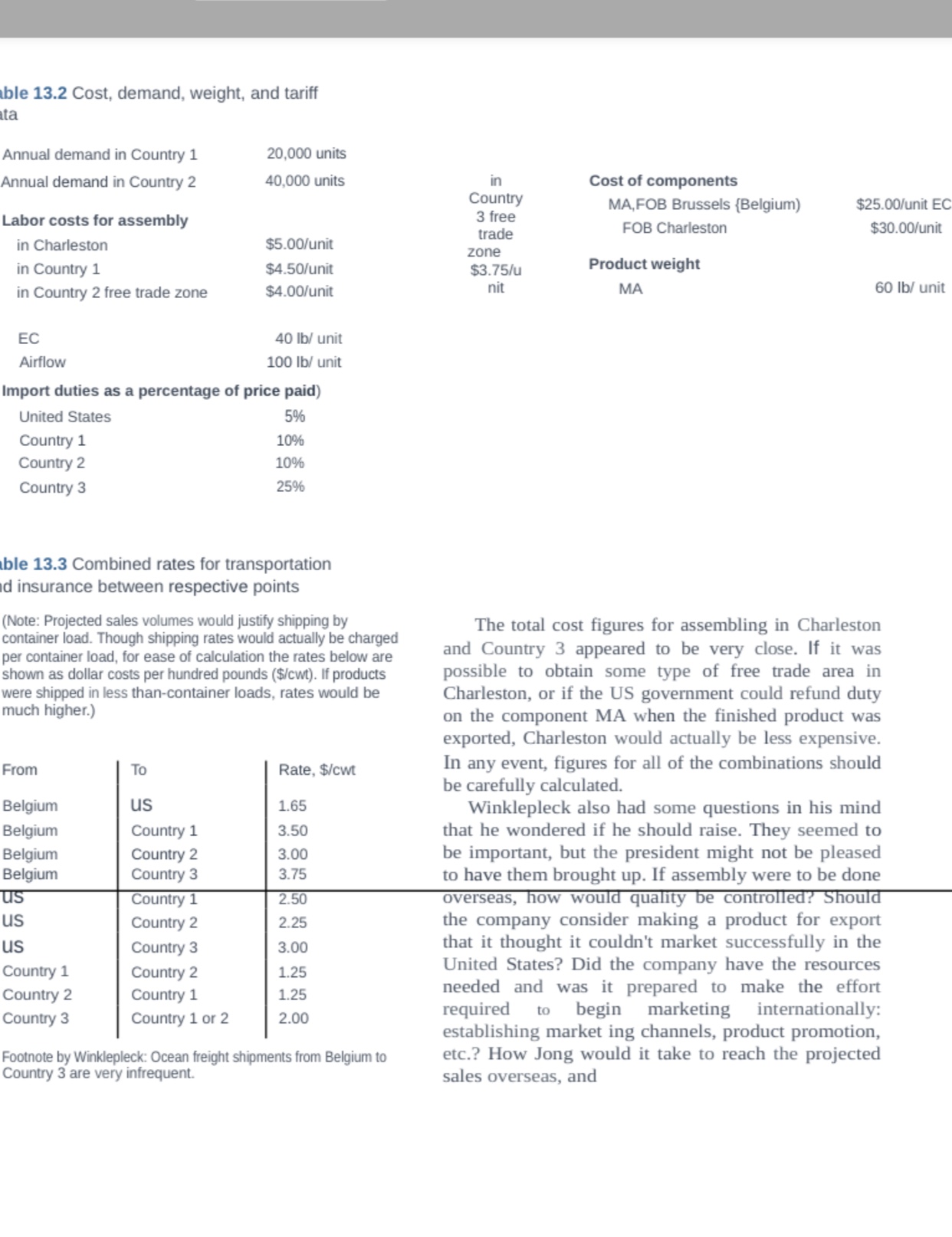
Case Stud Jaqual tlectr OlllCS. Irtc (This case study is derived from one Mitten by Frank C. Burinsky and Michael A. McGinnis. Shippensburg University. The com pany name. product and component names. oversea locations for selling the products. and sh'pping costs have been changed to protect the actual company name and reect changes it trade agreements and shipping practices.) Jaguar Electronics, Inc. is a specialized electronics rm located in Charleston, South Carolina in the United States. The company was founded in 1965 and has enjoyed success and modest growth as a supplier of components to large manufacturers of specialty electronic-mechanical devices. Recently the company's management has decided to begin manufacturing and marketing a product called the 'Airow'. The Airflow is manufactured by assembling two component parts: (1) mechanical assemblies (MA), which are purchased from a company in Belgium; and (2) electronic assem blies (EC) manufactured by Jaguar Electronics at its Charleston facility. Jaguar Electronics has manufactured and supplied the electronic assemblies to several national manufac turers of products similar to the Airow for several years. Most of the consumer demand for the nal products comes from areas enjoying a relatively warm climate throughout the year. Accordingly. the manu facturers of those products have sold their goods with great success throughout the southern and southwest em United States. The population and economic growth in these areas have contributed greatly to the success of this type of consumer product. The man largely responsible for Jaguar Electronics' proposed move into manufacturing and marketing Air ow is the company president. Mr Smith. He has spent his entire career in the electronics industry and was with Jaguar Electronics for several years before becom ing its president. His reign as president has been very successful. However. he has viewed the impressive sales growth of EC units with mixed feelings. As a supplier of EC components, Jaguar Electronics has prospered from the growth in sales of products such as Airow. However, Smith has always felt that his company was not reaping all of the benets available in sales to the consumers. At the same time he felt that Jaguar Elec tronics did not have the resources to compete success fully with the large firms that dominate the US market. Smith employed a consultant to determine where increasing consumer demand for Airow-type prod ucts would approach a level sufficiently high to justify entering these smaller markets. After reviewing the con sultant's recommendations. Smith decided that Jaguar Electronics should target two of the higher-income countries in Latin America, Country 1 and Country 2. These nations, because of the income levels in particu lar cities, had the potential to be lucrative markets for Airow. The consultant estimated the potential demand for Airflow to be 20,000 units per year in Country 1. and 40,000 units per year in Country 2. The consultant had also recommended four options available to Jaguar Electronics as to how the widgets could be produced and distributed to these markets: I. Assemble the widgets in Charleston and distribute them from that point. 2. Assemble them in Country 1, and distribute them from that point. 3. Assemble them in a free trade zone in Country 2. 4. Assemble them in a free trade zone in another coun try, Country 3, which had no signicant potential domestic market for Airflow, but a lower labor cost- Smith held a meeting to brief his production manager, Daphne R. Feldblum, and his distribution manager, Karl Q. Winklepleck. on the proposed Airflow venture and the consultants recommendations. Both had been with the company for several years. After brieng the two managers. Smith asked: 'What course of action would you recommend?" Feldblum replied: 'We should probably assemble them where the labor cost would be lowest.' Winklepleck commented: 'We should also consider transportation rates. insurance rates. import duties. and free trade zones.' Smith decided that Feldblum and Winklepleck should work together to compile the information nec essary for making the best possible decision. \"ve weeks later the information shown in Tables 13.2 and 13.3 had been compiled. With the data available, Smith had a meeting with Feldblum, Winklepleck. and a member of the corporate legal staff to discuss what should be done. The meeting went poorly. Feldblum still believed that the company should locate assembly in the place with the lowest labor cost. Winklepleck realized that he should have provided a spreadsheet indicating total costs associated with each approach. what would be needed to promote the product? How sure could they be that they could ever sell the expected calculations should be done for total sales to supply the number of units in each of the two overseas markets? two countries. 2 Which country should they select to assemble the Airflow to maximize profit? Questions 3. If the duty rate for Country 2 increases to 20%, how would this change your answer in question #2? 1 Calculate the total costs if the Airflow is assembled in Country 1 vs. Country 2, vs. Country 3. Note that Country 2 and 3 have a foreign trade zones and Country 1 does not. Note also thatble 13.2 Cost, demand, weight, and tariff ta Annual demand in Country 1 20,000 units Annual demand in Country 2 40,000 units in Cost of components Country MA,FOB Brussels {Belgium) $25.00/unit EC Labor costs for assembly 3 free FOB Charleston $30.00/unit in Charleston $5.00/unit trade zone in Country 1 $4.50/unit $3.75/u Product weight in Country 2 free trade zone $4.00/unit nit MA 60 lb/ unit EC 40 lb/ unit Airflow 100 lb/ unit Import duties as a percentage of price paid) United States 5% Country 1 10% Country 2 10% Country 3 25% ble 13.3 Combined rates for transportation d insurance between respective points Note: Projected sales volumes would justify shipping by container load. Though shipping rates would actually be charged The total cost figures for assembling in Charleston per container load, for ease of calculation the rates below are and Country 3 appeared to be very close. If it was shown as dollar costs per hundred pounds ($/cwt). If products possible to obtain some type of free trade area in were shipped in less than-container loads, rates would be much higher.) Charleston, or if the US government could refund duty on the component MA when the finished product was exported, Charleston would actually be less expensive. From To Rate, $/cwt In any event, figures for all of the combinations should be carefully calculated. Belgium us 1.65 Winklepleck also had some questions in his mind Belgium Country 1 3.50 that he wondered if he should raise. They seemed to Belgium Country 2 3.00 be important, but the president might not be pleased Belgium Country 3 3.75 to have them brought up. If assembly were to be done Us Country 1 2.50 overseas, how would quality be controlled? Should us Country 2 2.25 the company consider making a product for export us Country 3 3.00 that it thought it couldn't market successfully in the Country 1 Country 2 1.25 United States? Did the company have the resources Country 2 Country 1 1.25 needed and was it prepared to make the effort Country 3 Country 1 or 2 2.00 required to begin marketing internationally: establishing market ing channels, product promotion, Footnote by Winklepleck: Ocean freight shipments from Belgium to etc.? How Jong would it take to reach the projected Country 3 are very infrequent. sales overseas, and
Step by Step Solution
There are 3 Steps involved in it

Get step-by-step solutions from verified subject matter experts
 Study Help