Question: case study 1) what issues does Bob Hamilton have to resolve? 2) do you believe the consultant's savings estimate? where will the savings come from?
case study
1) what issues does Bob Hamilton have to resolve?
2) do you believe the consultant's savings estimate? where will the savings come from?
3) who are the real winners here if the consortium model is adopted? who are the losers?
4) do you think you can convince all four of the districts to adopt the consortium model? what would you do if only 2 or 3 districts wanted to proceed? 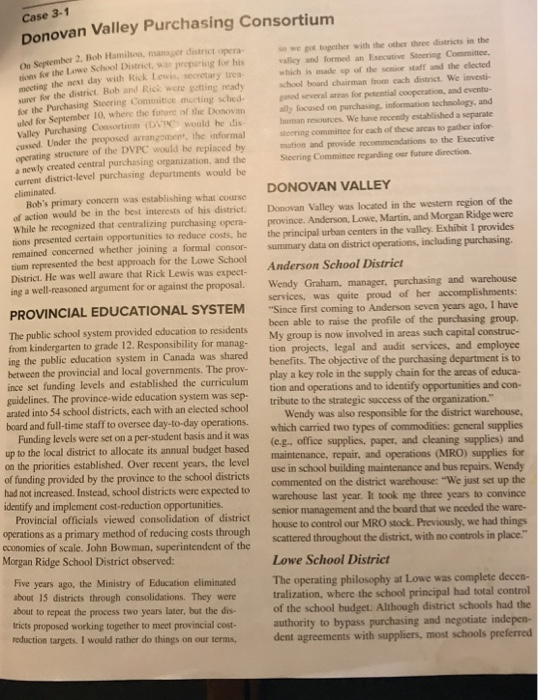
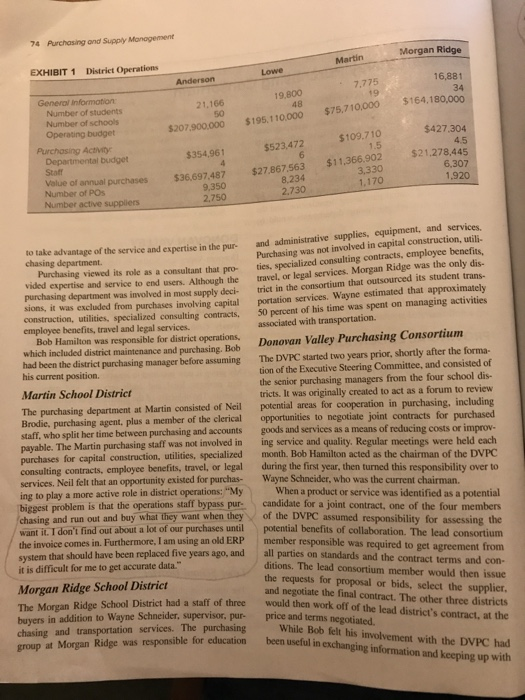
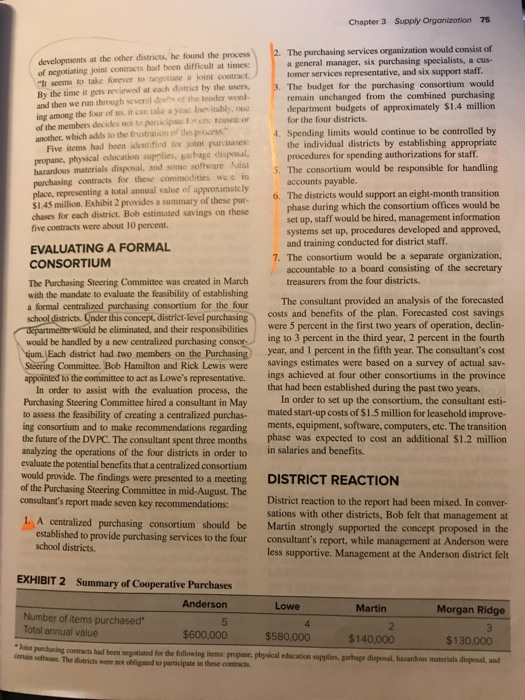
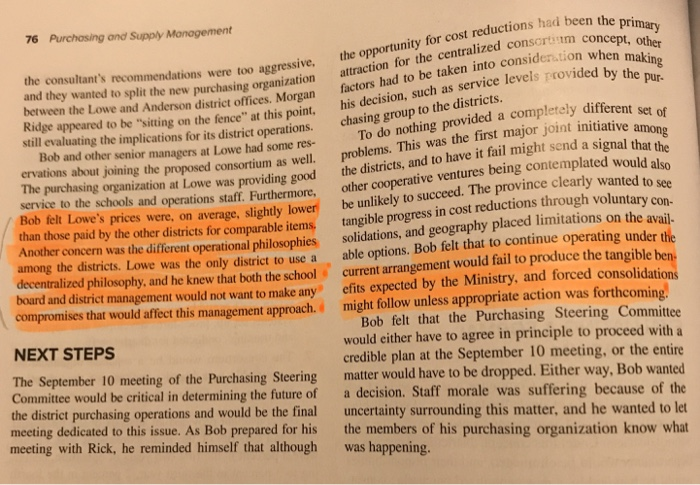
Case 3-1 Donovan Valley Purchasing Consortium we got together with the other the district is the walley and formed an Executive Steering Committee which is made up of the nice staff and the elected chool board chairman from each district. We vesti pated several areas for potential cooperation, and eventu- ally focused on purchasing, information technology, and man resources. We have recently established a separate steering committee for each of these areas to gather infor mation and provide recommendations to the Executive Steering Committee regarding our future direction September 2. Bob Hamile man district opera for the Law School District, preparing for his the next day with Rick Leie tary tres ser for the district. Bob and Rick were setting ready y the Purchasing Steering Committee meeting ched September to where the fun the Valley Purchasing Consortium ( D w ould be dis w Under the proposed arrangement, the informal operating structure of the DVPC would be replaced by a newly created central purchasing organization, and the current district-level purchasing departments would be climinated Bob's primary concern was establishing what course of action would be in the best interests of his district. While he recognized that centralizing purchasing opera tions presented certain opportunities to reduce costs, he remained concerned whether joining a formal consor tium represented the best approach for the Lowe School District. He was well aware that Rick Lewis was expect ing a well-reasoned argument for or against the proposal. PROVINCIAL EDUCATIONAL SYSTEM The public school system provided education to residents from kindergarten to grade 12. Responsibility for manag- ing the public education system in Canada was shared between the provincial and local governments. The prov- ince set funding levels and established the curriculum guidelines. The province-wide education system was sep- arated into 54 school districts, each with an elected school board and full-time staff to oversee day-to-day operations. Funding levels were set on a per-student basis and it was up to the local district to allocate its annual budget based on the priorities established. Over recent years, the level of funding provided by the province to the school districts had not increased. Instead, school districts were expected to identify and implement cost-reduction opportunities. Provincial officials viewed consolidation of district perations as a primary method of reducing costs through nomies of scale. John Bowman, superintendent of the forgan Ridge School District observed: Five years ago, the Ministry of Education eliminated about 15 districts through consolidations. They were about to repeat the process two years later, but the dis- tricts proposed working together to meet provincial cost- reduction targets. I would rather do things on our terms, DONOVAN VALLEY Donovan Valley was located in the western region of the province. Anderson, Lowe, Martin, and Morgan Ridge were the principal urban centers in the valley Exhibit I provides summary data on district operations, including purchasing. Anderson School District Wendy Graham, manager, purchasing and warehouse services, was quite proud of her accomplishments: "Since first coming to Anderson seven years ago, I have been able to raise the profile of the purchasing group. My group is now involved in areas such capital construc- tion projects, legal and audit services, and employee benefits. The objective of the purchasing department is to play a key role in the supply chain for the areas of educa- tion and operations and to identify opportunities and con- tribute to the strategic success of the organization." Wendy was also responsible for the district warehouse, which carried two types of commodities: general supplies (eg, office supplies, paper, and cleaning supplies) and maintenance, repair, and operations (MRO) supplies for use in school building maintenance and bus repairs. Wendy commented on the district warehouse: "We just set up the warehouse last year. It took me three years to convince senior management and the board that we needed the ware- house to controlour MRO stock. Previously, we had things scattered throughout the district, with no controls in place." Lowe School District The operating philosophy at Lowe was complete decen tralization, where the school principal had total control of the school budget. Although district schools had the authority to bypass purchasing and negotiate indepen dent agreements with suppliers, most schools preferred 74 Purchasing and Supply Management Morgan Ridge Martin EXHIBIT 1 District Operations Lowe Anderson 16,881 7.775 19.800 21.166 $164,180,000 $75,7 10,000 $195.110.000 $207.900.000 $109.710 $523,472 1.5 General Information Number of students Number of schools Operating budget Purchasing Activity Departmental budget Staff Value of annual purchases Number of POS Number active suppliers $354961 6 $427,304 4.5 $21.278,445 6,307 1.920 $11,366.902 $36,697,487 9,350 2.750 $27,867.563 8.234 2.730 3,330 1.170 to take advantage of the service and expertise in the pur- chasing department. Purchasing viewed its role as a consultant that pro- vided expertise and service to end users. Although the purchasing department was involved in most supply decl sions, it was excluded from purchases involving capital construction, utilities, specialized consulting contracts, employee benefits, travel and legal services. Bob Hamilton was responsible for district operations which included district maintenance and purchasing. Bob had been the district purchasing manager before assuming his current position. Martin School District The purchasing department at Martin consisted of Neil Brodie, purchasing agent, plus a member of the clerical staff, who split her time between purchasing and accounts payable. The Martin purchasing staff was not involved in purchases for capital construction, utilities, specialized consulting contracts, employee benefits, travel, or legal services. Neil felt that an opportunity existed for purchas- ing to play a more active role in district operations: "My biggest problem is that the operations staff bypass pur chasing and run out and buy what they want when they want it. I don't find out about a lot of our purchases until the invoice comes in. Furthermore, I am using an old ERP system that should have been replaced five years ago, and it is difficult for me to get accurate data." Morgan Ridge School District The Morgan Ridge School District had a staff of three huyers in addition to Wayne Schneider, supervisor, pur chasing and transportation services. The purchasing group at Morgan Ridge was responsible for education and administrative supplies, equipment, and services. Purchasing was not involved in capital construction, utili ties, specialized consulting contracts, employee benefits, travel, or legal services. Morgan Ridge was the only dis- trict in the consortium that outsourced its student trans- portation services. Wayne estimated that approximately 50 percent of his time was spent on managing activities associated with transportation. Donovan Valley Purchasing Consortium The DVPC started two years prior, shortly after the forma tion of the Executive Steering Committee, and consisted of the senior purchasing managers from the four school dis- tricts. It was originally created to act as a forum to review potential areas for cooperation in purchasing, including opportunities to negotiate joint contracts for purchased goods and services as a means of reducing costs or improv- ing service and quality. Regular meetings were held each month. Bob Hamilton acted as the chairman of the DVPC during the first year, then turned this responsibility over to Wayne Schneider, who was the current chairman. When a product or service was identified as a potential candidate for a joint contract, one of the four members of the DVPC assumed responsibility for assessing the potential benefits of collaboration. The lead consortium member responsible was required to get agreement from all parties on standards and the contract terms and con- ditions. The lead consortium member would then issue the requests for proposal or bids, select the supplier. and negotiate the final contract. The other three districts would then work off of the lead district's contract, at the price and terms is negotiated While Bob felt his involvement with the DVPC had been useful in exchanging information and keeping up with sible for education been Chapter 3 Supply Organization 75 developments at the other districts, he found the process of negotiating joint contracts had been difficult at times: It seems to take forever to becoise a joint contract By the time it gets reviewed at each district by the users. and then we run through several of the tender word ing among the four of us, it can take a year netbly one of the members decides not to participate to reason or another, which adds to the stration of the process." Five items had been identified for joint purchases: propane, physical education supplies, garbage disposal, hazardous materials disposal, and some software Point purchasing contracts for these commodities wwe in place, representing a total annual value of approximately $1.45 million. Exhibit 2 provides a summary of these pur- chases for each district, Bob estimated savings on these five contracts were about 10 percent. The purchasing services organization would consist of a general manager, six purchasing specialists, a cus- tomer services representative, and six support staff. The budget for the purchasing consortium would remain unchanged from the combined purchasing department budgets of approximately $1.4 million for the four districts. Spending limits would continue to be controlled by the individual districts by establishing appropriate procedures for spending authorizations for staff. The consortium would be responsible for handling accounts payable. The districts would support an eight-month transition phase during which the consortium offices would be set up, staff would be hired, management information systems set up, procedures developed and approved, and training conducted for district staff. The consortium would be a separate organization, accountable to a board consisting of the secretary treasurers from the four districts. EVALUATING A FORMAL CONSORTIUM The Purchasing Steering Committee was created in March with the mandate to evaluate the feasibility of establishing a formal centralized purchasing consortium for the four school districts. Under this concept, district-level purchasing departments would be eliminated, and their responsibilities would be handled by a new centralized purchasing consor tum. Each district had two members on the Purchasine Steering Committee. Bob Hamilton and Rick Lewis were appointed to the committee to act as Lowe's representative. In order to assist with the evaluation process, the Purchasing Steering Committee hired a consultant in May to assess the feasibility of creating a centralized purchas- ing consortium and to make recommendations regarding the future of the DVPC The consultant spent three months analyzing the operations of the four districts in order to evaluate the potential benefits that a centralized consortium would provide. The findings were presented to a meeting of the Purchasing Steering Committee in mid-August. The consultant's report made seven key recommendations: 1. A centralized purchasing consortium should be established to provide purchasing services to the four school districts. The consultant provided an analysis of the forecasted costs and benefits of the plan. Forecasted cost savings were 5 percent in the first two years of operation, declin- ing to 3 percent in the third year, 2 percent in the fourth year, and I percent in the fifth year. The consultant's cost savings estimates were based on a survey of actual sav- ings achieved at four other consortiums in the province that had been established during the past two years. In order to set up the consortium, the consultant esti- mated start-up costs of $1.5 million for leasehold improve- ments, equipment, software, computers, etc. The transition phase was expected to cost an additional $1.2 million in salaries and benefits. DISTRICT REACTION District reaction to the report had been mixed. In conver- sations with other districts, Bob felt that management at Martin strongly supported the concept proposed in the consultant's report, while management at Anderson were less supportive. Management at the Anderson district felt EXHIBIT 2 Summary of Cooperative Purchases Anderson Lowe Martin Morgan Ridge Number of items purchased Total annual value $600,000 $580,000 $140,000 $130,000 purchasing acts had been spotted for the following tema propune physical education supplies, partage disposal haardous materials disposal mais software. The districts were obligated to participate in these contracts 5 2 been the primary 76 Purchasing and Supply Management the opportunity for cost reductions ha attraction for the centralized consori factors had to be taken into consideration vided by the pur- joint initiative among oht send a signal that the the consultant's recommendations were too aggressive, and they wanted to split the new purchasing organization between the Lowe and Anderson district offices. Morgan Ridge appeared to be "sitting on the fence" at this point, still evaluating the implications for its district operations. Bob and other senior managers at Lowe had some res- ervations about joining the proposed consortium as well The purchasing organization at Lowe was providing good service to the schools and operations staff. Furthermore, Bob felt Lowe's prices were, on average, slightly lower than those paid by the other districts for comparable items. Another concern was the different operational philosophies among the districts. Lowe was the only district to use a decentralized philosophy, and he knew that both the school board and district management would not want to make any compromises that would affect this management approach. lized consortium concept, Other ken into consideration when makine his decision, such as service levels provided by th chasing group to the districts. rovided a completely different set of To do nothing provided a completely dif problems. This was the first major joint initiativ the districts, and to have it fail might send a signal the other cooperative ventures being contemplated would al be unlikely to succeed. The province clearly wanted tangible progress in cost reductions through voluntary solidations, and geography placed limitations on the avail able options. Bob felt that to continue operating under the current arrangement would fail to produce the tangible ben efits expected by the Ministry, and forced consolidations might follow unless appropriate action was forthcoming ductions through voluntary con- NEXT STEPS The September 10 meeting of the Purchasing Steering Committee would be critical in determining the future of the district purchasing operations and would be the final meeting dedicated to this issue. As Bob prepared for his meeting with Rick, he reminded himself that although Bob felt that the Purchasing Steering Committee would either have to agree in principle to proceed with a credible plan at the September 10 meeting, or the entire matter would have to be dropped. Either way, Bob wanted a decision. Staff morale was suffering because of the uncertainty surrounding this matter, and he wanted to let the members of his purchasing organization know what was happening









 Study Help