







Question: Case Study 1. Which challenges face the project? 2. Did the project face scope changes? Explain 3. As one of the key challenges in implementing
Case Study
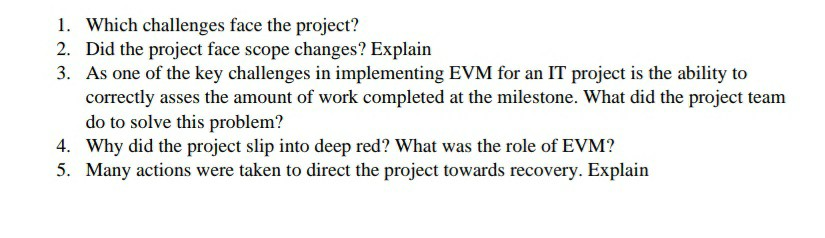
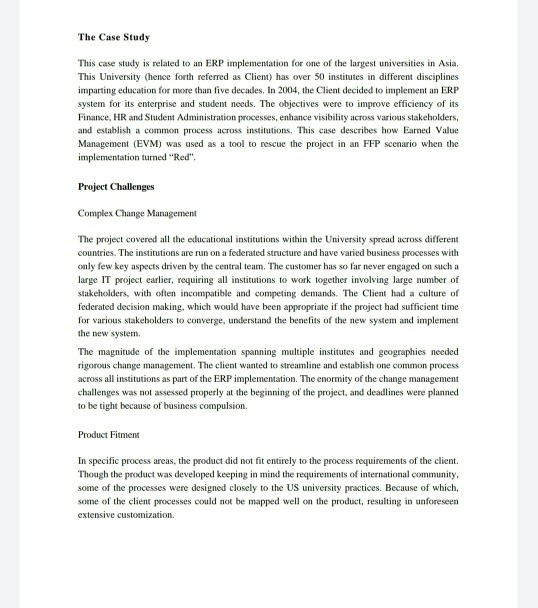
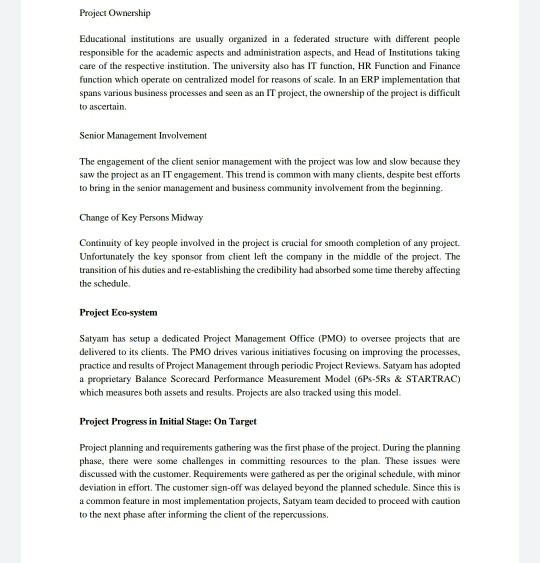
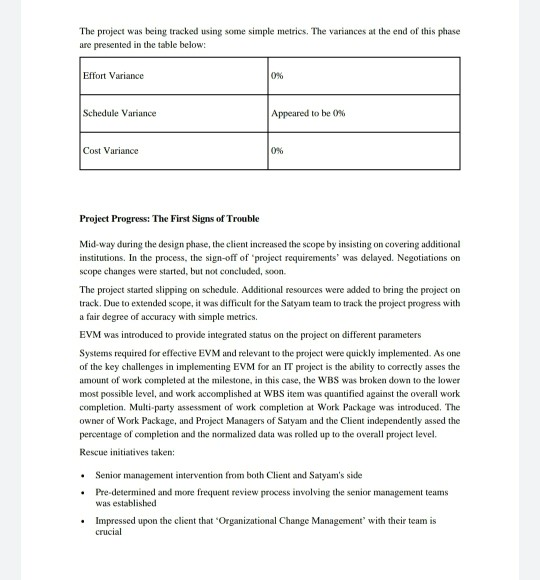
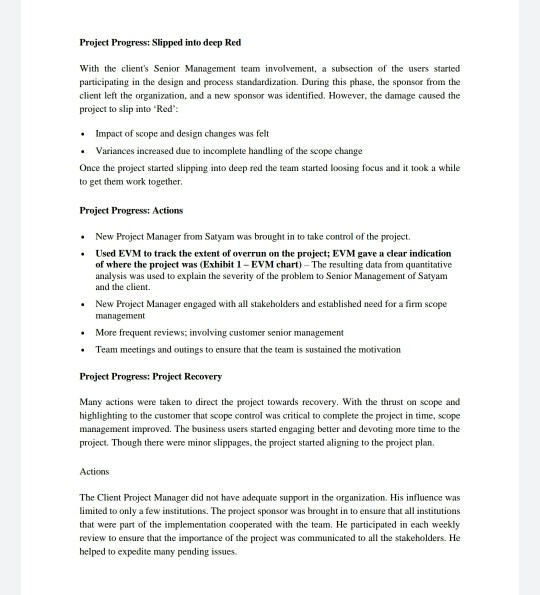
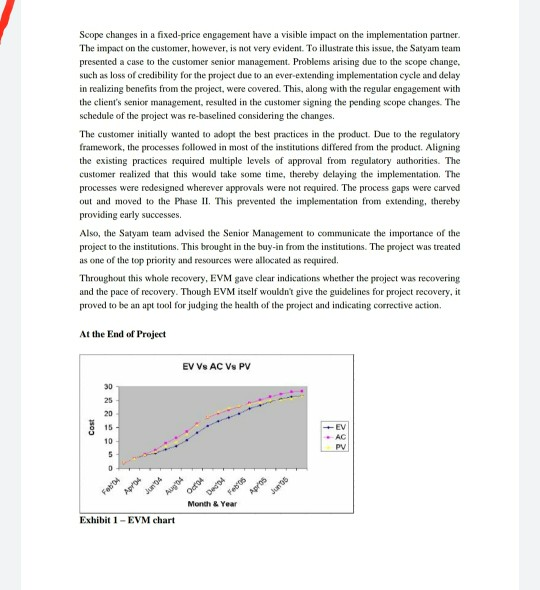
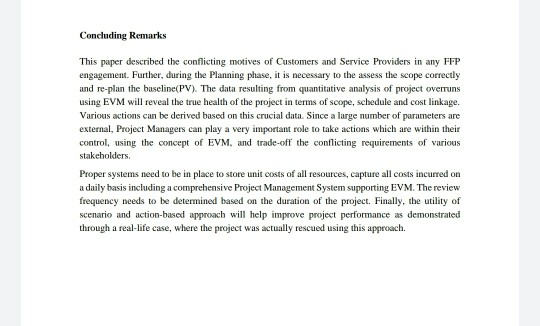
1. Which challenges face the project? 2. Did the project face scope changes? Explain 3. As one of the key challenges in implementing EVM for an IT project is the ability to correctly asses the amount of work completed at the milestone. What did the project team do to solve this problem? 4. Why did the project slip into deep red? What was the role of EVM? 5. Many actions were taken to direct the project towards recovery. Explain The Case Study This case study is related to an ERP implementation for one of the largest universities in Asia. This University (hence forth referred as Client) has over 50 institutes in different disciplines imparting education for more than five decades. In 2004, the Client decided to implement an ERP system for its enterprise and student needs. The objectives were to improve efficiency of its Finance, HR and Student Administration processes, enhance visibility across various stakeholders, and establish a common process across institutions. This case describes how Earned Value Management (EVM) was used as a tool to rescue the project in an FFP scenario when the implementation turned "Red". Project Challenges Complex Change Management The project covered all the educational institutions within the University spread across different countries. The institutions are run on a federated structure and have varied business processes with only few key aspects driven by the central team. The customer has so far never engaged on such a large IT project carlier, requiring all institutions to work together involving large number of stakeholders, with often incompatible and competing demands. The Client had a culture of federated decision making, which would have been appropriate if the project had sufficient time for various stakeholders to converge, understand the benefits of the new system and implement the new system, The magnitude of the implementation spanning multiple institutes and geographies needed rigorous change management. The client wanted to streamline and establish one common process across all institutions as part of the ERP implementation. The enormity of the change management challenges was not assessed properly at the beginning of the project, and deadlines were planned to be tight because of business compulsion. Product Fitment In specific process areas, the product did not fit entirely to the process requirements of the client. Though the product was developed keeping in mind the requirements of international community, some of the processes were designed closely to the US university practices. Because of which, some of the client processes could not be mapped well on the product, resulting in unforeseen extensive customization The project was being tracked using some simple metrics. The variances at the end of this phase are presented in the table below: Effort Variance Schedule Variance Appeared to be 0% Cost Variance On Project Progress: The First Signs of Trouble Mid-way during the design phase, the client increased the scope by insisting on covering additional institutions. In the process, the sign-off of project requirements' was delayed. Negotiations on scope changes were started, but not concluded, soon. The project started slipping on schedule. Additional resources were added to bring the project on track. Due to extended scope, it was difficult for the Satyam team to track the project progress with a fair degree of accuracy with simple metrics. EVM was introduced to provide integrated status on the project on different parameters Systems required for effective EVM and relevant to the project were quickly implemented. As one of the key challenges in implementing EVM for an IT project is the ability to correctly asses the amount of work completed at the milestone, in this case, the WBS was broken down to the lower most possible level, and work accomplished at WBS item was quantified against the overall work completion. Multiparty assessment of work completion at Work Package was introduced. The owner of Work Package, and Project Managers of Satyam and the Client independently assed the percentage of completion and the normalized data was rolled up to the overall project level. Rescue initiatives taken: Senior management intervention from both Client and Satyam's side Pre-determined and more frequent review process involving the senior management teams was established Impressed upon the client that "Organizational Change Management with their team is crucial Project Progress: Slipped into deep Red With the client's Senior Management team involvement, a subsection of the users started participating in the design and process standardization. During this phase, the sponsor from the client left the organization, and a new sponsor was identified. However, the damage caused the project to slip into "Red": Impact of scope and design changes was felt Variances increased due to incomplete handling of the scope change Once the project started slipping into deep red the team started loosing focus and it took a while to get them work together Project Progress: Actions New Project Manager from Satyam was brought in to take control of the project Used EVM to track the extent of overrun on the project; EVM gave a dear indication of where the project was (Exhibit 1 - EVM chart) - The resulting data from quantitative analysis was used to explain the severity of the problem to Senior Management of Satyam and the client. New Project Manager engaged with all stakeholders and established need for a firm scope management More frequent reviews, involving customer senior management Team meetings and outings to ensure that the team is sustained the motivation Project Progress: Project Recovery Many actions were taken to direct the project towards recovery. With the thrust on scope and highlighting to the customer that scope control was critical to complete the project in time, scope management improved. The business users started engaging better and devoting more time to the project. Though there were minor slippages, the project started aligning to the project plan. Actions The Client Project Manager did not have adequate support in the organization. His influence was limited to only a few institutions. The project sponsor was brought in to ensure that all institutions that were part of the implementation cooperated with the team. He participated in each weekly review to ensure that the importance of the project was communicated to all the stakeholders. He helped to expedite many pending issues Scope changes in a fixed-price engagement have a visible impact on the implementation partner The impact on the customer, however, is not very evident. To illustrate this issue, the Satyam team presented a case to the customer senior management. Problems arising due to the scope change. such as loss of credibility for the project due to an ever-extending implementation cycle and delay in realizing benefits from the project, were covered. This, along with the regular engagement with the client's senior management, resulted in the customer signing the pending scope changes. The schedule of the project was re-baselined considering the changes. The customer initially wanted to adopt the best practices in the product. Due to the regulatory framework, the processes followed in most of the institutions differed from the product. Aligning the existing practices required multiple levels of approval from regulatory authorities. The customer realized that this would take some time, thereby delaying the implementation. The processes were redesigned wherever approvals were not required. The process gaps were carved out and moved to the Phase II. This prevented the implementation from extending, thereby providing early successes. Also, the Satyam team advised the Senior Management to communicate the importance of the project to the institutions. This brought in the buy-in from the institutions. The project was treated as one of the top priority and resources were allocated as required Throughout this whole recovery, EVM gave clear indications whether the project was recovering and the pace of recovery. Though EVM itself wouldn't give the guidelines for project recovery, it proved to be an apt tool for judging the health of the project and indicating corrective action At the End of Project EV VS AC Vs PV Cost Month & Year Exhibit 1-EVM chart Concluding Remarks This paper described the conflicting motives of Customers and Service Providers in any FFP engagement. Further, during the Planning phase, it is necessary to the assess the scope correctly and re-plan the baseline(PV). The data resulting from quantitative analysis of project overruns using EVM will reveal the true health of the project in terms of scope, schedule and cost linkage. Various actions can be derived based on this crucial data. Since a large number of parameters are external, Project Managers can play a very important role to take actions which are within their control, using the concept of EVM, and trade-off the conflicting requirements of various stakeholders Proper systems need to be in place to store unit costs of all resources, capture all costs incurred on a daily basis including a comprehensive Project Management System supporting EVM. The review frequency needs to be determined based on the duration of the project. Finally, the utility of scenario and action-based approach will help improve project performance as demonstrated through a real-life case, where the project was actually rescued using this approachStep by Step Solution
There are 3 Steps involved in it
1 Expert Approved Answer
Step: 1 Unlock

Question Has Been Solved by an Expert!
Get step-by-step solutions from verified subject matter experts
Step: 2 Unlock
Step: 3 Unlock
 Study Help