Question: Case Study (10 marks) Read the following case and answer the questions Linkedin: A Table of Two Countries Linkedin bills itself as the world's largest
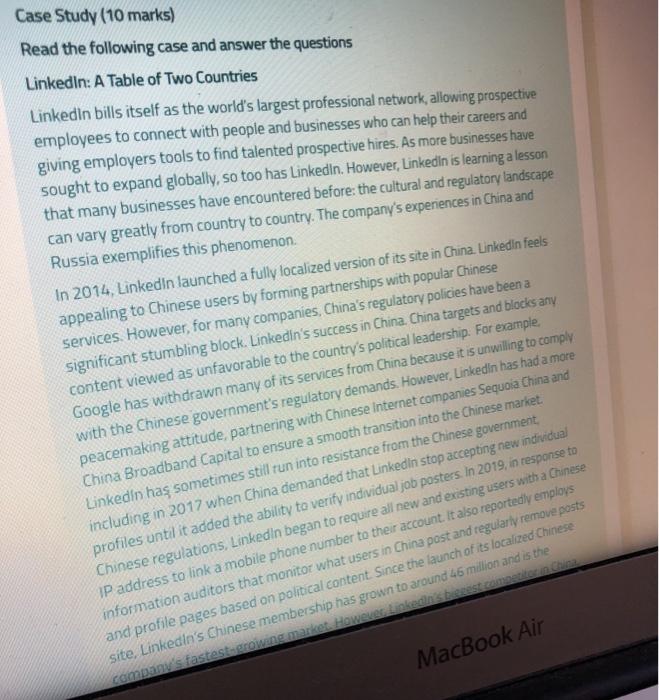
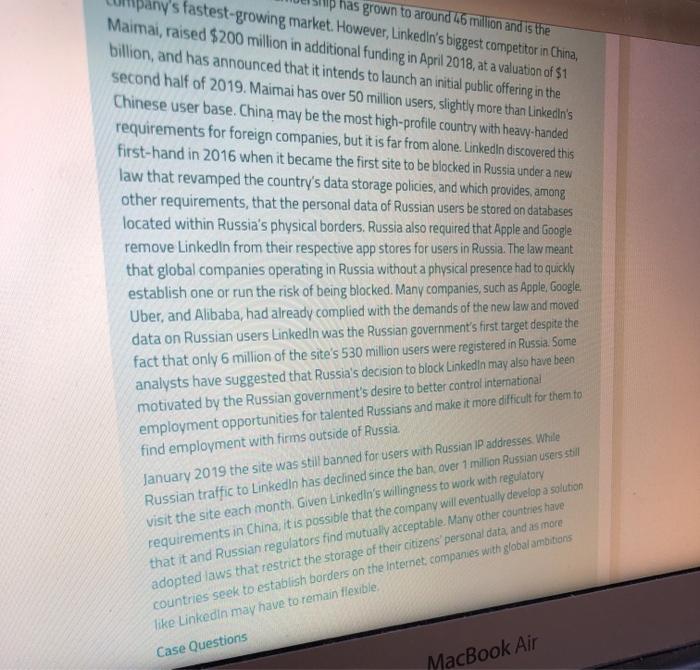
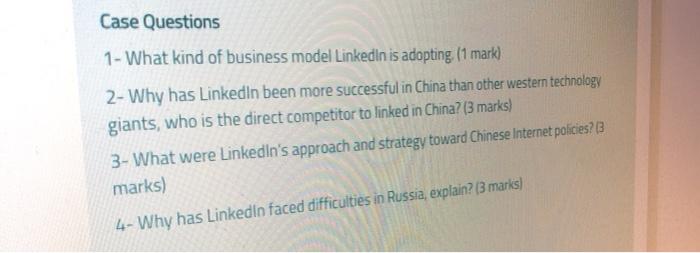
Case Study (10 marks) Read the following case and answer the questions Linkedin: A Table of Two Countries Linkedin bills itself as the world's largest professional network, allowing prospective employees to connect with people and businesses who can help their careers and giving employers tools to find talented prospective hires. As more businesses have sought to expand globally, so too has Linkedin. However, LinkedIn is learning a lesson that many businesses have encountered before: the cultural and regulatory landscape can vary greatly from country to country. The company's experiences in China and Russia exemplifies this phenomenon. In 2014, Linkedin launched a fully localized version of its site in China. Linkedin feels appealing to Chinese users by forming partnerships with popular Chinese services. However, for many companies, China's regulatory policies have been a significant stumbling block. Linkedin's success in China China targets and blocks any content viewed as unfavorable to the country's political leadership. For example, Google has withdrawn many of its services from China because it is unwilling to comply with the Chinese government's regulatory demands. However, Linkedin has had a more peacemaking attitude, partnering with Chinese internet companies Sequoia China and China Broadband Capital to ensure a smooth transition into the Chinese market. Linkedin has sometimes still run into resistance from the Chinese government including in 2017 when China demanded that Linkedin stop accepting new individual profiles until it added the ability to verify individual job posters in 2019, in response to Chinese regulations, Linkedin began to require all new and existing users with a Chinese IP address to link a mobile phone number to their account. It also reportedly employs information auditors that monitor what users in China post and regularly remove posts and profile pages based on political content. Since the launch of its localized Chinese site, Linkedin's Chinese membership has grown to around 46 million and is the company's fastest growing market. However Likeeln bestemte MacBook Air has grown to around 46 million and is the s fastest-growing market. However, Linkedin's biggest competitor in China, Maimai, raised $200 million in additional funding in April 2018, at a valuation of $1 billion, and has announced that it intends to launch an initial public offering in the second half of 2019. Maimai has over 50 million users, slightly more than Linkedin's Chinese user base. China may be the most high-profile country with heavy-handed requirements for foreign companies, but it is far from alone. Linkedin discovered this first-hand in 2016 when it became the first site to be blocked in Russia under a new law that revamped the country's data storage policies, and which provides, among other requirements, that the personal data of Russian users be stored on databases located within Russia's physical borders. Russia also required that Apple and Google remove Linkedin from their respective app stores for users in Russia. The law meant that global companies operating in Russia without a physical presence had to quickly establish one or run the risk of being blocked. Many companies, such as Apple, Google Uber, and Alibaba, had already complied with the demands of the new law and moved data on Russian users Linkedln was the Russian government's first target despite the fact that only 6 million of the site's 530 million users were registered in Russia. Some analysts have suggested that Russia's decision to block Linkedin may also have been motivated by the Russian government's desire to better control international employment opportunities for talented Russians and make it more difficult for them to find employment with firms outside of Russia January 2019 the site was still banned for users with Russian IP addresses While Russian traffic to Linkedin has declined since the ban over 1 million Russian users still visit the site each month. Given Linkedin's willingness to work with regulatory requirements in China, it is possible that the company will eventually develop a solution that it and Russian regulators find mutually acceptable. Many other countries have adopted laws that restrict the storage of their citizens personal data and as more countries seek to establish borders on the internet companies with global ambitions like Linkedin may have to remain flexible Case Questions MacBook Air Case Questions 1- What kind of business model Linkedin is adopting (1 mark) 2- Why has LinkedIn been more successful in China than other western technology giants, who is the direct competitor to linked in China? (3 marks) 3- What were LinkedIn's approach and strategy toward Chinese Internet policies? B marks) 4- Why has Linkedin faced difficulties in Russia, explain









 Study Help