Question: Case Study 1.1 Managing group behavior without formal power Sa'ad recently began taking business courses at his local university. Because, he is tired of working
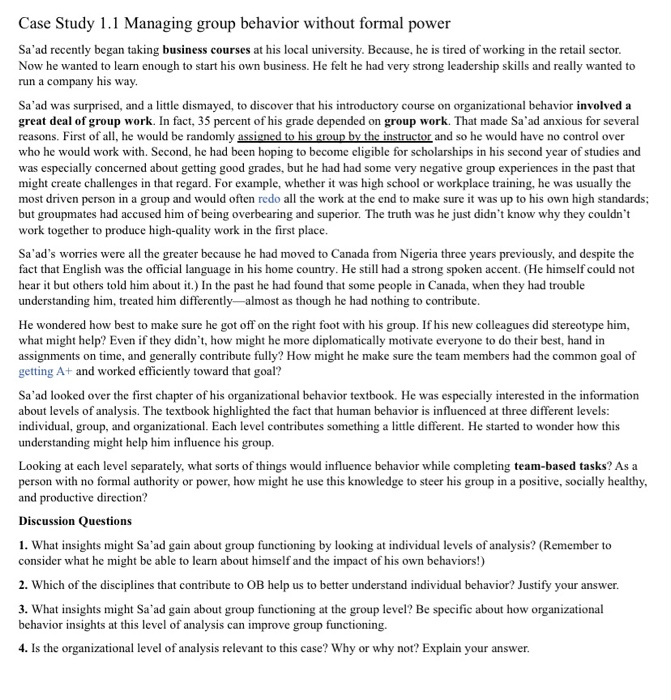
Case Study 1.1 Managing group behavior without formal power Sa'ad recently began taking business courses at his local university. Because, he is tired of working in the retail sector. Now he wanted to learn enough to start his own business. He felt he had very strong leadership skills and really wanted to run a company his way. Sa'ad was surprised, and a little dismayed, to discover that his introductory course on organizational behavior involved a great deal of group work. In fact, 35 percent of his grade depended on group work. That made Sa'ad anxious for several reasons. First of all, he would be randomly assigned to his group by the instructor and so he would have no control over who he would work with. Second, he had been hoping to become eligible for scholarships in his second year of studies and was especially concerned about getting good grades, but he had had some very negative group experiences in the past that might create challenges in that regard. For example, whether it was high school or workplace training, he was usually the most driven person in a group and would often redo all the work at the end to make sure it was up to his own high standards; but groupmates had accused him of being overbearing and superior. The truth was he just didn't know why they couldn't work together to produce high-quality work in the first place. Sa'ad's worries were all the greater because he had moved to Canada from Nigeria three years previously, and despite the fact that English was the official language in his home country. He still had a strong spoken accent. (He himself could not hear it but others told him about it.) In the past he had found that some people in Canada, when they had trouble understanding him, treated him differently-almost as though he had nothing to contribute. He wondered how best to make sure he got off on the right foot with his group. If his new colleagues did stereotype him, what might help? Even if they didn't, how might he more diplomatically motivate everyone to do their best, hand in assignments on time, and generally contribute fully? How might he make sure the team members had the common goal of getting A+ and worked efficiently toward that goal? Sa'ad looked over the first chapter of his organizational behavior textbook. He was especially interested in the information about levels of analysis. The textbook highlighted the fact that human behavior is influenced at three different levels: individual, group, and organizational. Each level contributes something a little different. He started to wonder how this understanding might help him influence his group. Looking at each level separately, what sorts of things would influence behavior while completing team-based tasks? As a person with no formal authority or power, how might he use this knowledge to steer his group in a positive, socially healthy, and productive direction? Discussion Questions 1. What insights might Sa'ad gain about group functioning by looking at individual levels of analysis? (Remember to consider what he might be able to learn about himself and the impact of his own behaviors!) 2. Which of the disciplines that contribute to OB help us to better understand individual behavior? Justify your answer. 3. What insights might Sa'ad gain about group functioning at the group level? Be specific about how organizational behavior insights at this level of analysis can improve group functioning. 4. Is the organizational level of analysis relevant to this case? Why or why not? Explain your









 Study Help