Question: Case Study 14.1 (p. 515, 5 th edition) New Jersey Kills Hudson River Tunnel Project Respond to Questions 2 and 3. ALSO--Review emotional and intellectual
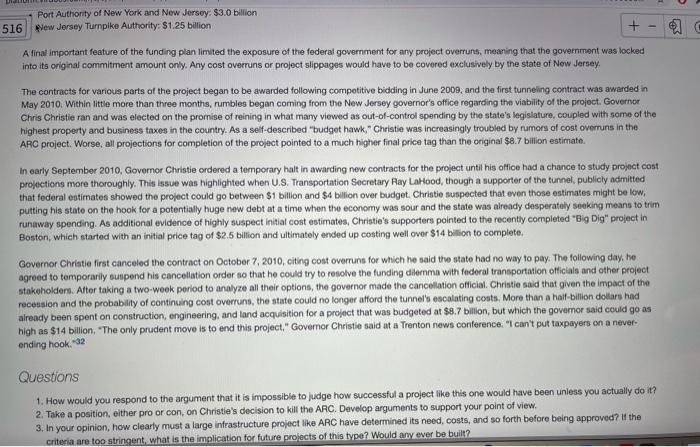
Case Study 14.1 (p. 515, 5th edition) New Jersey Kills Hudson River Tunnel Project
Respond to Questions 2 and 3.
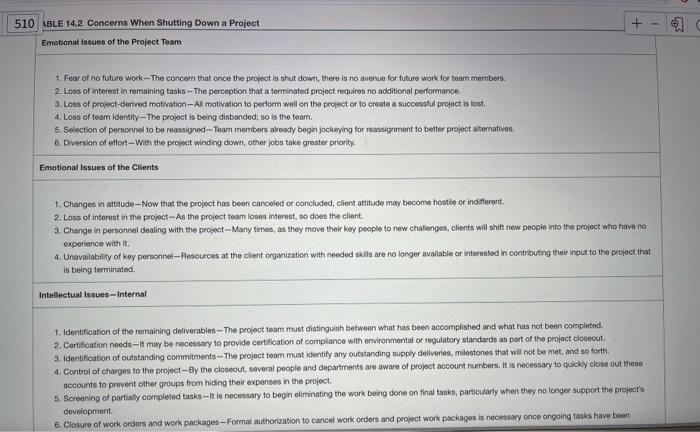
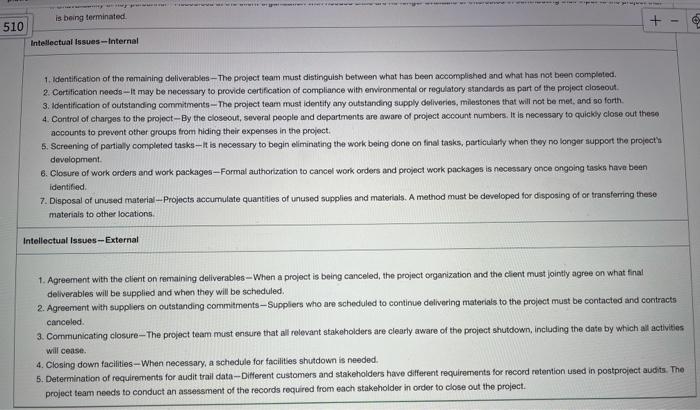
ALSO--Review emotional and intellectual issues identified in Table 14.2: Concerns When Shutting Down a Project. Select three of these 22 concerns that would be relevant to the termination of the Hudson River Project and provide an action plan for addressing each of the them.
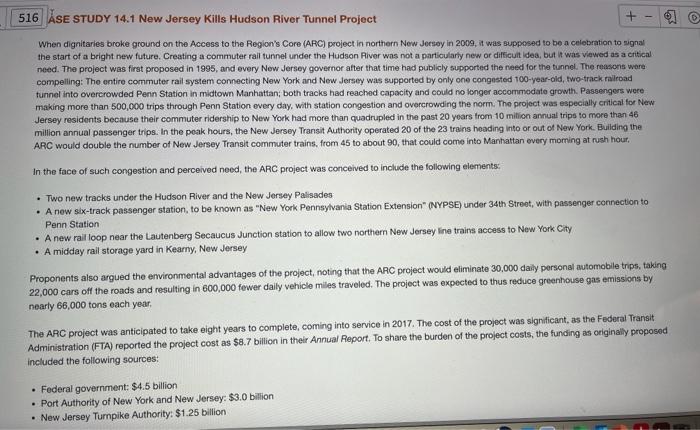
516 ASE STUDY 14.1 New Jersey Kills Hudson River Tunnel Project When dignitaries broke ground on the Access to the Region's Core (ARC) project in northern New Jersey in 2009, it was supposed to be a celebration to signal the start of a bright new future. Creating a commuter rail tunnel under the Hudson River was not a particularly new or difficult idea, but it was viewed as a critical need. The project was first proposed in 1995, and every New Jersey governor after that time had publicly supported the need for the tunnel. The reasons were compelling: The entire commuter rail system connecting New York and New Jersey was supported by only one congosted 100-year-old, two track railroad tunnel into overcrowded Penn Station in midtown Manhattan, both tracks had reached capacity and could no longer accommodate growth. Passengers were making more than 500,000 trips through Penn Station every day, with station congestion and overcrowding the norm. The project was especially critical for New Jersey residents because their commuter ridership to New York had more than quadrupled in the past 20 years from 10 million annual trips to more than 46 million annual passenger trips. In the peak hours, the New Jersey Transit Authority operated 20 of the 23 trains heading into or out of New York. Building the ARC would double the number of New Jersey Transit commuter trains, from 45 to about 90, that could come into Manhattan every morning at rush hour, In the face of such congestion and perceived need, the ARC project was conceived to include the following elements: Two new tracks under the Hudson River and the New Jersey Palisades A new six-track passenger station, to be known as "New York Pennsylvania Station Extension" (NYPSE) under 34th Street, with passenger connection to Penn Station A new rail loop near the Lautenberg Secaucus Junction station to allow two northern New Jersey line trains access to New York City A midday rail storage yard in Kearny, New Jersey Proponents also argued the environmental advantages of the project, noting that the ARC project would eliminate 30,000 daily personal automobile trips, taking 22,000 cars of the roads and resulting in 600,000 fewer daily vehicle miles traveled. The project was expected to thus reduce greenhouse gas emissions by nearly 66,000 tons each year, The ARC project was anticipated to take eight years to complete, coming into service in 2017. The cost of the project was significant, as the Federal Transit Administration (FTA) reported the project cost as $8.7 billion in their Annual Report. To share the burden of the project costs, the funding as originally proposed included the following sources: Federal government: $4.5 billion Port Authority of New York and New Jersey: $3.0 billion New Jersey Turnpike Authority: $1.25 billion Port Authority of New York and New Jersey: $3.0 billion 516 New Jersey Turnpike Authority: $1.25 billion + A finat important feature of the funding plan limited the exposure of the federal government for any project overruns, meaning that the government was locked into its original commitment amount only. Any cost overruns or project slippages would have to be covered exclusively by the state of New Jersey, The contracts for various parts of the project began to be awarded following competitive bidding in June 2009, and the first tunneling contract was awarded in May 2010. Within little more than three months, rumbles began coming from the New Jersey governor's office regarding the viability of the project. Governor Chris Christie ran and was elected on the promise of reining in what many viewed as out-of-control spending by the state's legislature, coupled with some of the highest property and business taxes in the country. As a self-described budget hawk, Christie was increasingly troubled by rumors of cost overruns in the ARC project. Worse, all projections for completion of the project pointed to a much higher final price tag than the original $8.7 billion estimate In early September 2010, Governor Christie ordered a temporary halt in awarding new contracts for the project until his office had a chance to study project cost projections more thoroughly. This issue was highlighted when U.S. Transportation Secretary Ray La Hood, though a supporter of the tunnel, publicly admitted that federal estimates showed the project could go between $1 billion and $4 bilion over budget. Christie suspected that even those estimates might below, putting his state on the hook for a potentially huge new debt at a time when the economy was sour and the state was already desperately seeking means to trim runaway spending. As additional evidence of highly suspect initial cost estimates, Christie's supporters pointed to the recently completed "Big Dig" project in Boston, which started with an initial price tag of $2.5 billion and ultimately ended up conting well over $14 billion to complete. Governor Christie first canceled the contract on October 7, 2010, citing cost overruns for which he said the state had no way to pay. The following day, he agreed to temporarily suspend his cancellation order so that he could try to resolve the funding dilemma with federal transportation officials and other project stakeholders. After taking a two-week period to analyze all their options, the governor made the cancellation official. Christie said that given the impact of the recension and the probability of continuing cost overruns, the state could no longer afford the tunnel's escalating costs. More than a half-billion dollars had already been spent on construction engineering, and land acquisition for a project that was budgeted at $8.7 billion, but which the governor said could go as high as $14 billion. The only prudent move is to end this project," Governor Christie said at a Trenton news conference. loan't put taxpayers on a never ending hook -32 Questions 1. How would you respond to the argument that it is impossible to judge how successful a project like this one would have been unless you actually do it? 2. Take a position, either pro or con, on Christie's decision to kill the ARC. Develop arguments to support your point of view. 3. In your opinion, how clearly must a large infrastructure project like ARC have determined its need, costs, and so forth before being approved? If the criteria are too stringent, what is the implication for future projects of this type? Would any ever be built? + 1 510 ABLE 14.2 Concerns When Shutting Down a Project Emotional issues of the Project Team 1. Fear of no future work-The concern that once the project is shut down, there is no avenue for future work for team members. 2. Loss of interest in remaining tasks - The perception that a terminated project requires no additional performance 3.Loss of project-derived motivation-Al motivation to perform well on the project or to create a successful project is font. 4. Loss of team identity - The project is being disbanded, so is the team. 5. Selection of personnel to be reassigned-Team members already begin jockaying for reassignment to better project alternatives 6. Diversion of effort-With the project winding down, other jobs take greater priority, Emotional Issues of the Clients 1. Changes in attitude --Now that the project has been canceled or concluded, client attitude may become hostile or indifferent 2. Loss of interest in the project-As the project team loses Interest, so does the client. 3. Change in personnel dealing with the project Many times, as they move their key people to new challenges, clients will shift new people into the project who have no experience with it, 4. Unavailability of key personnel-Resources at the client organization with needed skills are no longer available or interested in contributing their input to the project that is being terminated Intellectual Issues - Internal 1. Identification of the remaining deliverables - The project team must distinguish between what has been accomplished and what has not been completed. 2. Certification needs -- it may be necessary to provide certification of compliance with environmental or regulatory standards as part of the project closeout 3. Identification of outstanding commitments - The project team must identify any outstanding supply deliveries, milestones that will not be met, and so forth 4. Control of charges to the project-By the closeout, several people and departments are aware of project account numbers. It is necessary to quickly close out these accounts to prevent other groups from hiding their expenses in the project 5. Screening of partially completed tasks - It is necessary to begin eliminating the work being done on final tasks, particularly when they no longer support the project's development 6. Closure of work orders and work packages --Formal authorization to cancel work orders and project work packagut is necessary once ongoing tasks have been is being terminated + 510 Intellectual Issues - Internal 1. Identification of the remaining deliverables - The project team must distinguish between what has been accomplished and what has not been completed 2. Certification needs-it may be necessary to provide certification of compliance with environmental or regulatory standards as part of the project closeout 3. Identification of outstanding commitments. The project team must identify any outstanding supply deliveries, milestones that will not be met, and so forth 4. Control of charges to the project--By the closeout, several people and departments are aware of project account numbers. It is necessary to quickly close out these accounts to prevent other groups from hiding their expenses in the project. 5. Screening of partially completed tasks -- It is necessary to begin eliminating the work being done on final tasks, particularly when they no longer support the project's development 6. Closure of work orders and work packages -Formal authorization to cancel work orders and project work packages is necessary once ongoing tasks have been identified 7. Disposal of unused material - Projects accumulate quantities of unused supplies and materials. A method must be developed for disposing of or transferring these materials to other locations Intellectual Issues-External 1. Agreement with the client on remaining deliverables-When a project is being canceled, the project organization and the client must jointly agree on what final deliverables will be supplied and when they will be scheduled 2. Agreement with suppliers on outstanding commitments -- Suppliers who are scheduled to continue delivering materials to the project must be contacted and contracts canceled 3. Communicating closure. The project team must ensure that all relevant stakeholders are clearly aware of the project shutdown, including the date by which all activities will cease. 4. Closing down facilities -When necessary, a schedule for facilities shutdown is needed 5. Determination of requirements for audit trail data--Different customers and stakeholders have different requirements for record retention used in postproject audits. The project team needs to conduct an assessment of the records required from each stakeholder in order to close out the project









 Study Help