







Question: Case study 15.1 Hewlett-packard (HP) This case study looks at two major reorganizations at Hewlett-packard (HP). The first, begun in 2000, introduced a new type
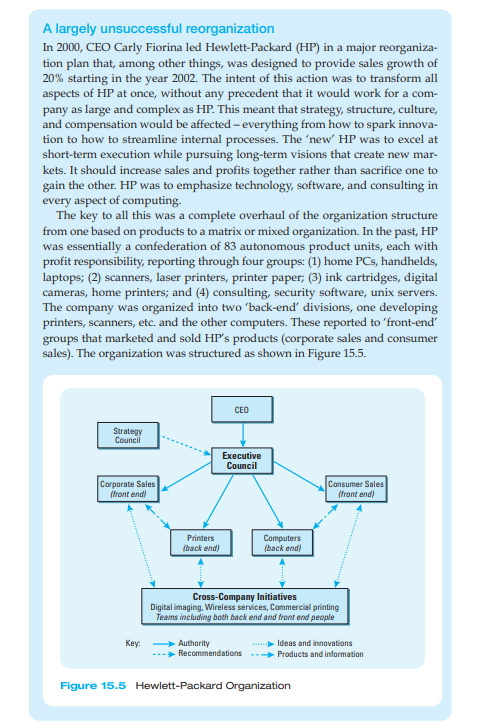
Case study 15.1 Hewlett-packard (HP) This case study looks at two major reorganizations at Hewlett-packard (HP). The first, begun in 2000, introduced a new type of structure. Communications problems, other difficulties and a 50% drop in the price of the company's stock, resulted in the replacement of the CEO. The incoming CEO, after exten- sive interviews and discussions with both customers and HP employees, developed a new company organization structure. Both provide useful insights, and are discussed here in chronological order.A largely unsuccessful reorganization In 2000, CEO Carly Fiorina led Hewlett-packard (HP) in a major reorganiza- tion plan that, among other things, was designed to provide sales growth of 20% starting in the year 2002. The intent of this action was to transform all aspects of HP at once, without any precedent that it would work for a com- pany as large and complex as HP. This meant that strategy, structure, culture, and compensation would be affected - everything from how to spark innova- tion to how to streamline internal processes. The 'new' HP was to excel at short-term execution while pursuing long-term visions that create new mar- kets. It should increase sales and profits together rather than sacrifice one to gain the other. HP was to emphasize technology, software, and consulting in every aspect of computing. The key to all this was a complete overhaul of the organization structure from one based on products to a matrix or mixed organization. In the past, HP was essentially a confederation of 83 autonomous product units, each with profit responsibility, reporting through four groups: (1) home PCs, handhelds, laptops; (2) scanners, laser printers, printer paper, (3) ink cartridges, digital cameras, home printers; and (4) consulting, security software, unix servers. The company was organized into two 'back-end' divisions, one developing printers, scanners, etc. and the other computers. These reported to 'front-end" groups that marketed and sold HP's products (corporate sales and consumer sales). The organization was structured as shown in Figure 15.5. CEO Strategy Council Executive Council Corporate Sales Consumer Sales (front end) Printers Computers (back end) (back end Cross-Company Initiatives Digital imaging, Wireless services, Commercial printing Teams including both back end and front end people Key: Authority wow. Ideas and innovations --- Recommendations Products and information Figure 15.5 Hewlett-packard OrganizationThe functions of the major units were: 1 Strategy Council. Nine managers who advise the Executive Council on allocating money and people to growth industries. 2 Executive Council. Eight top managers, including heads of the back- and front-end groups. 3 Corporate Sales. Sell technology solutions to corporate clients. Keep back- end units abreast of what is hot. 4 Consumer Sales. Sell consumer gear. Let back-end know of must-have products and features. 5 Printers. Build new printing and imaging products to ensure HP's long- term growth. 6 Computers. Focus on future success by making computers that companies and consumers want, with sales input from front end. 7 Cross-company Initiatives. Personnel from back- and front-end groups work together to identify new markets that will create growth. It was not clear whether such an organization would work as there was no 'model' to look to. Some expected benefits were happier customers, increased sales, products could be sold as solutions to problems, and financial flexibility. Concerning the latter, with all corporate sales under one roof, HP could meas- ure the total value of a customer. There were some risks, however. With so much being made and sold by just four units, executives could be over- whelmed by their duties. There could be poorer execution as the front-end and back-end units would coordinate their plans with such a time schedule that quick response to changes would not be possible. Since profit and loss respons sibility is shared between the front- and back-end groups, no one person would be accountable. Finally, there would be fewer controls over expenditures. This clearly was an ambitious direction being taken by HP. Problems did develop, with large corporate customers later complaining that they didn't know whom to call at HP because of the confusion caused by the several layers of management. Some complained that HP sales people in Europe and the United States gave different prices in quotations. Ms. Fiorina made several changes in the organization's sales force over time, but the prob- lems were not solved. The Board of Directors became divided over the pur- chase of Compaq Computer Company that she was pushing for. After Compaq was acquired in 2002, the sales force became increasingly less effective. Eleven layers of management stood between the CEO and a customer (Tam, 2006). Ms. Fiorina was replaced as CEO by Mark Hurd in 2005. Some of the changes brought about by Ms. Fiorina, such as the purchase of Compaq Com- puter had longer-range benefits as it paved the way for HP to overtake and surpass Dell in personal computer sales (Kessler, 2006; Allison, 2007). How- ever, sales when she left were at just about the same level as when she had arrived over five years earlier. The company had lost money in 2002, but both sales and earnings have increased since then (HP, 2006).\f\f
Step by Step Solution
There are 3 Steps involved in it

Get step-by-step solutions from verified subject matter experts
 Study Help