Question: Case Study 2 (for Ouestion 3 & Question 4) Spending Addiction in Online Gaming Among Children With everyone in lockdown, children can rack up huge
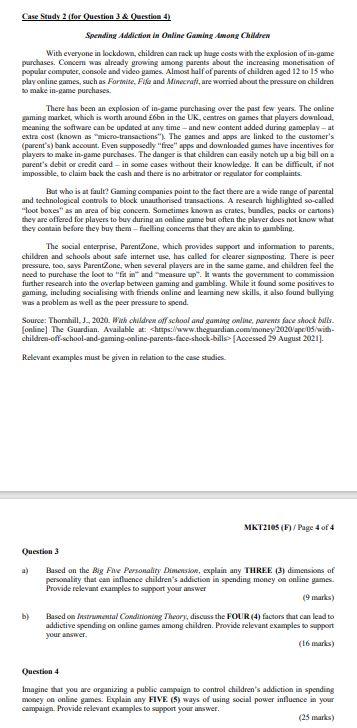
Case Study 2 (for Ouestion 3 & Question 4) Spending Addiction in Online Gaming Among Children With everyone in lockdown, children can rack up huge costs with the explosion of in-game purchases. Concem was already growing among parents about the increasing monetisation of popular computer, console and video games. Almost half of parents of children aged 12 to 15 who play online games, such as Fortise, Fife and Minecraft, are worried about the pressure on children to make in-game purchases. There has been an explosion of in-game purchasing over the past few years. The online gaming market, which is worth around be in the UK, centres on games that players download. meaning the software can be updated at any time--and new content added during gameplay - at extra cost (known as "micro-transactions") The games and apps are linked to the customer's (parent's) bank account. Even supposedly "free" apps and downloaded games have incentives for players to make in-game purchases. The danger is that children can easily notch up a big bill on a Parent's debitor credit card in some cases without their knowledge. It can be difficult, if not impossible to claim back the cash and there is no arbitrator or regulator for complaints. But who is at fault? Gaming companies point to the fact there are a wide range of parental and technological controls to block unauthorised transactions. A research highlighted so-called loot boxes as an area of big concern. Sometimes known as crates, bundles, packs or cartons) they are offered for players to buy during an online game but often the player does not know what they contain before they buy them - foelling concems that they are akin to cambling The social enterprise, ParentZone, which provides support and information to parents. children and schools about safe internet use, has called for clearer signposting. There is peer pressure, too, says Parentonc, when several players are in the same game, and children feel the need to purchase the loot so "Et in and measure up. It was the government to commission further research into the overlap between gaming and gambling. While it found some positives to gaming, including socialising with friends online and leaming new skills, it also found bullying was a problem as well as the peer pressure to spend. Source: Thornhill, J. 2020. With children off school and gaming online parents face shock bills. [online] The Guardian. Available at: https://www.theguardian.com/money 2020 apr 05 with children-off-school-and-gaming-online-parents-face-shock-bille Accessed 29 August 2021)- Relevant examples must be given in relation to the case studies MKT2105 (5)/Page 4 of 4 Question 3 a) Based on the Big Phe Personality Dimension, explain any THREE (3) dimensions of personality that can influence children's addiction in spending money on online games. Provide relevant examples to support your answer (9 marks) b) Based on Instrumental Condinioning Theory, discuss the FOUR (4) factors that can lead to addictive spending on online games among children. Provide relevant examples to support your answer (16 marks) Question 4 Imagine that you are organizing a public campaign to control children's addiction in spending money online games. Explain any FIVE (5) ways of using social power influence in your campaign. Provide relevant examples to support your answer. (25 marks)









 Study Help