Question: Case Study 2 (for Question 3 & Question 4) Internet Banking Among Baby Boomers The market potential is important as internet banking is capable not
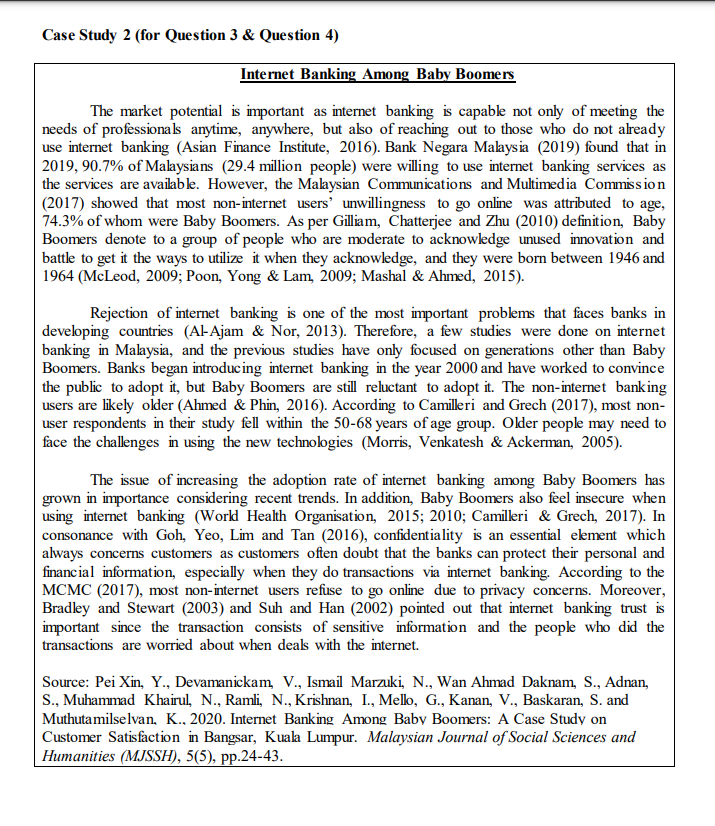
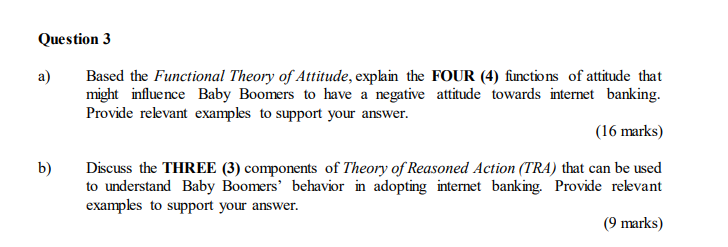
Case Study 2 (for Question 3 & Question 4) Internet Banking Among Baby Boomers The market potential is important as internet banking is capable not only of meeting the needs of professionals anytime, anywhere, but also of reaching out to those who do not already use internet banking (Asian Finance Institute, 2016). Bank Negara Malaysia (2019) found that in 2019, 90.7% of Malaysians (29.4 million people) were willing to use internet banking services as the services are available. However, the Malaysian Communications and Multimedia Commission (2017) showed that most non-internet users' unwillingness to go online was attributed to age, 74.3% of whom were Baby Boomers. As per Gilliam, Chatterjee and Zhu (2010) definition, Baby Boomers denote to a group of people who are moderate to acknowledge unused innovation and battle to get it the ways to utilize it when they acknowledge, and they were born between 1946 and 1964 (McLeod, 2009; Poon, Yong & Lam, 2009; Mashal & Ahmed, 2015). Rejection of internet banking is one of the most important problems that faces banks in developing countries (Al-Ajam & Nor, 2013). Therefore, a few studies were done on internet banking in Malaysia, and the previous studies have only focused on generations other than Baby Boomers. Banks began introducing internet banking in the year 2000 and have worked to convince the public to adopt it, but Baby Boomers are still reluctant to adopt it. The non-internet banking users are likely older (Ahmed & Phin, 2016). According to Camilleri and Grech (2017), most non- user respondents in their study fell within the 50-68 years of age group. Older people may need to face the challenges in using the new technologies (Morris, Venkatesh & Ackerman, 2005). The issue of increasing the adoption rate of internet banking among Baby Boomers has grown in importance considering recent trends. In addition, Baby Boomers also feel insecure when using internet banking (World Health Organisation, 2015; 2010; Camilleri & Grech, 2017). In consonance with Goh, Yeo, Lim and Tan (2016), confidentiality is an essential element which always concerns customers as customers often doubt that the banks can protect their personal and financial information, especially when they do transactions via internet banking. According to the MCMC (2017), most non-internet users refuse to go online due to privacy concerns. Moreover, Bradley and Stewart (2003) and Suh and Han (2002) pointed out that internet banking trust is important since the transaction consists of sensitive information and the people who did the transactions are worried about when deals with the internet. Source: Pei Xin, Y., Devamanickam, V., Ismail Marzuki, N., Wan Ahmad Daknam, S., Adnan, S., Muhammad Khairul, N., Ramli, N., Krishnan, I., Mello, G., Kanan, V., Baskaran, S. and Muthutamilselvan, K., 2020. Internet Banking Among Baby Boomers: A Case Study on Customer Satisfaction in Bangsar, Kuala Lumpur. Malaysian Journal of Social Sciences and Humanities (MJSSH), 5(5), pp.24-43. Question 3 a) Based the Functional Theory of Attitude, explain the FOUR (4) functions of attitude that might influence Baby Boomers to have a negative attitude towards internet banking. Provide relevant examples to support your answer. (16 marks) Discuss the THREE (3) components of Theory of Reasoned Action (TRA) that can be used to understand Baby Boomers' behavior in adopting internet banking. Provide relevant examples to support your answer. (9 marks) b)









 Study Help