Question: Case Study 2: Lowe's IT Portfolio Management Process Lowe's is the second most popular home-improvement retailer behind Home Depot, with recent annual revenues exceeding $43
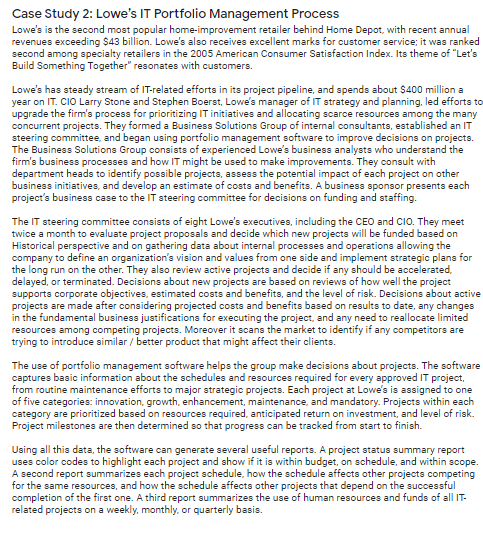
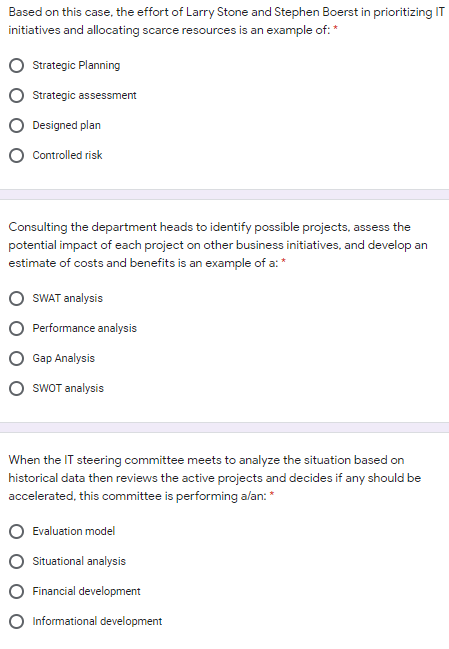
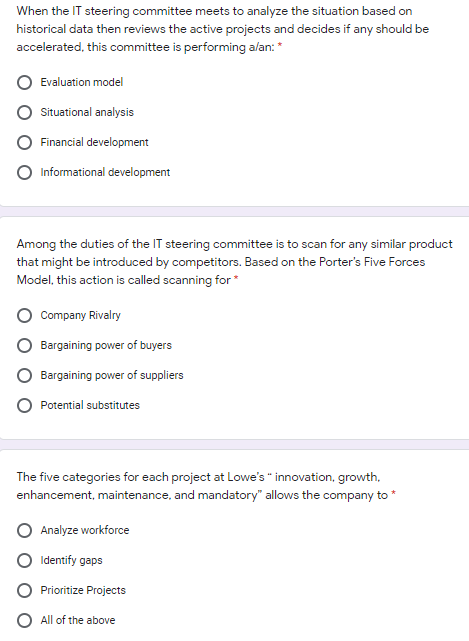
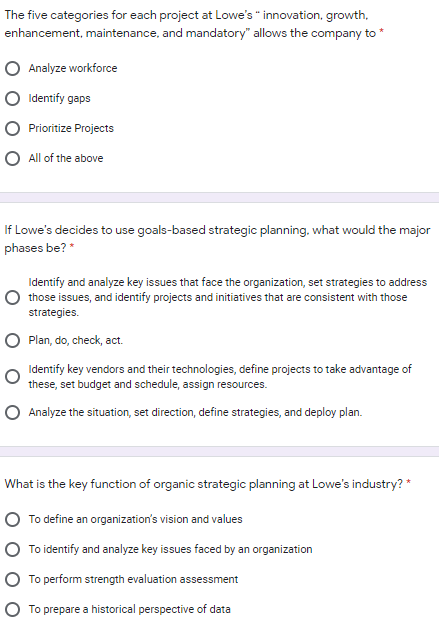
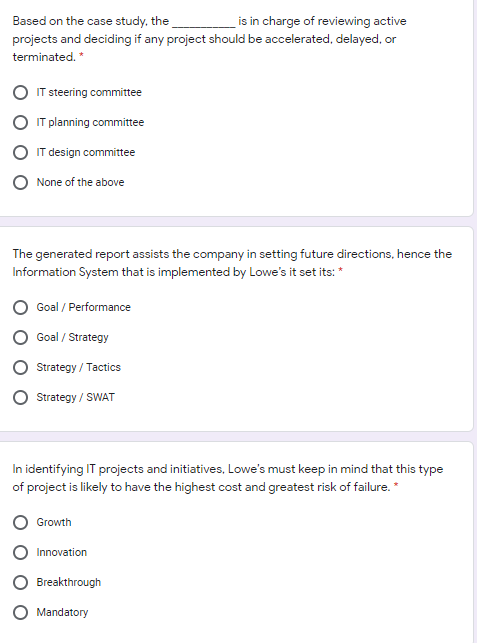
Case Study 2: Lowe's IT Portfolio Management Process Lowe's is the second most popular home-improvement retailer behind Home Depot, with recent annual revenues exceeding $43 billion. Lowe's also receives excellent marks for customer service; it was ranked second among specialty retailers in the 2005 American Consumer Satisfaction Index. Its theme of "Let's Build Something Together" resonates with customers. Lowe's has steady stream of IT-related efforts in its project pipeline, and spends about $400 million a year on IT. CIO Larry Stone and Stephen Boerst, Lowe's manager of IT strategy and planning, led efforts to upgrade the firm's process for prioritizing IT initiatives and allocating scarce resources among the many concurrent projects. They formed a Business Solutions Group of internal consultants, established an IT steering committee and began using portfolio management software to improve decisions on projects. The Business Solutions Group consists of experienced Lowe's business analysts who understand the firm's business processes and how It might be used to make improvements. They consult with department heads to identify possible projects, assess the potential impact of each project on other business initiatives, and develop an estimate of costs and benefits. A business sponsor presents each project's business case to the IT steering committee for decisions on funding and staffing. The IT steering committee consists of eight Lowe's executives, including the CEO and CIO. They meet twice a month to evaluate project proposals and decide which new projects will be funded based on Historical perspective and on gathering data about internal processes and operations allowing the company to define an organization's vision and values from one side and implement strategic plans for the long run on the other. They also review active projects and decide if any should be accelerated, delayed, or terminated. Decisions about new projects are based on reviews of how well the project supports corporate objectives, estimated costs and benefits, and the level of risk. Decisions about active projects are made after considering projected costs and benefits based on results to date, any changes in the fundamental business justifications for executing the project, and any need to reallocate limited resources among competing projects. Moreover it scans the market to identify if any competitors are trying to introduce similar / better product that might affect their clients. The use of portfolio management software helps the group make decisions about projects. The software captures basic information about the schedules and resources required for every approved IT project, from routine maintenance efforts to major strategic projects. Each project at Lowe's is assigned to one of five categories: innovation, growth, enhancement, maintenance and mandatory. Projects within each category are prioritized based on resources required, anticipated return on investment, and level of risk. Project milestones are then determined so that progress can be tracked from start to finish. Using all this data, the software can generate several useful reports. A project status summary report uses color codes to highlight each project and show if it is within budget, on schedule, and within scope. A second report summarizes each project schedule, how the schedule affects other projects competing for the same resources, and how the schedule affects other projects that depend on the successful completion of the first one. A third report summarizes the use of human resources and funds of all IT- related projects on a weekly, monthly, or quarterly basis. Based on this case, the effort of Larry Stone and Stephen Boerst in prioritizing IT initiatives and allocating scarce resources is an example of: * Strategic Planning Strategic assessment Designed plan Controlled risk Consulting the department heads to identify possible projects, assess the potential impact of each project on other business initiatives, and develop an estimate of costs and benefits is an example of a: * SWAT analysis Performance analysis Gap Analysis SWOT analysis When the IT steering committee meets to analyze the situation based on historical data then reviews the active projects and decides if any should be accelerated, this committee is performing alan:* Evaluation model Situational analysis Financial development Informational development When the IT steering committee meets to analyze the situation based on historical data then reviews the active projects and decides if any should be accelerated, this committee is performing alan:* Evaluation model Situational analysis Financial development Informational development Among the duties of the IT steering committee is to scan for any similar product that might be introduced by competitors. Based on the Porter's Five Forces Model, this action is called scanning for Company Rivalry Bargaining power of buyers Bargaining power of suppliers Potential substitutes The five categories for each project at Lowe's innovation, growth. enhancement, maintenance, and mandatory" allows the company to * Analyze workforce Identify gaps Prioritize Projects All of the above The five categories for each project at Lowe's innovation, growth, enhancement, maintenance, and mandatory" allows the company to * Analyze workforce Identify gaps Prioritize Projects All of the above If Lowe's decides to use goals-based strategic planning. what would the major phases be? Identify and analyze key issues that face the organization, set strategies to address those issues, and identify projects and initiatives that are consistent with those strategies. O Plan, do, check, act. o Identify key vendors and their technologies, define projects to take advantage of these, set budget and schedule, assign resources. Analyze the situation, set direction, define strategies, and deploy plan. What is the key function of organic strategic planning at Lowe's industry?* To define an organization's vision and values To identify and analyze key issues faced by an organization To perform strength evaluation assessment To prepare a historical perspective of data Based on the case study, the _is in charge of reviewing active projects and deciding if any project should be accelerated, delayed, or terminated. * IT steering committee IT planning committee IT design committee None of the above The generated report assists the company in setting future directions, hence the Information System that is implemented by Lowe's it set its: * Goal / Performance Goal / Strategy Strategy / Tactics Strategy / SWAT In identifying IT projects and initiatives, Lowe's must keep in mind that this type of project is likely to have the highest cost and greatest risk of failure.* Growth Innovation Breakthrough Mandatory









 Study Help