Question: Case Study - 3 Questions 1. What are the cost implications of each delivery option? 2. What are the qualitative and service characteristics of each
Case Study - 3 Questions
1. What are the cost implications of each delivery option?
2. What are the qualitative and service characteristics of each delivery option?
3. Based on your analysis, what would you recommend to Bob Barley?
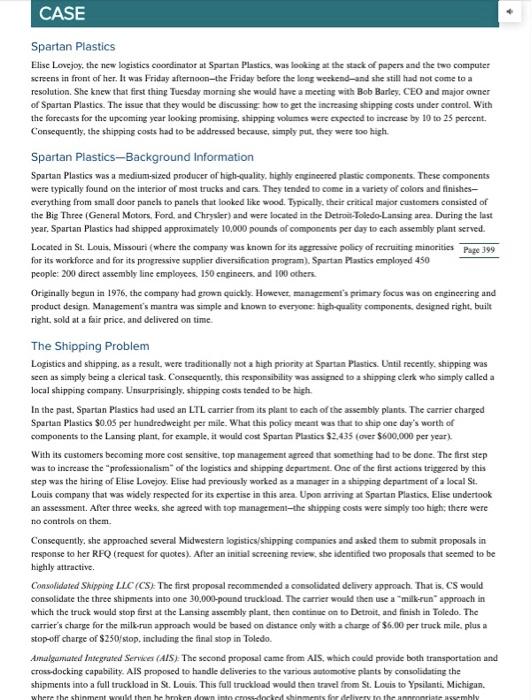
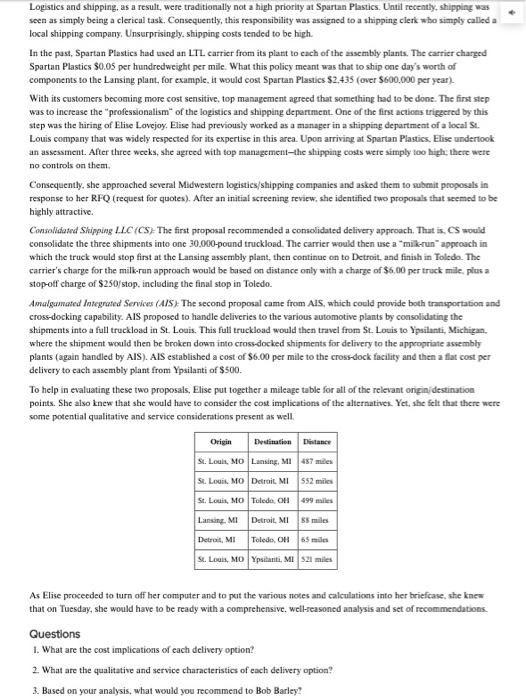
CASE Spartan Plastics Elise Lovejoy, the new logistics coordinator at Spartan Plastics, was looking at the stack of papers and the two computer screens in front of her. It was Friday afternoon-the Friday before the long weekend and she still had not come to a resolution. She knew that first thing Tuesday morning she would have a meeting with Bob Barley. CEO and major owner of Spartan Plastics. The issue that they would be discussing how to get the increasing shipping costs under control. With the forecasts for the upcoming year looking promising, shipping volumes were expected to increase by 10 to 25 percent. Consequently, the shipping costs had to be addressed because, simply put they were too high. Spartan Plastics-Background Information Spartan Plastics was a medium-sized producer of high-quality, highly engineered plastic components. These components were typically found on the Interior of most trucks and cars. They tended to come in a variety of colors and finishes- everything from small door panch to panels that looked like wood. Typically their critical major customers consisted of the Big Three (General Motors, Ford, and Chrysler) and were located in the Detro-Toledo-Lansing area. During the last year. Spartan Plastics had shipped approximately 10.000 pounds of components per day to each assembly plant served. Located in St. Louis, Missouri (where the company was known for its aggressive policy of recruiting minorities Page 399 for its workforce and for its progressive supplier diversification program). Spartan Plastics employed 450 people: 200 direct assembly line employees. 150 engineers, and 100 others Originally begun in 1976, the company had grown quickly. However, management's primary focus was on engineering and product design. Management's mantra was simple and known to everyone: high quality components designed right, built right sold at a fair price and delivered on time The Shipping Problem Logistics and shipping, as a result, were traditionally not a high priority at Spartan Plastics. Until recently, shipping was seen as simply being a clerical task. Consequently, this responsibility was assigned to a shipping clerk who simply called a local shipping company. Unsurprisingly, shipping costs tended to be high. In the past, Spartan Plastics had used an LTL carrier from its plant to each of the assembly plants. The carrier charged Spartan Plastics $0.05 per hundredweight per mile. What this policy meant was that to ship one day's worth of components to the Lansing plant, for example. it would cost Spartan Plastics $2.435 (over $600.000 per year) With its customers becoming more cost sensitive, top management agreed that something had to be done. The first step was to increase the professionalism" of the logistics and shipping department. One of the first actions triggered by this step was the hiring of Elise Lovejoy. Elise had previously worked as a manager in a shipping department of a local St. Louis company that was widely respected for its expertise in this area. Upon arriving at Spartan Plastics. Elise undertook an assessment. After three weeks, she agreed with top management the shipping costs were simply too high; there were no controls on them Consequently, she approached several Midwestern logistics/shipping companies and asked them to submit proposals in response to her RFQ (request for quotes). After an initial screening review she identified two proposals that seemed to be highly attractive Consolidated Shipping LLC (CS): The first proposal recommended a consolidated delivery approach. That is. Cs would consolidate the three shipments into one 30,000-pound truckload. The carrier would then use a "milk-run approach in which the truck would stop first at the Lansing assembly plant, then continue on to Detroit, and finish in Toledo. The carrier's charge for the mill-run approach would be based on distance only with a charge of $6.00 per truck mile. plus a stop-off charge of $250/stop, including the final stop in Toledo. Amalgamated Integrated Services (AIS): The second proposal came from Als, which could provide both transportation and cross-docking capability. AIS proposed to handle deliveries to the various automotive plants by consolidating the shipments into a full truckload in St. Louis. This full truckload would then travel from St. Louis to Ypsilanti. Michigan. where the shipment will then the broken down into crossdeckert Shinment for delivery in the annooriate assembly Logistics and shipping, as a result, were traditionally not a high priority at Spartan Plastics. Until recently, shipping was seen as simply being a clerical task. Consequently, this responsibility was assigned to a shipping clerk who simply called a local shipping company. Unsurprisingly shipping costs tended to be high In the past, Spartan Plastics had used an LTL carrier from its plant to each of the assembly plants. The carrier charged Spartan Plastics $0.05 per hundredweight per mile. What this policy meant was that to ship one day's worth of components to the Lansing plant, for example, it would cost Spartan Plastics $2,435 (over $600.000 per year) With its customers becoming more cost sensitive, top management agreed that something had to be done. The first step was to increase the professionalism of the logistics and shipping department. One of the first actions triggered by this step was the hiring of Elise Lovejoy, Elise had previously worked as a manager in a shipping department of a local St. Louis company that was widely respected for its expertise in this area. Upon arriving at Spartan Plastics, Elise undertook an assessment. After three weeks, she agreed with top management the shipping costs wete simply too high, there were no controls on them Consequently, she approached several Midwestern logistics/shipping companies and asked them to submit proposals in response to her RFQ (request for quotes). After an initial screening review, she identified two proposals that seemed to be highly attractive Consolidated Shipping LLC(CS)The first proposal recommended a consolidated delivery approach. That is. Cs would consolidate the three shipments into one 30,000-pound truckload. The carrier would then use a mill-run approach in which the truck would stop first at the Lansing assembly plant, then continue on to Detroit, and finish in Toledo. The carrier's charge for the milkran approach would be based on distance only with a charge of $6,00 per track mileplus a stop-off charge of $250/stop, including the final stop in Toledo Amalgamated Integrated Services (AIS)The second proposal came from Als, which could provide both transportation and cross-docking capability. AIS proposed to handle deliveries to the various automotive plants by consolidating the shipments into a full truckload in St. Louis. This full truckload would then travel from St. Louis to Ypsilanti, Michigan where the shipment would then be broken down into cross-docked shipments for delivery to the appropriate assembly plants (again handled by AIS). AIS established a cost of $6.00 per mile to the cross-dock facility and then a flat cost per delivery to each assembly plant from Ypsilanti of $500. To help in evaluating these two proposals, Elise put together a mileage table for all of the relevant ongin destination points. She also knew that she would have to consider the cost implications of the alternatives. Yet, she felt that there were some potential qualitative and service considerations present as well. Origin Destination Distance St. Louis, MO Lansing, MI 457 miles St. Louis, MO Detroit, MI 552 miles St. Louis, MO Toledo, OH 499 miles Lansing, MI Detroit, MI 55 miles Detroit, MI Toledo, OH St. Louis, MO Ypsilanit, MI 521 miles As Elise proceeded to turn off her computer and to put the various notes and calculations into her briefcase, she knew that on Tuesday, she would have to be ready with a comprehensive, well-reasoned analysis and set of recommendations Questions 1. What are the cost implications of each delivery option? 2. What are the qualitative and service characteristics of each delivery option! 3. Bused on your analysis, what would you recommend to Bob Barley









 Study Help