







Question: Case study 3 Without realizing it, we've become a nation of monopolies. A large and growing part of our economy is owned by a handful
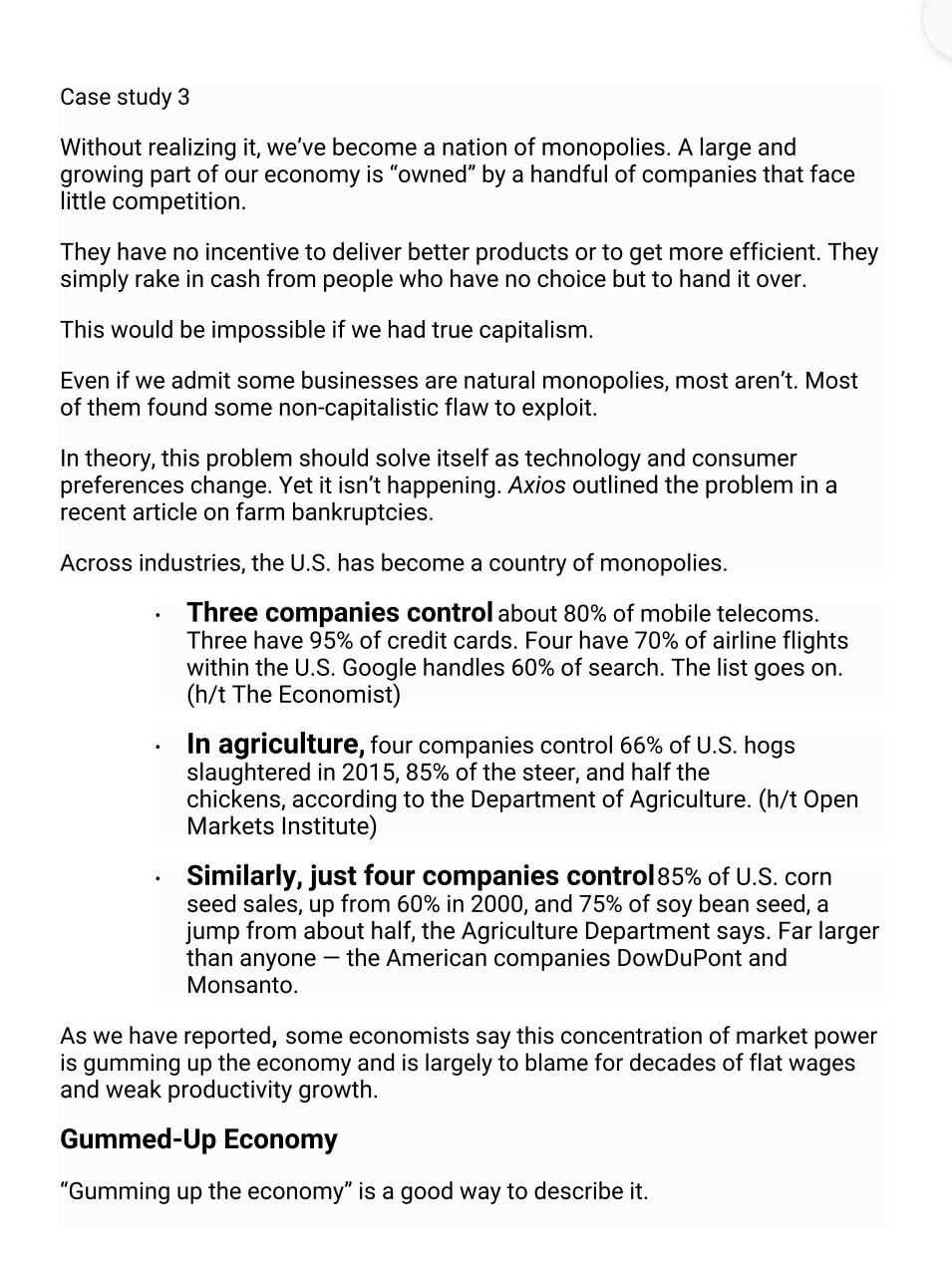
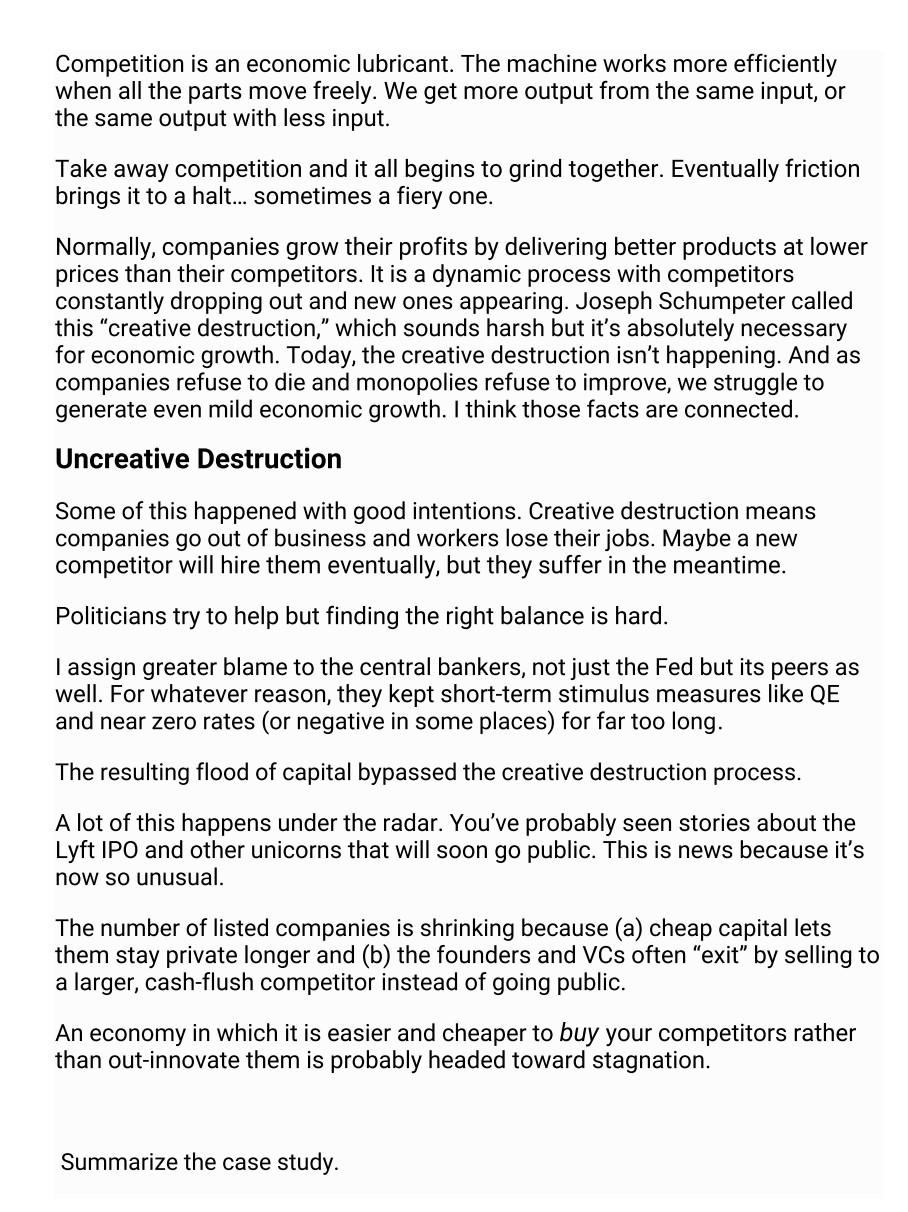
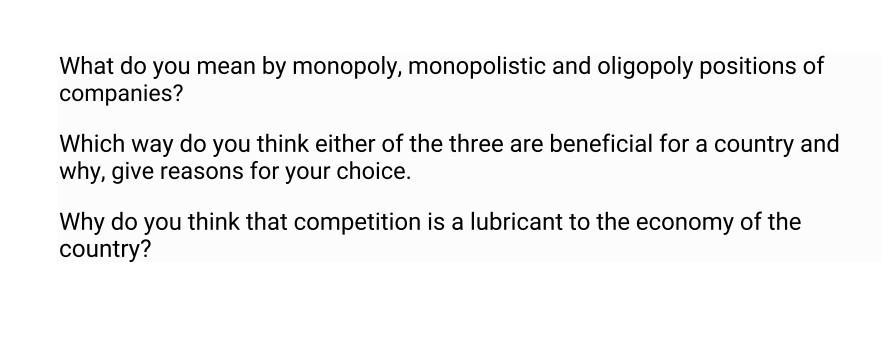
Case study 3 Without realizing it, we've become a nation of monopolies. A large and growing part of our economy is "owned" by a handful of companies that face little competition. They have no incentive to deliver better products or to get more efficient. They simply rake in cash from people who have no choice but to hand it over. This would be impossible if we had true capitalism. Even if we admit some businesses are natural monopolies, most aren't. Most of them found some non-capitalistic flaw to exploit. In theory, this problem should solve itself as technology and consumer preferences change. Yet it isn't happening. Axios outlined the problem in a recent article on farm bankruptcies. Across industries, the U.S. has become a country of monopolies. - Three companies control about 80% of mobile telecoms. Three have 95% of credit cards. Four have 70% of airline flights within the U.S. Google handles 60% of search. The list goes on. (h/t The Economist) - In agriculture, four companies control 66% of U.S. hogs slaughtered in 2015,85% of the steer, and half the chickens, according to the Department of Agriculture. ( h/t Open Markets Institute) - Similarly, just four companies control 85% of U.S. corn seed sales, up from 60% in 2000 , and 75% of soy bean seed, a jump from about half, the Agriculture Department says. Far larger than anyone - the American companies DowDuPont and Monsanto. As we have reported, some economists say this concentration of market power is gumming up the economy and is largely to blame for decades of flat wages and weak productivity growth. Gummed-Up Economy "Gumming up the economy" is a good way to describe it. Competition is an economic lubricant. The machine works more efficiently when all the parts move freely. We get more output from the same input, or the same output with less input. Take away competition and it all begins to grind together. Eventually friction brings it to a halt... sometimes a fiery one. Normally, companies grow their profits by delivering better products at lower prices than their competitors. It is a dynamic process with competitors constantly dropping out and new ones appearing. Joseph Schumpeter called this "creative destruction," which sounds harsh but it's absolutely necessary for economic growth. Today, the creative destruction isn't happening. And as companies refuse to die and monopolies refuse to improve, we struggle to generate even mild economic growth. I think those facts are connected. Uncreative Destruction Some of this happened with good intentions. Creative destruction means companies go out of business and workers lose their jobs. Maybe a new competitor will hire them eventually, but they suffer in the meantime. Politicians try to help but finding the right balance is hard. I assign greater blame to the central bankers, not just the Fed but its peers as well. For whatever reason, they kept short-term stimulus measures like QE and near zero rates (or negative in some places) for far too long. The resulting flood of capital bypassed the creative destruction process. A lot of this happens under the radar. You've probably seen stories about the Lyft IPO and other unicorns that will soon go public. This is news because it's now so unusual. The number of listed companies is shrinking because (a) cheap capital lets them stay private longer and (b) the founders and VCs often "exit" by selling to a larger, cash-flush competitor instead of going public. An economy in which it is easier and cheaper to buy your competitors rather than out-innovate them is probably headed toward stagnation. Summarize the case study. What do you mean by monopoly, monopolistic and oligopoly positions of companies? Which way do you think either of the three are beneficial for a country and why, give reasons for your choice. Why do you think that competition is a lubricant to the economy of the country
Step by Step Solution
There are 3 Steps involved in it
1 Expert Approved Answer
Step: 1 Unlock

Question Has Been Solved by an Expert!
Get step-by-step solutions from verified subject matter experts
Step: 2 Unlock
Step: 3 Unlock
 Study Help