







Question: Case Study 4 Dancing Shoes Limited ('DSL') is a very large company based in the south-east of England that manufactures three types of dancing shoes:
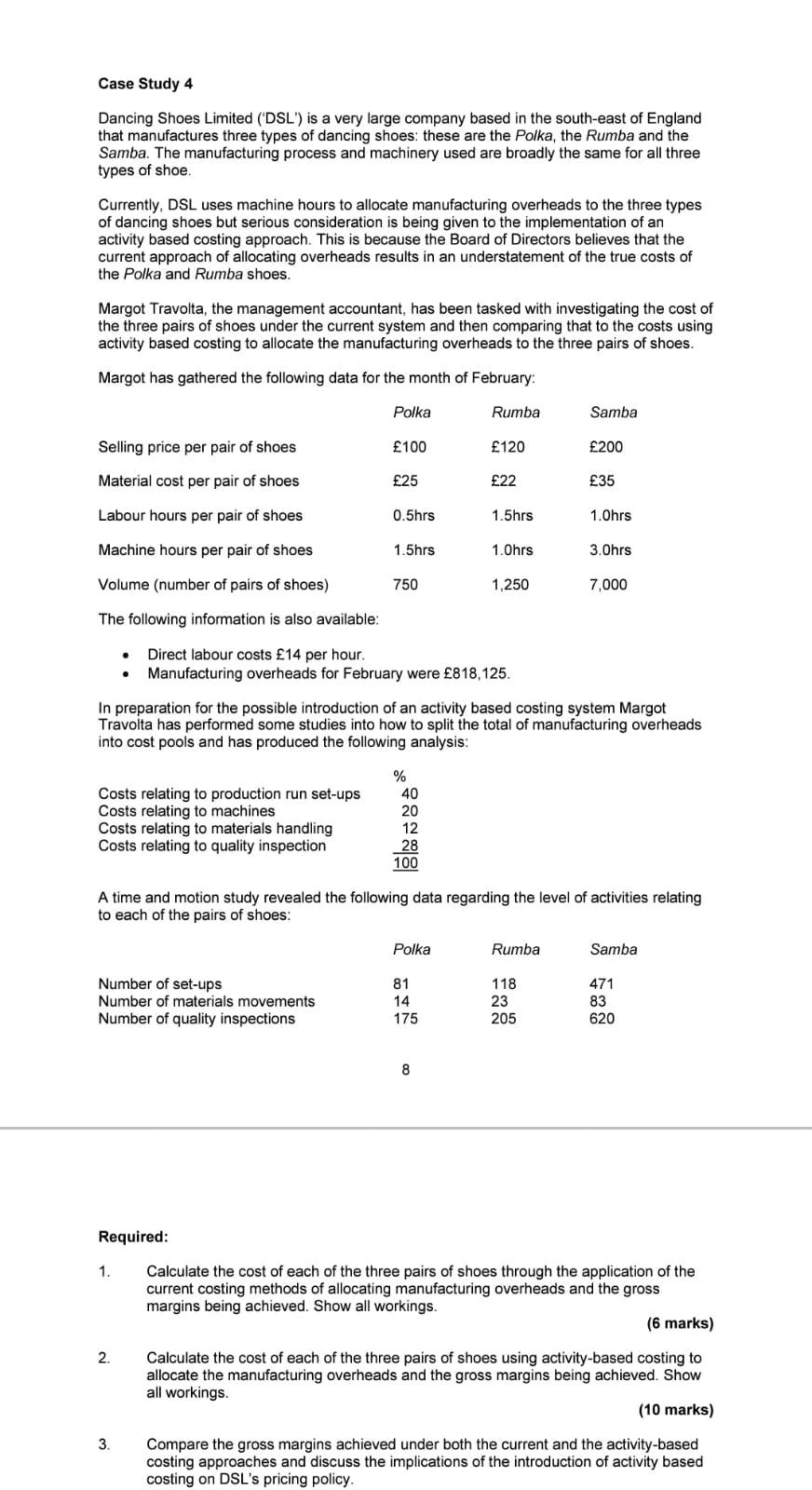
Case Study 4 Dancing Shoes Limited ('DSL') is a very large company based in the south-east of England that manufactures three types of dancing shoes: these are the Polka, the Rumba and the Samba. The manufacturing process and machinery used are broadly the same for all three types of shoe. Currently, DSL uses machine hours to allocate manufacturing overheads to the three types of dancing shoes but serious consideration is being given to the implementation of an activity based costing approach. This is because the Board of Directors believes that the current approach of allocating overheads results in an understatement of the true costs of the Polka and Rumba shoes. Margot Travolta, the management accountant, has been tasked with investigating the cost of the three pairs of shoes under the current system and then comparing that to the costs using activity based costing to allocate the manufacturing overheads to the three pairs of shoes. Margot has gathered the following data for the month of February Polka Rumba Samba Selling price per pair of shoes 100 120 200 Material cost per pair of shoes 25 22 35 Labour hours per pair of shoes 0.5hrs 1.5hrs 1.Ohrs Machine hours per pair of shoes 1.5hrs 1.Ohrs 3.Ohrs Volume (number of pairs of shoes) 750 1,250 7,000 The following information is also available: Direct labour costs 14 per hour. Manufacturing overheads for February were 818,125. In preparation for the possible introduction of an activity based costing system Margot Travolta has performed some studies into how to split the total of manufacturing overheads into cost pools and has produced the following analysis: Costs relating to production run set-ups Costs relating to machines Costs relating to materials handling Costs relating to quality inspection % 40 20 12 28 100 A time and motion study revealed the following data regarding the level of activities relating to each of the pairs of shoes: Polka Rumba Samba Number of set-ups Number of materials movements Number of quality inspections 81 14 175 118 23 205 471 83 620 8 Required: 1. Calculate the cost of each of the three pairs of shoes through the application of the current costing methods of allocating manufacturing overheads and the gross margins being achieved. Show all workings. (6 marks) 2. Calculate the cost of each of the three pairs of shoes using activity-based costing to allocate the manufacturing overheads and the gross margins being achieved. Show all workings. (10 marks) 3 Compare the gross margins achieved under both the current and the activity-based costing approaches and discuss the implications of the introduction of activity based costing on DSL's pricing policy
Step by Step Solution
There are 3 Steps involved in it

Get step-by-step solutions from verified subject matter experts
 Study Help