Question: Case Study #4 Read the case study Sugar and Spice Bakery on pages 14 - 17 Write a 2 paragraph summary of the case and
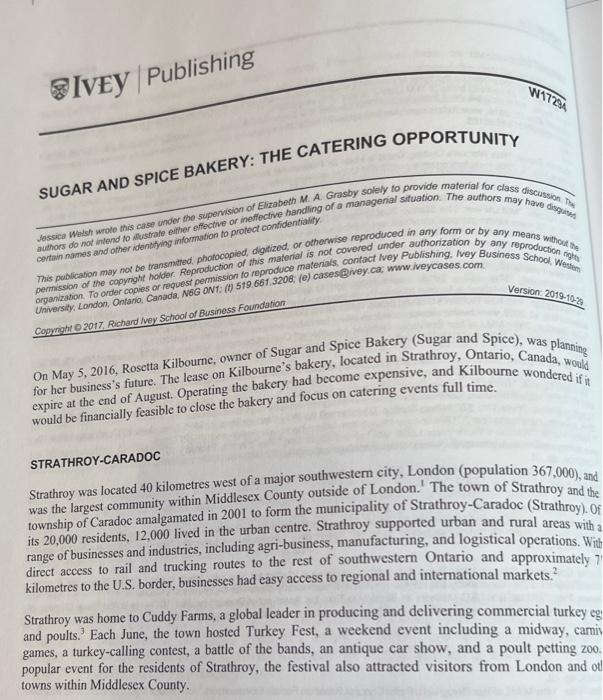
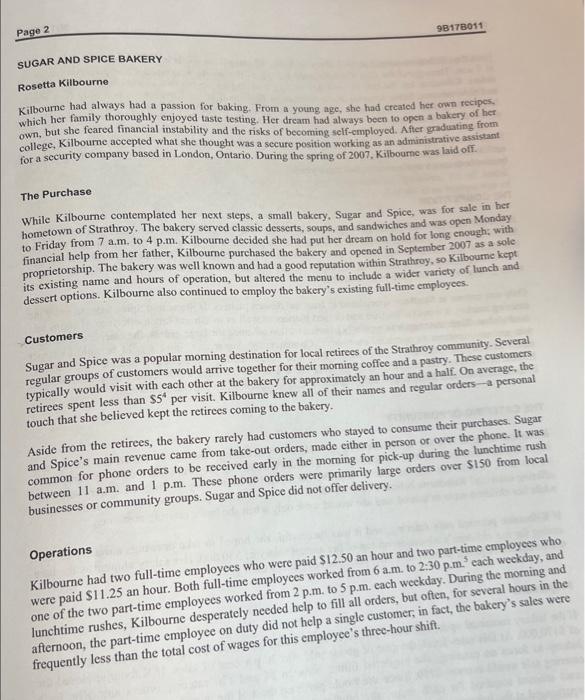
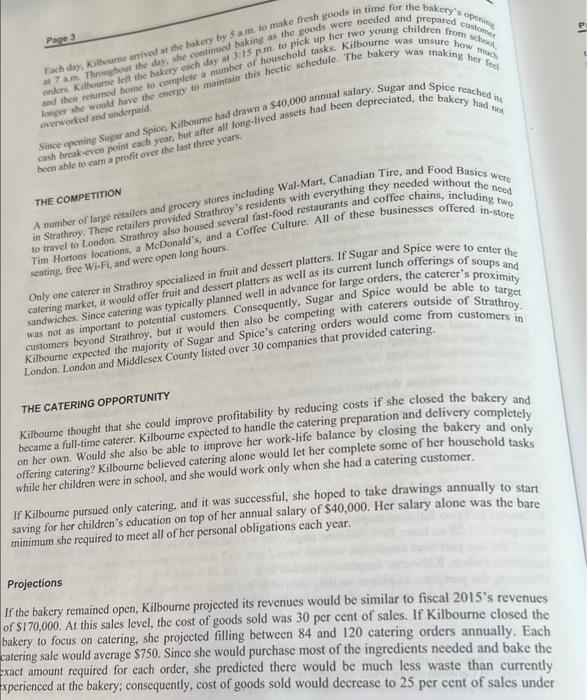
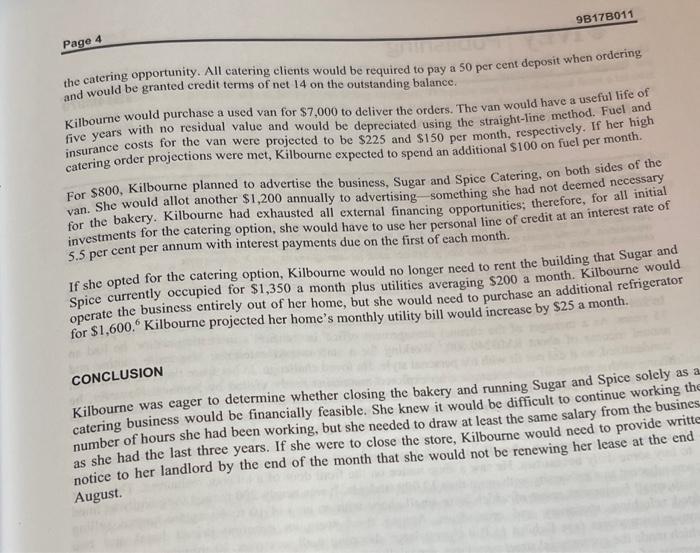
Case Study #4 Read the case study Sugar and Spice Bakery on pages 14 - 17 Write a 2 paragraph summary of the case and answer the following questions (please list the questions above each answer): 1. What are the bakery's best product lines and why are they the best? 2. Would you recommend that Kilourne close the bakery and become a FT caterer? Why or why not? Be specific in your answer. 3. What should Klbourne know about the competition before she makes her final docnion? Ivey | Publishing W1724 mm or by any means without SUGAR AND SPICE BAKERY: THE CATERING OPPORTUNITY Jessica Welsh wrote this case under the supervision of Elizabeth M A Grasby solely to provide material for class discuss the thors do not intend to Austrate eller effective or ineffective handling of a managenal situation. The authors may have dig certain names and other identity information to protect confidentiality permission of the copyright holder. Reproduction of this material is not covered under authorization by any reproduction This publication may nor be transmitted photocopied digitized or otherwise reproduced in any organization. To order copies or request permission to reproduce materials contact Ivey Publishing. Ivey Business School Westen University, London, Ontario, Canada, NOG ONT: (0519.661.3208, (e) cases corey.ca, www.iveycases.com Copyah 2017. Richard Ivey School of Business Foundation Version 2019-10-24 planning On May 5, 2016, Rosetta Kilbourne, owner of Sugar and Spice Bakery (Sugar and Spice), was for her business's future. The lease on Kilbourne's bakery, located in Strathroy, Ontario, Canada, would expire at the end of August. Operating the bakery had become expensive, and Kilbourne wondered if it would be financially feasible to close the bakery and focus on catering events full time. STRATHROY-CARADOC Strathroy was located 40 kilometres west of a major southwester city, London (population 367,000), and township of Caradoc amalgamated in 2001 to form the municipality of Strathroy-Caradoc (Strathroy). Of was the largest community within Middlesex County outside of London. The town of Strathroy and the its 20,000 residents, 12,000 lived in the urban centre. Strathroy supported urban and rural areas with a range of businesses and industries , including agri-business, manufacturing, and logistical operations. Will direct access to rail and trucking routes to the rest of southwestern Ontario and approximately 7 kilometres to the U.S. border, businesses had easy access to regional and international markets.? Strathroy was home to Cuddy Farms, a global leader in producing and delivering commercial turkey eg and poults. Each June, the town hosted Turkey Fest, a weekend event including a midway, camis games, a turkey-calling contest, a battle of the bands, an antique car show, and a poult petting zoo. popular event for the residents of Strathroy, the festival also attracted visitors from London and ot towns within Middlesex County. 9B178051 Page 2 SUGAR AND SPICE BAKERY Rosetta Kilbourne Kilbourne had always had a passion for baking. From a young age, she had created her own recipes. which her family thoroughly enjoyed tuste testing. Her dream had always been to open a bakery of her own, but she feared financial instability and the risks of becoming self-employed. After graduating from college, Kilbourne accepted what she thought was a secure position working as an administrative assistant for a security company based in London, Ontario. During the spring of 2007, Kilbourne was laid off. The Purchase While Kilbourne contemplated her next steps, a small bakery, Sugar and Spice, was for sale in her hometown of Strathroy. The bakery served classic desserts, soups, and sandwiches and was open Monday to Friday from 7 a.m. to 4 p.m. Kilbourne decided she had put her dream on hold for long enough: with financial help from her father, Kilbourne purchased the bakery and opened in September 2007 as a sole proprietorship. The bakery was well known and had a good reputation within Strathray, so Kilbourne kept its existing name and hours of operation, but altered the menu to include a wider variety of lunch and dessert options. Kilbourne also continued to employ the bakery's existing full-time employees. Customers Sugar and Spice was a popular morning destination for local retirees of the Strathroy community. Several regular groups of customers would arrive together for their morning coffee and a pastry. These customers typically would visit with each other at the bakery for approximately an hour and a half. On average, the retirees spent less than $5 per visit. Kilbourne knew all of their names and regular orders--a personal touch that she believed kept the retirees coming to the bakery. Aside from the retirees, the bakery rarely had customers who stayed to consume their purchases. Sugar and Spice's main revenue came from take-out orders, made either in person or over the phone. It was common for phone orders to be received early in the morning for pick-up during the lunchtime rush between 11 a.m. and 1 p.m. These phone orders were primarily large orders over S150 from local businesses or community groups. Sugar and Spice did not offer delivery, Operations Kilbourne had two full-time employees who were paid $12.50 an hour and two part-time employees who were paid $11.25 an hour. Both full-time employees worked from 6 a.m. to 2:30 p.m. cach weekday, and one of the two part-time employees worked from 2 p.m. to 5 p.m. cach weekday. During the morning and lunchtime rushes, Kilbourne desperately needed help to fill all orders, but often, for several hours in the afternoon, the part-time employee on duty did not help a single customer, in fact, the bakery's sales were frequently less than the total cost of wages for this employee's three-hour shift 1 Page 3 a7m. Throughout the day when baking as the goods were needed and prepared w Each day home and at the Bakery by 3 ano make fresh goods in time for the bakery op or she would have the energy to maintain this hectic schedule. The bakery was making her feel and then returned home to complete a number of household tasks. Kilbourne was unsure how wch drs Kilbourne In the bakery each day at 3:15 pm to pick up her two young children from scho overworked and underpaid. Since opening Sugar and Spice, Kilbourne had drawn a $40.000 annual salary. Sugar and Spice reachedias casch break-even point cach year, but after all long-lived assets had been depreciated, the bakery had to been able to com a profit over the last three years THE COMPETITION in Strathroy. These retailers provided Strathroy's residents with everything they needed without the need A number of large retailers and grocery stores including Wal-Mart, Canadian Tire, and Food Basics were to travel to London, Strathroy also housed several fast-food restaurants and coffee chains, including two Tim Hortons locations, a McDonald's, and a Coffee Culture. All of these businesses offered in-store seating, free Wi-Fi, and were open long hours. Only one caterer in Strathroy specialized in fruit and dessert platters. If Sugar and Spice were to enter the catering market, it would offer fruit and dessert platfers as well as its current lunch offerings of soups and was not as important to potential customers. Consequently, Sugar and Spice would be able to target Sandwiches. Since catering was typically planned well in advance for large orders, the caterer's proximity customers beyond Strathroy, but it would then also be competing with caterers outside of Strathroy. Kilboume expected the majonty of Sugar and Spice's catering orders would come from customers in London. London and Middlesex County listed over 30 companies that provided catering. THE CATERING OPPORTUNITY Kilbourne thought that she could improve profitability by reducing costs if she closed the bakery and became a full-time caterer. Kilbourne expected to handle the catering preparation and delivery completely offering catering? Kilbourne believed catering alone would let her complete some of her household tasky on her own. Would she also be able to improve her work-life balance by closing the bakery and only while her children were in school, and she would work only when she had a catering customer. If Kilbourne pursued only catering, and it was successful, she hoped to take drawings annually to start saving for her children's education on top of her annual salary of $40,000. Her salary alone was the bare minimum she required to meet all of her personal obligations each year, Projections If the bakery remained open, Kilbourne projected its revenues would be similar to fiscal 2015's revenues of $170,000. At this sales level, the cost of goods sold was 30 per cent of sales. If Kilbourne closed the bakery to focus on catering, she projected filling between 84 and 120 catering orders annually. Each catering sale would average $750. Since she would purchase most of the ingredients needed and bake the Exact amount required for each order, she predicted there would be much less waste than currently Experienced at the bakery; consequently, cost of goods sold would decrease to 25 per cent of sales under 9B17B011 Page 4 the catering opportunity. All catering clients would be required to pay a 50 per cent deposit when ordering and would be granted credit terms of net 14 on the outstanding balance. Kilbourne would purchase a used van for $7,000 to deliver the orders. The van would have a useful life of five years with no residual value and would be depreciated using the straight-line method. Fuel and insurance costs for the van were projected to be $225 and $150 per month, respectively. If her high catering order projections were met, Kilbourne expected to spend an additional $100 on fuel per month. For $800, Kilbourne planned to advertise the business, Sugar and Spice Catering, on both sides of the van. She would allot another $1,200 annually to advertising something she had not deemed necessary for the bakery. Kilbourne had exhausted all external financing opportunities, therefore, for all initial investments for the catering option, she would have to use her personal line of credit at an interest rate of 5.5 per cent per annum with interest payments due on the first of cach month. If she opted for the catering option, Kilbourne would no longer need to rent the building that Sugar and Spice currently occupied for $1,350 a month plus utilities averaging $200 a month. Kilbourne would operate the business entirely out of her home, but she would need to purchase an additional refrigerator for $1,600. Kilbourne projected her home's monthly utility bill would increase by $25 a month. CONCLUSION Kilbourne was eager to determine whether closing the bakery and running Sugar and Spice solely as a catering business would be financially feasible. She knew it would be difficult to continue working the number of hours she had been working, but she needed to draw at least the same salary from the busines as she had the last three years. If she were to close the store, Kilbourne would need to provide writte notice to her landlord by the end of the month that she would not be renewing her lease at the end August










 Study Help