Question: CASE STUDY: Please read the following case study about NETFLIX, the American subscription streaming service and production company, and answer ALL of the questions that
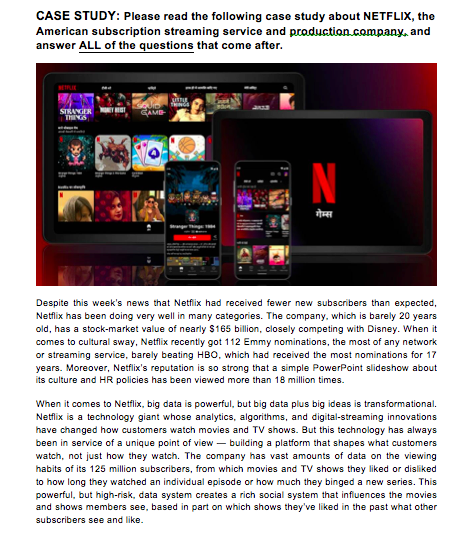
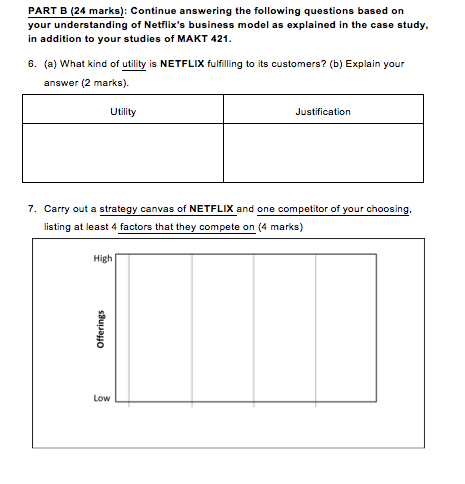
CASE STUDY: Please read the following case study about NETFLIX, the American subscription streaming service and production company, and answer ALL of the questions that come after. UTTE THING STRANIER THIS N Despite this week's news that Netflix had received fewer new subscribers than expected, Netflix has been doing very well in many categories. The company, which is barely 20 years old, has a stock-market value of nearly $165 billion, closely competing with Disney. When it comes to cultural sway, Netflix recently got 112 Emmy nominations, the most of any network or streaming service, barely beating HBO, which had received the most nominations for 17 years. Moreover, Netflix's reputation is so strong that a simple PowerPoint slideshow about its culture and HR policies has been viewed more than 18 million times. When it comes to Netflix, big data is powerful, but big data plus big ideas is transformational. Netflix is a technology giant whose analytics, algorithms, and digital-streaming innovations have changed how customers watch movies and TV shows. But this technology has always been in service of a unique point of view building a platform that shapes what customers watch, not just how they watch. The company has vast amounts of data on the viewing habits of its 125 million subscribers, from which movies and TV shows they liked or disliked to how long they watched an individual episode or how much they binged a new series. This powerful, but high-risk, data system creates a rich social system that influences the movies and shows members see, based in part on which shows they've liked in the past what other subscribers see and like. Netflix could be the dictionary definition of a Silicon Valley disruptor, a new entrant that reshaped the logic of an entire industry. Yet what's truly remarkable about the company's trajectory over the last two decades is how dramatically it has disrupted itself in service of its mission. Netflix began, of course, with a pretty simple innovation - crushing Blockbuster by shipping DVDs by mail and abolishing late fees. It then transitioned from mailing content to streaming movies and TV shows digitally. Today, Netflix is most noteworthy as a creator of content; it will spend a staggering $12 billion this year alone on programming. Here again, Netflix is entering an industry by challenging its conventions. As a recent cover story in New York magazine noted, the company's approach to programming "has upended so many norms of the TV business," from eliminating pilot episodes to inventing the idea of binge-watching to replacing demographics with what it calls 'taste clusters' an approach to programming fuelled by technology. At every step, Netflix's dramatic strategic moves invited external scepticism and required deep internal rethinking of what had worked before. Last year, the company updated its roadmap. In this roadmap, Netflix outlined their plans to invent more flexible ways for viewers to interact with their content, which Netflix explained needs more research to achieve flexibility and responsiveness but will provides a chance to learn more about-and appropriately monetize-audiences. 4. Based on your understanding of the case study above and your studies of the different segmentation strategies, (a) What kind of segmentation strategy is NETFLIX following? (b) Justify your answer (3 marks). Segmentation Strategy Justification 5. Based on your studies of strategic focus and your understanding of the above case study, (a) Do you think NETFLIX is following a red or blue ocean marketing strategy? (b) Explain your answer (2 marks). Red or blue ocean strategy? Justification PART B (24 marks): Continue answering the following questions based on your understanding of Netflix's business model as explained in the case study, in addition to your studies of MAKT 421. 6. (a) What kind of utility is NETFLIX fulfilling to its customers? (b) Explain your answer (2 marks). Utility Justification 7. Carry out a strategy canvas of NETFLIX and one competitor of your choosing, listing at least 4 factors that they compete on (4 marks) High Offerings Low









 Study Help