







Question: case study 5 Question 1. build up a model to solve the problem. this model should find the optimal solution such as which teacher should
case study 5
Question 1. build up a model to solve the problem. this model should find the optimal solution such as which teacher should teach which courses and in which time and day.
question 2. for building up this model, find out the variables and constraints.
Question 3. explain what is the problem and how to find the solution.
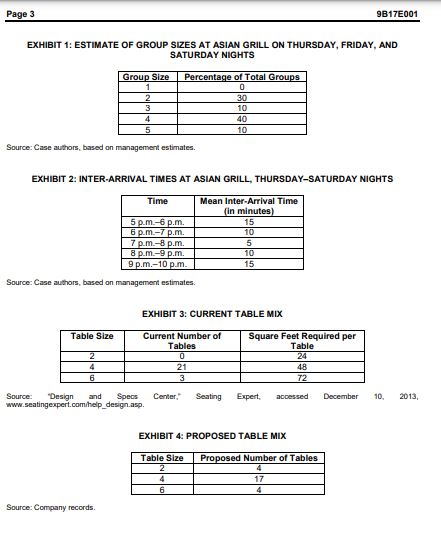
Ivey Publishing W17056 ASIAN GRILL: FINDING THE OPTIMAL TABLE MIX Kyle Maclean and Srinivas Krishnamoorthy wrote this case solely to provide material for class discussion. The authors do not intend fo Mustrafe either effective or ineffective handling of a managerial situation. The authors may have disguised certain names and other identifying Information to protect confidentiality This publication may not be transmitted, photocopied, digitized, or otherwise reproduced in any form or by any means without the permission of the copyright holder. Reproduction of this material is not covered under autonation by any reproduction nights organization. To order coples of request permission to reproduce materials, contact ivey Publishing Ivey Business School Westam University, London, Ontario, Canada NOG ONT; (t) 519 651.3208 (e) casespivey.ca; www.beycases.com. Copyright @ 2017. Richard ivey School of Business Foundation Version: 2017-01-30 Sarah Richards arrived late to her home office on December 9, 2016. It had been another busy Saturday night at Asian Grill, the restaurant she owned and had founded in Henderson, Nevada. She was grateful to finally sit down after working 10 hours straight. This Saturday had been like every other Saturday: the line for seating had stretched out the door, and the restaurant had been buzzing with activity. As great as this was, as Richards got a chance to catch her breath, she felt uneasy; in spite of this consumer demand, some seats were still going unfilled because some parties were seated at tables that were bigger than they needed. She knew that she would have to take advantage of the current demand in order for her restaurant to be successful. Knowing that the historical winter demand lull was just around the corner, Richards knew she would have to consider this issue sooner rather than later. ASIAN GRILL RESTAURANT Asian Grill's concept was somewhat unusual: guests paid a fixed fee to eat an unlimited amount of food." However, unlike at a traditional buffet restaurant, guests at Asian Grill created their own unique dishes by choosing elements from several stations in the restaurant (protein, vegetables, sauces, and spices); specially trained chefs then cooked the creations in front of guests on a giant grill. The centrepiece of the restaurant was the grill itself, which was intended to entertain guests as they watched their own dishes being prepared and also to provide fresh hot meals. The restaurant had been open for over a decade and was generally considered to be very successful, and this led Richards to consider franchising the concept across the United States. OPERATIONS Asian Grill was situated in Blue Hills, a popular shopping and restaurant district. The area was popular with urban professionals who worked nearby, and it became especially popular on weekends with families who were doing their shopping. Although the restaurant was open for lunch and dinner seven days a week, it was typically busiest on Thursday, Friday, and Saturday nights between 6:00 p.m. and 10:00 p.m. On these nights, Asian Grill often had long waits for tables, especially for larger groups of The average revenue per guest was US$21. 18. All currency amounts are in US$ unless otherwise specified. Authorbid for use only by Dan Hum LI in POM8.8340 Analytic Decbion-Making Tack (on-campus; taught by THOMAS SLOAN, University of Machusous Jan 2024 16 May 2023Page 2 98178001 guests. This was a problem because it could possibly deter customers who were considering dining there as well as groups who were already waiting. Richards believed that customers would not stand to wait more than 30 minutes, especially given the number of restaurant choices within walking distance. Therefore, keeping the wait time below this critical level was a priority on busy nights. Upon arriving at Asian Grill, guests visited the host stand, and a host seated them if a table was immediately available or recorded their name on a waiting list for the first available table. Richards estimated that the majority of guests arrived in groups of two or four (see Exhibit 1) and that the interval between arrivals on Thursday, Friday, and Saturday nights became shorter between 5:00 p.m. and 8:00 p.m., after which it lengthened (see Exhibit 2). Customers were generally taken from the waiting list on a first-come, first-served basis to ensure fairness and simplicity for the hosts. Richards had experimented with taking reservations, but she found that they actually increased waiting times because many groups did not show up on time and some did not show up at all. Because of this experience, Asian Grill did not take reservations. After being seated, guests were approached by a waiter, who explained the restaurant's concept to them, took drink orders, and invited them to make their first dish. It generally took 50-70 minutes between the time a guest was seated and the time the table was ready for the next customer. During this time, guests had an average of three bowls of food prepared for them. TABLE MIXES The restaurant currently contained 21 four-top tables," three six-tops, and one extra-large table in the back, which was designed for special events (see Exhibit 3). This extra-large table could not be moved and was not usually used in normal restaurant operations. Each table size required a certain amount of space in the restaurant (see Exhibit 3): the total floor space dedicated to seating was 1,224 square feet (about 1 14 square metres). Two of the six-tops were required to stay for traffic flow purposes and thus could not be moved or removed. Looking through her files, Richards remembered that a former manager had once proposed a new layout and table mix for the restaurant (see Exhibit 4). Pulling out the table plan, Richards wondered how to evaluate the proposal and on what basis. She would first have to determine what criteria she could use to evaluate the effectiveness of the new table mix compared to the old one. If she decided to change the table mix in the restaurant, she would have to close Asian Grill for two days, which would cost about $1,000 in renovation costs and lost profit. Luckily, a traditional holiday period was less than two weeks away, and business at Asian Grill would be sluggish at that time anyway. If she was going to change the table mix for the restaurant, this would be the best time to do so. THE DECISION Richards sighed and leaned back in her antique desk chair. She wondered whether it was worth the time and effort to change her entire restaurant to a new table mix, what the benefits would be, and if they could be quantified. She even questioned whether there was a better table mix than the one her former manager had suggested. Slowly sipping the hot chocolate in front of her, she pulled out her laptop, brought up Microsoft Excel, and got to work. Industry terminology identified table size based on the number of people who could sit at the table. A four-top table, for example, had four seats.Page 3 98178001 EXHIBIT 1: ESTIMATE OF GROUP SIZES AT ASIAN GRILL ON THURSDAY, FRIDAY, AND SATURDAY NIGHTS Group Size Percentage of Total Groups 0 30 10 40 5 10 Source: Case authors, based on management estimates. EXHIBIT 2: INTER-ARRIVAL TIMES AT ASIAN GRILL, THURSDAY-SATURDAY NIGHTS Time Mean Inter-Arrival Time in minutes] 5 p.m.-6 p.m. 15 6 p.m.-7 p.m 10 7 p.m.-8 p.m 5 8 p.m.-8 p.m 10 9 p.m.-10 p.m- 15 Source: Case authors, based on management estimates. EXHIBIT 3: CURRENT TABLE MIX Table Size Current Number of Square Feet Required per Tables Table 21 48 3 72 Source: Design and Specs Center." Seating Expert, accessed : December 10 2013, www.seatingexpert.com/help_design.asp. EXHIBIT 4: PROPOSED TABLE MIX Table Size Proposed Number of Tables 17 Source: Company records
Step by Step Solution
There are 3 Steps involved in it

Get step-by-step solutions from verified subject matter experts
 Study Help